
Merkle Tree

Merkle Tree: Efficient Data Verification

Merkle trees enable efficient verification of large datasets without downloading everything. They’re like having a fingerprint for an entire library that proves any book belongs.

A Merkle tree is a binary tree structure where each leaf represents a data element and each branch contains cryptographic hashes of its children. The root hash summarizes the entire dataset, enabling quick verification of any element’s inclusion.

How Merkle Trees Work

Bottom-up hashing combines pairs of data elements into parent hashes, continuing until a single root hash represents the entire tree structure.

Inclusion proofs require only a small subset of hashes (the “Merkle path”) to prove any specific element exists in the tree without revealing other elements.

Tamper detection makes any change to underlying data immediately visible since it would change the root hash, alerting observers to modifications.
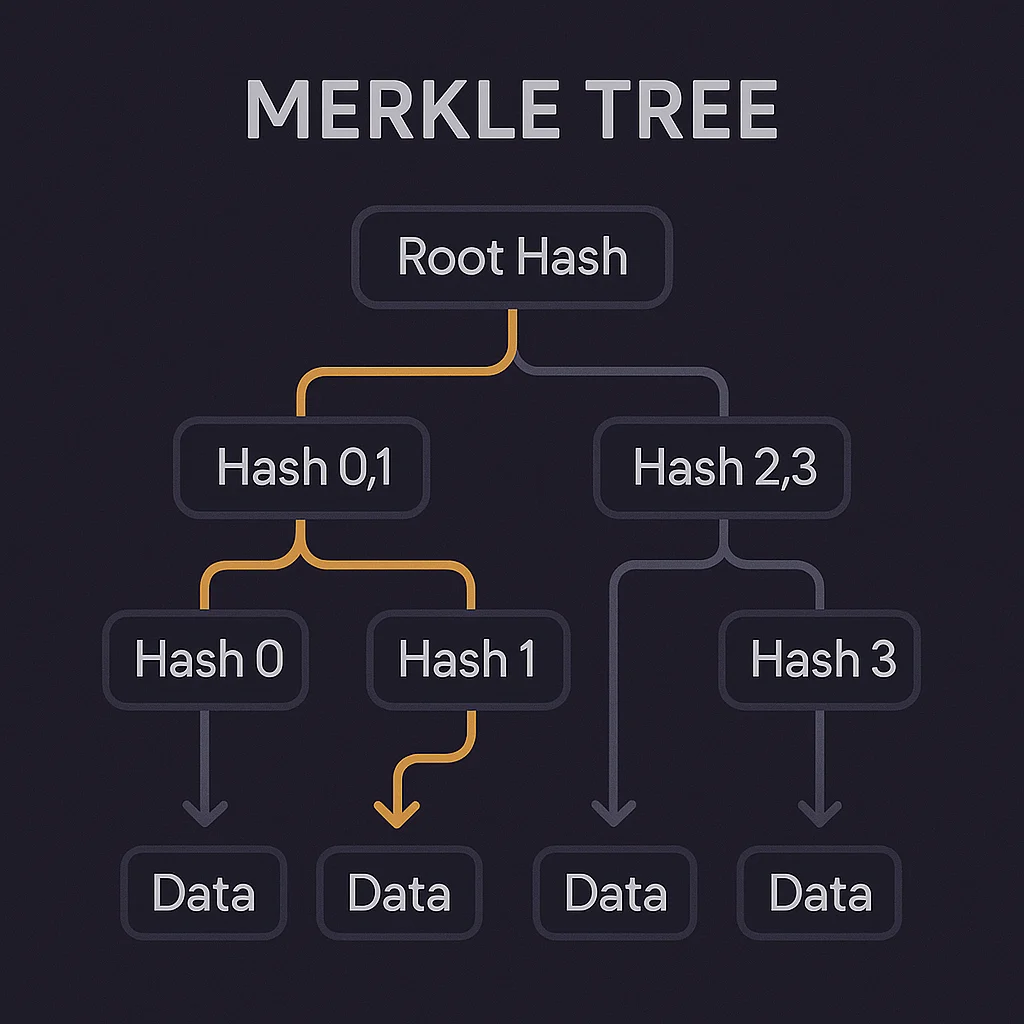
Merkle tree structure showing data blocks at the bottom, combined hashes at each branch, and a root hash at the top with a highlighted path for inclusion proof.]

Real-World Examples

  • Bitcoin blocks use Merkle trees to summarize all transactions in the block header
  • IPFS storage employs Merkle trees for content addressing and verification
  • Airdrop claims often use Merkle trees to efficiently verify eligibility without revealing all addresses

Why Beginners Should Care

Efficient verification allows light clients to verify specific transactions without downloading entire blockchains, enabling mobile and web wallets.

Privacy benefits from Merkle trees let systems prove inclusion without revealing the complete dataset to verifiers.

Scalability foundation for many Layer 2 solutions and blockchain optimizations that need to efficiently prove large amounts of data.

Related Terms: Hash Function, Light Client, Cryptographic Proof

Back to Crypto Glossary

Similar Posts

  • Smart Contract Risk

    Smart Contract Risk: Code-Based VulnerabilitiesSmart contract risk encompasses potential losses from bugs, exploits, or unexpected behavior in automated blockchain programs. It's like the risk that the software controlling your digital money might malfunction or be hacked.Smart contract risk refers to potential vulnerabilities, bugs, exploits, or failures in smart contract code that could result in loss…

  • Governance Token

    Governance Token: Voting Rights in Digital Form Governance tokens turn users into stakeholders with voting power over protocol decisions. It’s democracy meets DeFi, with mixed results. A governance token grants holders voting rights on protocol decisions like parameter changes, upgrade proposals, treasury spending, and strategic direction. Token weight typically determines voting power – more tokens…

  • Order Matching

    Order Matching: Connecting Buyers and SellersOrder matching is the process of pairing buy and sell orders to execute trades on exchanges. It's like a digital matchmaker that finds the perfect trading partners for each transaction.Order matching refers to the algorithmic process that pairs compatible buy and sell orders to execute trades at agreed prices on…

  • Digital Securities

    Digital Securities: Blockchain-Based Financial InstrumentsDigital securities are traditional financial instruments like stocks and bonds represented as tokens on blockchain networks. They're like digitizing paper stock certificates to work on the internet.Digital securities are blockchain-based tokens that represent ownership in traditional financial instruments such as stocks, bonds, or real estate, subject to securities regulations. These bridge conventional…

  • Native Interop

    Native Interop: Built-in Cross-Chain CommunicationNative interoperability refers to blockchain networks designed from the ground up to communicate with other chains without requiring external bridges or intermediaries. It's like speaking multiple languages fluently.Native interoperability describes blockchain architectures that include cross-chain communication capabilities as core features rather than external additions. These systems can interact with other networks through…

  • Soulbound Token (SBT)

    Soulbound Token (SBT): Non-Transferable Achievements Soulbound tokens are NFTs that cannot be transferred or sold once received. They represent achievements, credentials, or identity elements that should remain permanently attached to specific individuals. A Soulbound Token (SBT) is a non-fungible token that is permanently bound to a specific wallet address and cannot be transferred or sold….