
NFT (Non-Fungible Token)

NFT (Non-Fungible Token): Digital Ownership Certificates

NFTs transformed JPEGs into million-dollar assets and made digital ownership mainstream. Love them or hate them, they’re reshaping how we think about digital property.

A Non-Fungible Token (NFT) is a unique digital certificate stored on a blockchain that proves ownership of a specific digital asset. Unlike cryptocurrencies where each token is identical, every NFT is one-of-a-kind and cannot be replicated or substituted.

How NFTs Work

Smart contracts create NFTs by minting unique token IDs linked to digital files. The blockchain stores ownership records, not the actual image or video – most NFT files live on separate storage systems.

Metadata describes what the NFT represents – the image, attributes, and properties. This metadata can be stored on-chain (expensive but permanent) or off-chain (cheaper but potentially changeable).

Transferring ownership happens through blockchain transactions. When you buy an NFT, the smart contract updates to show you as the new owner, creating an immutable ownership record.
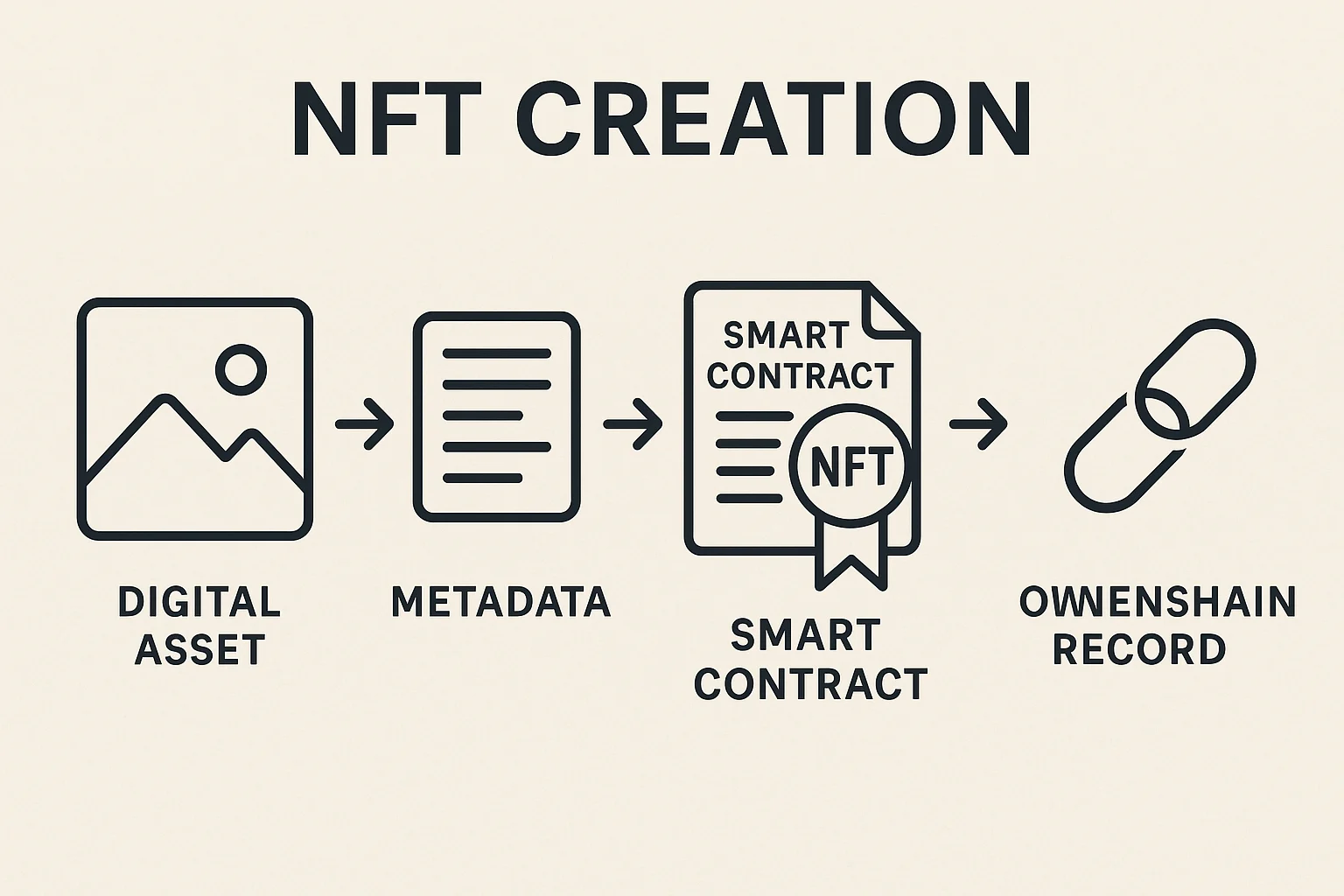
Infographic showing the NFT creation process: digital asset, metadata, smart contract minting, and blockchain ownership record

Real-World Examples

  • Bored Ape Yacht Club – 10,000 unique ape avatars selling for tens of thousands each
  • NBA Top Shot – Video highlights packaged as collectible NFT moments
  • Domain names like .eth addresses that function as decentralized websites

Why Beginners Should Care

NFTs prove that digital scarcity is possible and valuable. They enable new business models for artists, musicians, and content creators who can monetize digital work directly.

Utility matters more than hype. The best NFT projects provide ongoing value through community access, gaming benefits, or real-world perks rather than just speculative trading.

Most NFT projects fail long-term, so treat them like collectibles or entertainment rather than guaranteed investments.

Related Terms: Minting, Smart Contract, Floor Price, Metadata

Back to Crypto Glossary

Similar Posts

  • Hash Function

    Hash Function: One-Way Mathematical TransformationHash functions are mathematical algorithms that convert input data into fixed-size output strings in a way that's easy to compute forward but practically impossible to reverse. They're like digital fingerprints for data.A hash function is a mathematical algorithm that takes input data of any size and produces a fixed-size output (hash)…

  • Sustainable Yield

    Sustainable Yield: Long-Term Return GenerationSustainable yield refers to returns that can be maintained long-term without depleting the underlying value source. It's like earning interest that doesn't eventually destroy the principal.Sustainable yield represents returns generated from real economic activity and value creation rather than unsustainable token emissions or Ponzi-like mechanisms. These yields can theoretically continue indefinitely.How Sustainable…

  • Price Impact

    Price Impact: Trade Size Effect on Market PricesPrice impact refers to how trading activity affects cryptocurrency prices, particularly when large orders move markets significantly. It's like how jumping into a small pool creates bigger waves than jumping into an ocean.Price impact is the effect that trading activity has on cryptocurrency prices, with larger trades typically…

  • ICO

    ICO: Initial Coin OfferingAn ICO is a fundraising method where new cryptocurrency projects sell tokens to early investors. It's like an IPO for stocks, but for new cryptocurrency tokens instead of company shares.An Initial Coin Offering (ICO) is a fundraising mechanism where cryptocurrency projects sell tokens to investors to raise capital for development and operations. ICOs…

  • Conservative Investing

    Conservative Investing: Low-Risk Investment ApproachConservative investing prioritizes capital preservation and steady returns over high-risk, high-reward strategies. It's like choosing the scenic route that takes longer but is much safer than the dangerous mountain pass.Conservative investing refers to investment strategies that prioritize capital preservation and risk reduction over maximum returns, typically focusing on established assets and…

  • Go

    Go: Programming Language for BlockchainGo is a programming language widely used for building blockchain infrastructure and cryptocurrency applications. It's like the construction language for digital money systems.Go (also called Golang) is a programming language developed by Google that's popular for blockchain development due to its performance, simplicity, and excellent concurrency support. Many major cryptocurrency projects use…