
Oracle

Oracle: Connecting Blockchains to Reality

Oracles are the bridges between blockchain smart contracts and real-world data. Without them, DeFi would be a closed system talking only to itself.

An oracle is a service that provides external data to blockchain networks, enabling smart contracts to access real-world information like prices, weather, sports scores, or any off-chain data. Blockchains can’t access external APIs directly, so oracles act as trusted data feeds.

How Oracles Work

Data aggregation combines information from multiple sources to prevent single points of failure. Price oracles might average data from 10+ exchanges to provide accurate, manipulation-resistant feeds.

Cryptographic proofs ensure data integrity during transmission from external sources to blockchain networks. Oracles sign data with private keys that smart contracts can verify.

Decentralized oracle networks use multiple independent node operators to fetch and verify data, reducing risks of manipulation or single points of failure that plague centralized oracles.
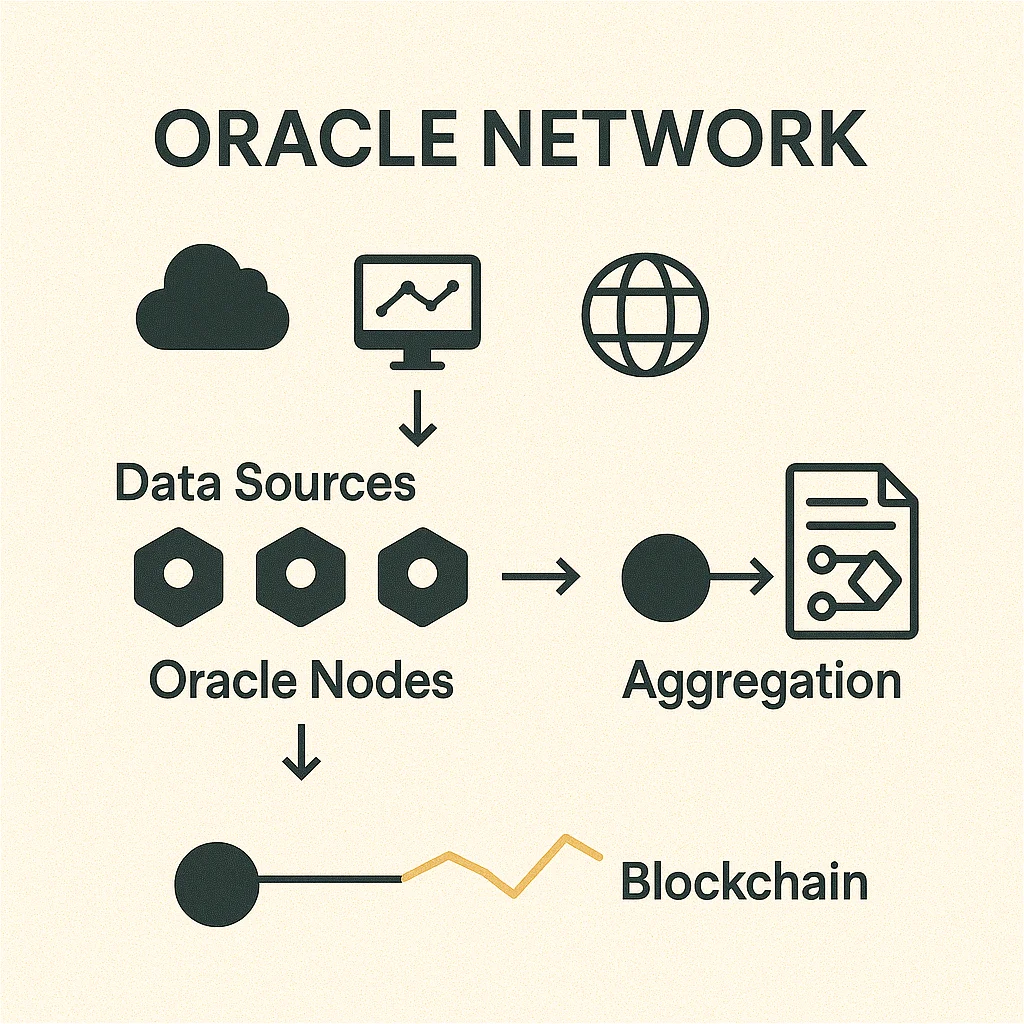
Infographic showing how oracle networks connect multiple data sources to blockchain smart contracts via aggregation and oracle nodes

Real-World Examples

  • Chainlink – Largest oracle network providing price feeds to thousands of DeFi protocols
  • Band Protocol – Cross-chain oracle solution supporting multiple blockchains
  • Tellor – Decentralized oracle network secured by crypto-economic incentives

Why Beginners Should Care

Oracle failures can catastrophically break DeFi protocols. If price feeds fail or get manipulated, lending protocols can liquidate healthy positions or allow undercollateralized borrowing.

Oracle attacks have caused hundreds of millions in DeFi losses. Attackers manipulate price feeds to exploit smart contracts that rely on inaccurate data.

Choose DeFi protocols that use reputable, decentralized oracle solutions rather than single-source price feeds vulnerable to manipulation.

Related Terms: Smart Contract, DeFi, Price Feed, Chainlink

Back to Crypto Glossary

Similar Posts

  • Message Relay

    Message Relay: Cross-Chain Communication HubMessage relay systems transport data and instructions between different blockchain networks. They're like postal services for blockchain messages, ensuring information gets delivered across network boundaries.Message relay refers to infrastructure that enables communication between different blockchain networks by transporting data, transaction proofs, and execution instructions across chain boundaries. These systems enable cross-chain applications…

  • Scalability

    Scalability: Handling Growing Network DemandScalability refers to a blockchain network's ability to handle increasing transaction volumes without degrading performance or significantly increasing costs. It's like building highways that don't get congested as more cars use them.Scalability describes how well blockchain networks can accommodate growing user bases and transaction volumes while maintaining reasonable fees and confirmation…

  • Validator

    Validator: Proof-of-Stake Network Guardians Validators are the security backbone of proof-of-stake networks. They propose blocks, verify transactions, and earn rewards for honest behavior. A validator is a network participant in proof-of-stake blockchains who validates transactions, proposes new blocks, and maintains network consensus in exchange for staking rewards. Validators replace miners in PoS systems. How Validators…

  • Capital Preservation

    Capital Preservation: Protecting Investment PrincipalCapital preservation focuses on protecting the original investment amount rather than maximizing returns. It's like choosing a safe over a lottery ticket for your money.Capital preservation is an investment strategy that prioritizes protecting the original principal amount over generating high returns. This conservative approach minimizes downside risk while accepting lower potential upside.How…

  • Real Yield

    Real Yield: Sustainable Revenue-Based Returns Real yield comes from actual protocol revenue rather than token emissions or inflationary rewards. It’s the difference between earning from productive business activity versus printing more money. Real yield refers to returns generated from genuine protocol revenue, fees, or value creation rather than token inflation or emissions. These yields can…

  • Token Economy

    Token Economy: Digital Asset EcosystemsToken economies are systems where digital tokens serve as medium of exchange, store of value, and incentive mechanisms within specific ecosystems. They're like creating your own mini-economy with digital money.A token economy refers to an ecosystem where cryptocurrency tokens facilitate economic activity, incentivize participation, and coordinate behavior among participants. These economies can…