
Launchpad

Launchpad: The Crypto Startup Accelerator

Launchpads are platforms that help new crypto projects raise funds and launch tokens. They’re like Kickstarter for cryptocurrencies, but with more speculation and less product delivery.

A launchpad is a platform that facilitates fundraising and token launches for new cryptocurrency projects. They provide infrastructure, marketing, and community access to help projects raise capital and distribute tokens to early supporters.

How Launchpads Work

Project vetting screens potential launches for legitimacy, though quality varies significantly between different launchpad platforms and market conditions.

Token sales occur through various mechanisms like fixed prices, bonding curves, or Dutch auctions, often with whitelisting requirements or lottery systems for popular projects.

Community building helps projects gain exposure to existing investor communities who are actively seeking new investment opportunities in early-stage crypto projects.
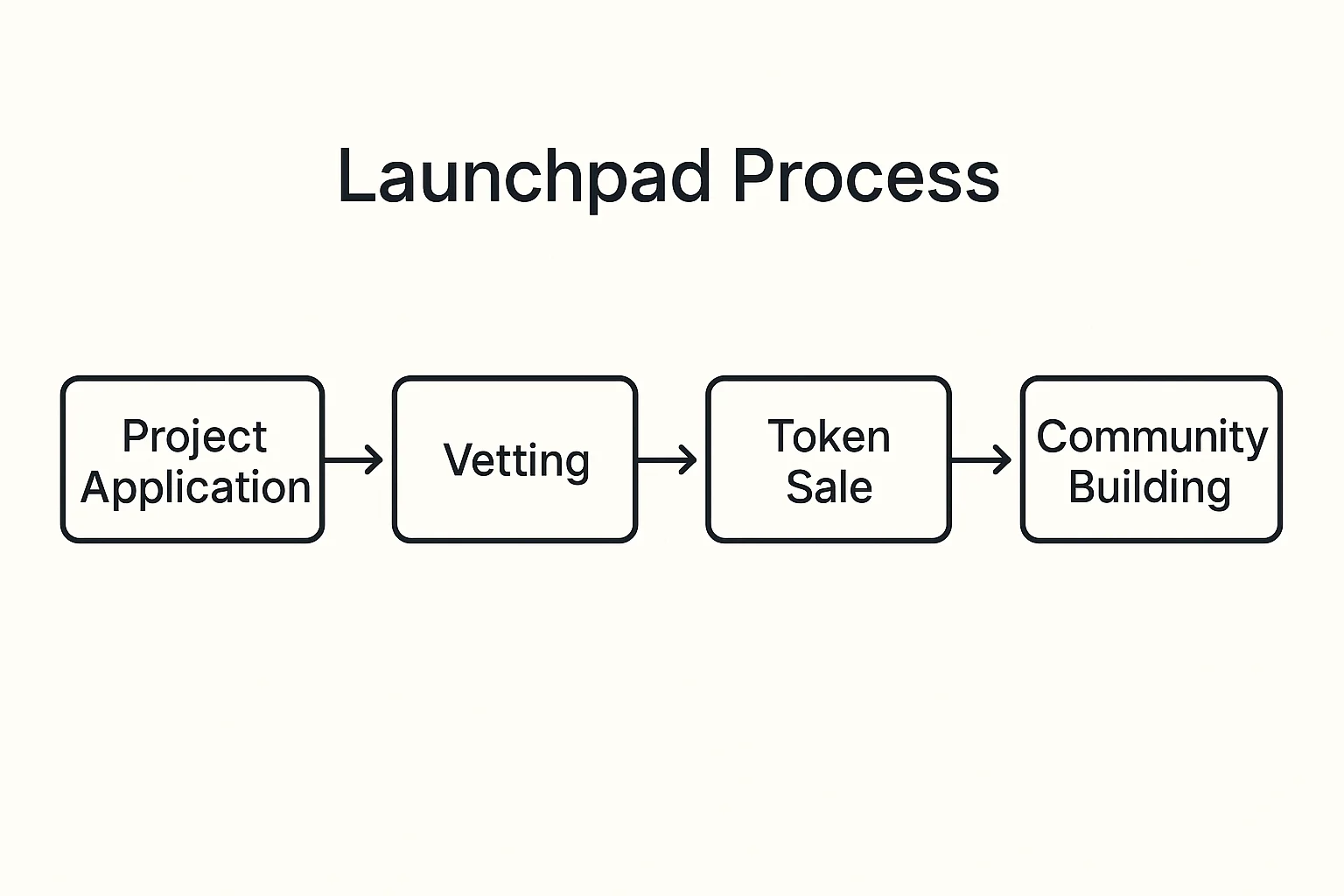
Launchpad process flowchart showing steps from project application to vetting, token sale, and community building.

Real-World Examples

  • Binance Launchpad has launched major projects like Polygon (MATIC) and Sandbox (SAND)
  • Polkastarter focuses on cross-chain token launches and DeFi projects
  • DAO Maker combines launchpad services with community-driven project incubation

Why Beginners Should Care

Early access to new projects can provide significant returns, but most launchpad projects fail or lose value after initial hype subsides.

High risk exists since many projects are experimental or lack working products, making launchpad investing closer to speculation than traditional investment.

FOMO marketing creates artificial urgency around launches, often leading to poor investment decisions based on fear of missing out rather than fundamental analysis.

Related Terms: Token Sale, ICO, Whitelist, Project Vetting

Back to Crypto Glossary

Similar Posts

  • Asset Rehypothecation

    Asset Rehypothecation: Reusing Collateral for Multiple PurposesAsset rehypothecation involves using the same collateral for multiple financial purposes simultaneously. It's like using your house as collateral for multiple loans at the same time.Asset rehypothecation refers to the practice of using deposited or pledged assets as collateral for additional financial activities beyond their original purpose. This can multiply…

  • Economic Security

    Economic Security: Financial Incentive ProtectionEconomic security refers to protection mechanisms that use financial incentives and penalties to secure blockchain networks and protocols. It's like having a security system where guards are paid well for protecting property and fined heavily for allowing break-ins.Economic security describes protection mechanisms that use financial incentives, stake requirements, and economic penalties…

  • Circulating Supply

    Circulating Supply: Tokens Available for TradingCirculating supply represents the number of cryptocurrency tokens currently available for public trading and use. It's like counting how much money is actually in circulation versus locked away.Circulating supply refers to the number of cryptocurrency tokens that are publicly available and actively trading in the market. This excludes tokens that are…

  • Slippage

    Slippage: The Cost of Market Impact Slippage is the difference between expected and actual trade prices. It’s the tax you pay for moving markets when your trade is large relative to available liquidity. Slippage occurs when the execution price of a trade differs from the expected price due to market movement or insufficient liquidity. Large…

  • Order Matching

    Order Matching: Connecting Buyers and SellersOrder matching is the process of pairing buy and sell orders to execute trades on exchanges. It's like a digital matchmaker that finds the perfect trading partners for each transaction.Order matching refers to the algorithmic process that pairs compatible buy and sell orders to execute trades at agreed prices on…

  • ZK Proof Aggregation

    ZK Proof Aggregation: Scaling Zero-Knowledge Systems ZK proof aggregation combines multiple zero-knowledge proofs into single, more efficient proofs. It’s like having one master key that proves you have access to multiple locked boxes. ZK proof aggregation is a technique that combines multiple zero-knowledge proofs into a single proof that verifies all the original statements simultaneously….