
DeFi Aggregator

DeFi Aggregator: Finding the Best Yields

DeFi aggregators automatically find the best rates across multiple protocols for lending, borrowing, or trading. They’re like Expedia for decentralized finance.

A DeFi aggregator is a platform that searches multiple protocols to find the best rates, yields, or liquidity for users’ specific needs. Instead of manually checking dozens of platforms, aggregators do the comparison shopping automatically.

How DeFi Aggregators Work

Rate comparison across lending protocols, DEXs, and yield farming opportunities to identify the highest returns or lowest costs for specific actions.

Smart routing splits large trades across multiple DEXs to minimize slippage and maximize execution efficiency compared to single-platform trades.

Yield optimization automatically moves funds between protocols as rates change, maintaining exposure to the highest available returns.
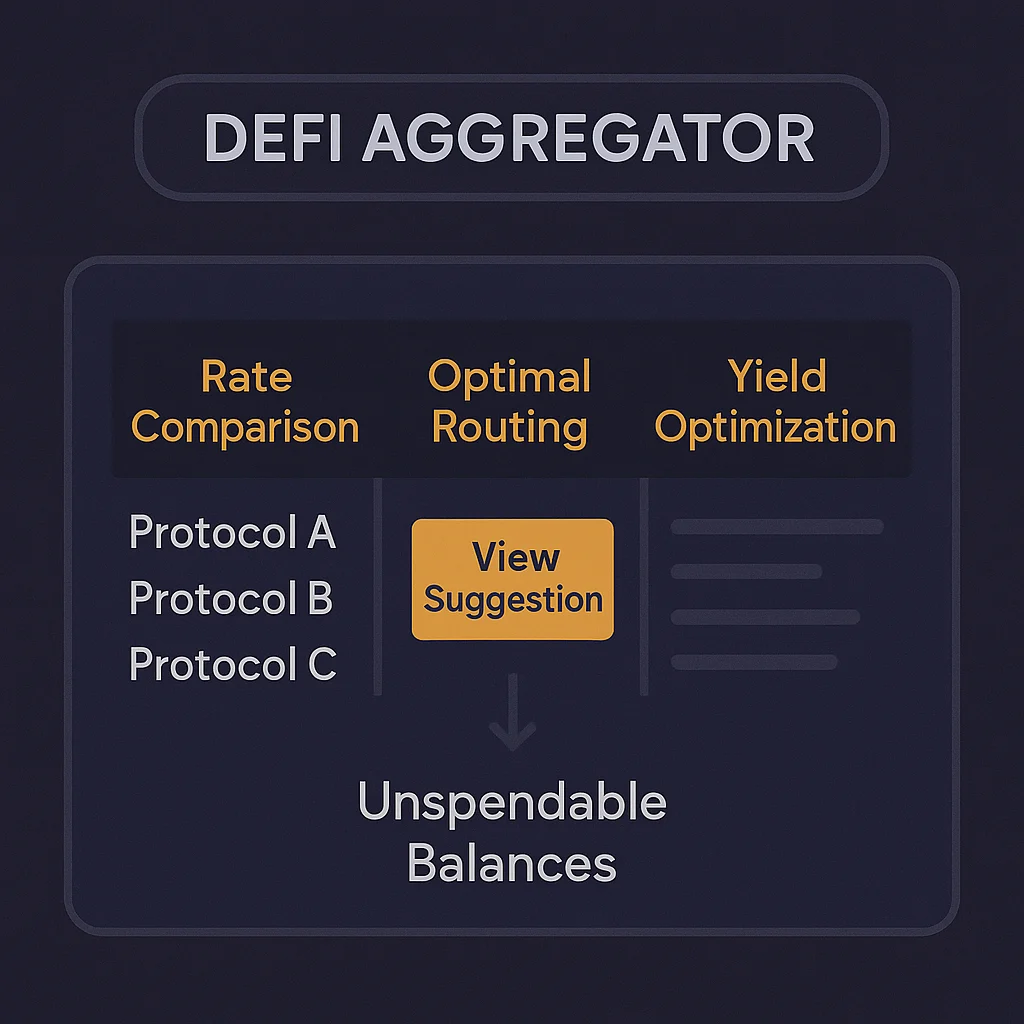
DeFi aggregator dashboard displaying rate comparisons, optimal routing suggestions, and yield optimization strategies across multiple protocols.

Real-World Examples

  • 1inch aggregates DEX liquidity to find best trading prices across multiple exchanges
  • Yearn Finance automatically moves deposited funds to highest-yielding opportunities
  • Zapper simplifies complex DeFi interactions through a single interface

Why Beginners Should Care

Time savings from aggregators eliminate the need to manually research and compare rates across dozens of constantly changing DeFi protocols.

Better execution through smart routing and yield optimization can significantly improve returns compared to single-protocol strategies.

Smart contract risk increases when aggregators interact with multiple protocols, as vulnerabilities in any connected platform could affect aggregator users.

Related Terms: Yield Farming, DEX, Slippage, Yield Optimization

Back to Crypto Glossary

Similar Posts

  • Public Key

    Public Key: Your Crypto Receiving Address Your public key is like your email address for crypto – you can share it freely without security concerns. A public key is cryptographically derived from your private key and generates your wallet addresses where others can send you cryptocurrency. It’s mathematically linked to your private key but reveals…

  • Block Reward

    Block Reward: Miner and Validator Compensation Block rewards are the cryptocurrency payments that miners and validators receive for successfully adding new blocks to the blockchain. It’s how networks incentivize security without charging transaction fees. Block reward is the amount of cryptocurrency awarded to miners or validators for successfully creating and validating a new block on…

  • Bridge Aggregator

    Bridge Aggregator: Cross-Chain Route OptimizationBridge aggregators find the best routes for moving assets between blockchain networks by comparing multiple bridge options. They're like travel booking sites that find the cheapest flights across different airlines.A bridge aggregator is a service that compares multiple cross-chain bridge options to find optimal routes for transferring assets between different blockchain…

  • Soulbound Token (SBT)

    Soulbound Token (SBT): Non-Transferable Achievements Soulbound tokens are NFTs that cannot be transferred or sold once received. They represent achievements, credentials, or identity elements that should remain permanently attached to specific individuals. A Soulbound Token (SBT) is a non-fungible token that is permanently bound to a specific wallet address and cannot be transferred or sold….

  • Gas Price

    Gas Price: Cost of Ethereum ComputingGas price determines how much you pay per unit of computational work on Ethereum. It's like setting the hourly rate for blockchain computing services.Gas price is the amount of cryptocurrency (usually measured in gwei) that users are willing to pay for each unit of gas consumed by their Ethereum transactions. Higher…

  • Flashbots

    Flashbots: MEV Infrastructure Flashbots is a research and development organization that builds infrastructure to mitigate the negative externalities of MEV. They’re trying to make the blockchain economy more fair and transparent. Flashbots develops tools and infrastructure to democratize MEV extraction and reduce its harmful effects on regular users. Their products include private mempools, MEV-protected transaction…