
Dust

Dust: Tiny Amounts That Clog Networks

Dust refers to cryptocurrency amounts so small they’re not economically viable to spend due to transaction fees exceeding their value. It’s like having pennies that cost dollars to use.

Dust consists of very small amounts of cryptocurrency that cost more in transaction fees to send than their actual value. These tiny balances accumulate in wallets over time and can clog network resources if moved.

How Dust Accumulates

Change outputs from transactions often leave small remainders that aren’t worth the gas fees to consolidate or spend separately.

Airdrop residuals may distribute tiny token amounts that become worthless after market prices decline below transaction costs.

Spam attacks deliberately send dust to many addresses to clog networks or track user behavior through forced interactions.
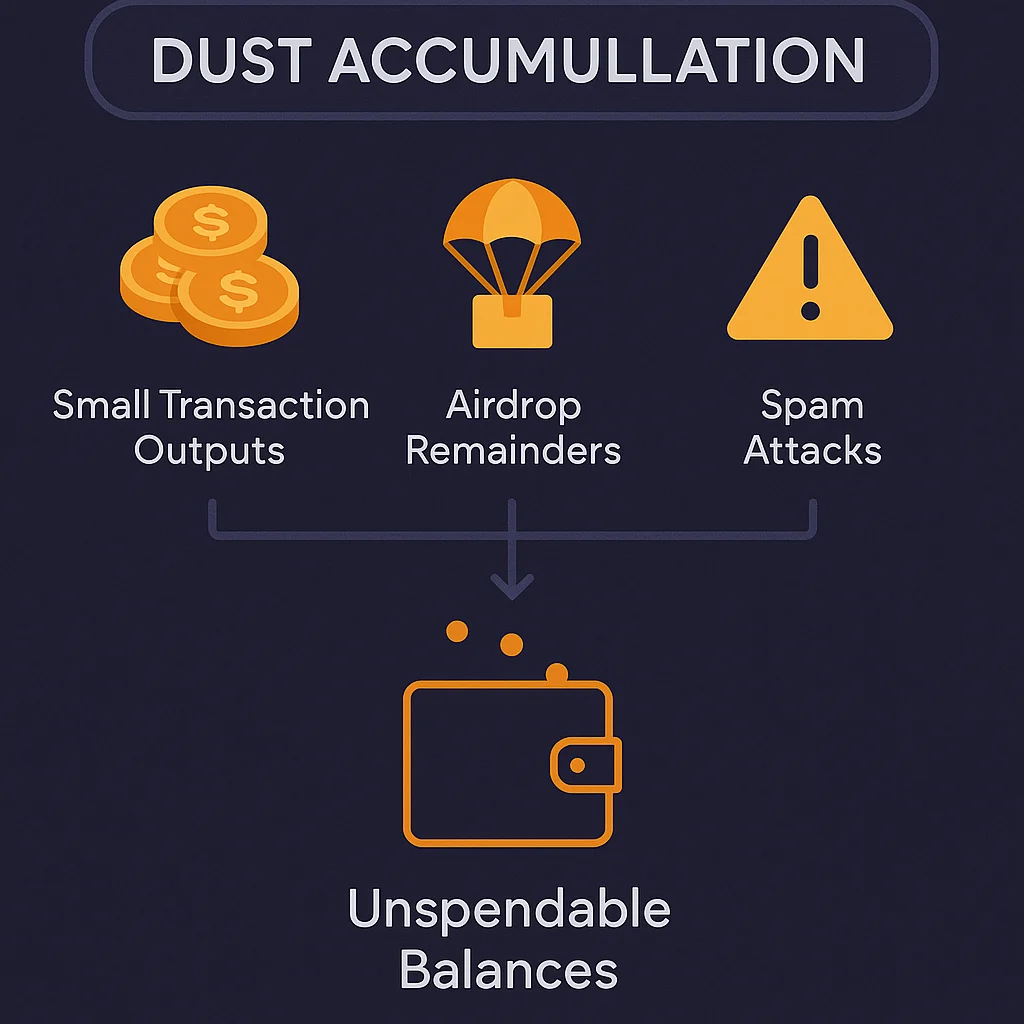
Dust accumulation diagram showing how small transaction outputs, airdrop remainders, and spam attacks lead to unspendable balances in crypto wallets.

Real-World Examples

  • Bitcoin dust limit is around 546 satoshis – amounts below this may be rejected by nodes
  • Ethereum gas fees can make sub-$10 token amounts uneconomical to move during network congestion
  • BSC spam tokens often leave dust amounts that users can’t profitably remove

Why Beginners Should Care

Wallet clutter from dust makes portfolio tracking difficult and can hide significant balances among dozens of worthless token remnants.

Privacy implications exist since dust can be used for tracking purposes when users consolidate small amounts with larger balances.

Network efficiency suffers when dust gets moved, consuming block space for economically insignificant transactions that could handle larger value transfers.

Related Terms: Transaction Fees, UTXO, Dusting Attack, Spam

Back to Crypto Glossary

Similar Posts

  • Multi-Chain

    Multi-Chain: Using Multiple Blockchain Networks Multi-chain refers to applications, strategies, or ecosystems that operate across multiple different blockchain networks simultaneously. It’s like being multilingual in the blockchain world. Multi-chain describes systems that utilize multiple different blockchain networks rather than being limited to a single chain. This approach leverages the unique strengths of different blockchains while…

  • Lockup Period

    Lockup Period: Temporary Access RestrictionsLockup periods prevent token holders from selling or transferring their holdings for specified time frames. It's like having a certificate of deposit that you can't cash out early.A lockup period is a predetermined time frame during which cryptocurrency holders cannot sell, transfer, or access their tokens. These restrictions are typically enforced through…

  • Ethereum

    Ethereum: The Smart Contract PlatformEthereum is the blockchain platform that pioneered smart contracts and hosts most decentralized applications. It's like the operating system for programmable money and decentralized apps.Ethereum is a decentralized blockchain platform that enables smart contracts and serves as the foundation for thousands of decentralized applications (dApps). It introduced programmable money and became the…

  • Gas Refund Token

    Gas Refund Token: Optimizing Transaction Costs Gas refund tokens exploit Ethereum’s gas refund mechanism to reduce transaction costs by clearing unused storage. They’re like getting paid to clean up the blockchain. A gas refund token uses Ethereum’s gas refund mechanism to partially offset transaction costs by clearing unused contract storage during token transfers. The protocol…

  • Digital Securities

    Digital Securities: Blockchain-Based Financial InstrumentsDigital securities are traditional financial instruments like stocks and bonds represented as tokens on blockchain networks. They're like digitizing paper stock certificates to work on the internet.Digital securities are blockchain-based tokens that represent ownership in traditional financial instruments such as stocks, bonds, or real estate, subject to securities regulations. These bridge conventional…

  • Permit (EIP-2612)

    Permit (EIP-2612): Gasless Approvals Permit functionality allows token approvals through signatures instead of transactions, enabling gasless user experiences for DeFi interactions. It’s like signing a check instead of going to the bank. Permit (EIP-2612) is a token standard that enables gasless approvals through cryptographic signatures rather than on-chain transactions. Users can authorize token spending without…