
Session Keys

Session Keys: Temporary Wallet Permissions

Session keys provide temporary, limited permissions for applications to perform specific actions without exposing main wallet private keys. It’s like giving valet keys instead of your full car keys.

Session keys are temporary cryptographic keys that grant limited permissions to applications for specific time periods or transaction types. They enable seamless user experiences while maintaining security through restricted access scope.

How Session Keys Work

Permission scoping limits what actions session keys can perform, such as trading specific tokens, interacting with certain contracts, or spending up to defined amounts.

Time expiration automatically revokes session key access after predetermined periods, preventing indefinite exposure if keys are compromised.

Revocation mechanisms allow users to immediately cancel session keys if they detect suspicious activity or no longer want to grant access.
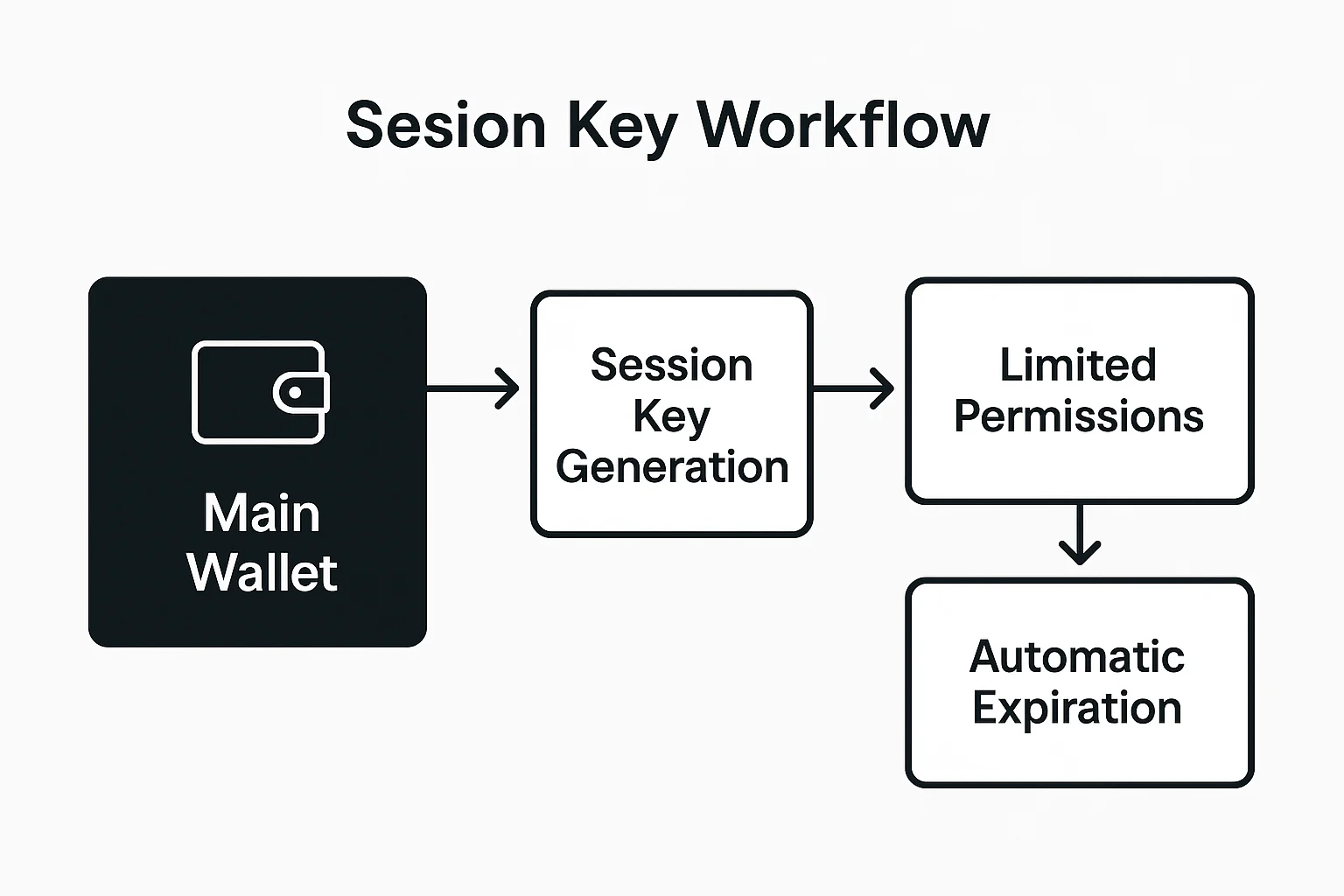
Session key workflow diagram showing main wallet generating a session key with limited permissions and automatic expiration.

Real-World Examples

  • Gaming applications use session keys for in-game transactions without requiring wallet approval for every action
  • DeFi protocols enable automated trading strategies with spending limits and time constraints
  • Mobile wallets create session keys for app interactions while keeping main keys in secure storage

Why Beginners Should Care

Improved UX eliminates constant wallet approval prompts for routine actions while maintaining security through limited permission scope.

Risk reduction means compromised session keys can only perform limited actions rather than providing full wallet access to attackers.

Automation enablement allows complex multi-step operations to execute automatically within predefined parameters without manual intervention.

Related Terms: Account Abstraction, Smart Contract, Security

Back to Crypto Glossary

Similar Posts

  • Leverage

    Leverage: Borrowing Money to Amplify TradesLeverage lets you control larger positions than your actual capital by borrowing funds from exchanges or platforms. It's like using a lever to lift heavy objects – small movements create big effects.Leverage in cryptocurrency trading allows borrowing funds to increase position sizes beyond available capital, amplifying both potential profits and…

  • Shared Security

    Shared Security: Collective Network ProtectionShared security allows multiple blockchain applications or chains to benefit from common security infrastructure rather than maintaining separate validator sets. It's like having a shared security service for multiple buildings.Shared security refers to security models where multiple blockchain networks or applications are protected by a common set of validators or consensus…

  • Consensus Layer

    Consensus Layer: Network Agreement FoundationThe consensus layer handles how blockchain networks achieve agreement on valid transactions and network state. It's the democratic voting system that keeps everyone on the same page.The consensus layer is the component of blockchain architecture responsible for coordinating agreement among network participants about transaction validity and blockchain state. This layer ensures all…

  • Recursive Proofs

    Recursive Proofs: Self-Verifying Cryptographic SystemsRecursive proofs are cryptographic proofs that can verify other proofs of the same type, enabling compression and scalability. They're like mathematical matryoshka dolls where each proof contains and verifies other proofs.Recursive proofs are cryptographic systems where proofs can verify other instances of the same proof system, enabling compression of multiple proofs…

  • Cold Storage

    Cold Storage: Maximum Security for Crypto Assets Cold storage keeps cryptocurrency private keys completely offline, away from any internet connection. It’s the digital equivalent of storing gold bars in a bank vault rather than your wallet. Cold storage refers to keeping cryptocurrency private keys on devices or media that have never been connected to the…

  • Asset Rehypothecation

    Asset Rehypothecation: Reusing Collateral for Multiple PurposesAsset rehypothecation involves using the same collateral for multiple financial purposes simultaneously. It's like using your house as collateral for multiple loans at the same time.Asset rehypothecation refers to the practice of using deposited or pledged assets as collateral for additional financial activities beyond their original purpose. This can multiply…