
On-Chain Gaming

On-Chain Gaming: Fully Decentralized Games

On-chain gaming runs game logic entirely on blockchain networks rather than traditional servers. It’s like having board games where the rules are enforced by mathematics instead of human referees.

On-chain gaming executes all game logic, state management, and interactions through smart contracts on blockchain networks. Unlike traditional games with centralized servers, on-chain games operate through decentralized infrastructure that players cannot manipulate.

How On-Chain Gaming Works

Smart contract logic handles all game rules, player actions, and state transitions through deterministic code that executes identically for all players.

Transparent mechanics make all game rules publicly visible and verifiable, preventing hidden advantages or manipulation by game operators.

Composable assets enable game items and characters to be used across different games and applications that support the same standards.
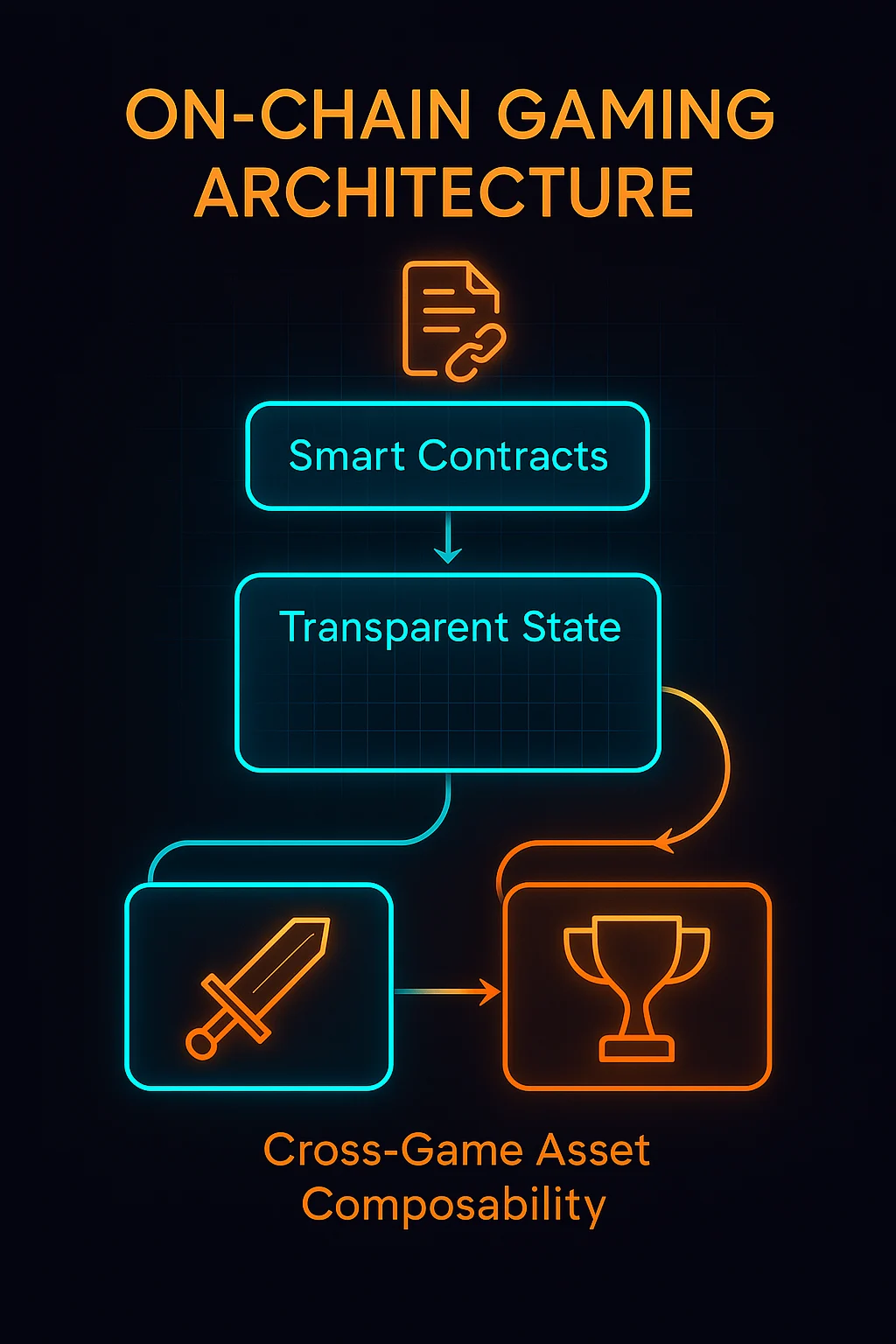
Illustration of on-chain gaming architecture, featuring smart contracts, transparent state management, and asset composability across multiple games.

Real-World Examples

  • Chess on-chain with provably fair random events and permanent game records
  • Strategy games where all moves and outcomes are cryptographically verifiable
  • Trading card games with truly scarce digital cards that work across multiple game implementations

Why Beginners Should Care

Provably fair gameplay eliminates concerns about rigged random number generation or hidden advantages for certain players.

Asset portability allows taking game items between different implementations and derivative games built by various developers.

Permanent records of achievements and gameplay history that persist even if original game developers stop supporting their games.

Related Terms: Smart Contract, Autonomous World, NFT Gaming, Verifiable Randomness

Back to Crypto Glossary

Similar Posts

  • Ethereum

    Ethereum: The Smart Contract PlatformEthereum is the blockchain platform that pioneered smart contracts and hosts most decentralized applications. It's like the operating system for programmable money and decentralized apps.Ethereum is a decentralized blockchain platform that enables smart contracts and serves as the foundation for thousands of decentralized applications (dApps). It introduced programmable money and became the…

  • Blockchain Trilemma

    Blockchain Trilemma: The Impossible TrinityThe blockchain trilemma describes the challenge of simultaneously achieving decentralization, security, and scalability in blockchain networks. It's like trying to be fast, cheap, and high-quality all at the same time.The blockchain trilemma refers to the fundamental trade-off between three key properties: decentralization, security, and scalability, where optimizing for two typically requires…

  • Whale

    Whale: The Big Players Who Move Markets In crypto, whales are individuals or entities holding massive amounts of cryptocurrency. When whales move, markets tremble. A whale is someone who holds enough cryptocurrency to significantly influence market prices through their trading decisions. For Bitcoin, this typically means holding 1,000+ BTC (worth $30+ million at current prices)….

  • Dust

    Dust: Tiny Amounts That Clog Networks Dust refers to cryptocurrency amounts so small they’re not economically viable to spend due to transaction fees exceeding their value. It’s like having pennies that cost dollars to use. Dust consists of very small amounts of cryptocurrency that cost more in transaction fees to send than their actual value….

  • Altcoin

    Altcoin: Every Cryptocurrency That Isn’t Bitcoin “Altcoin” literally means “alternative to Bitcoin.” Some are innovative improvements, others are marketing experiments, and many are outright scams. An altcoin is any cryptocurrency other than Bitcoin. The term covers everything from Ethereum’s smart contract platform to obscure meme coins with dog themes. How Altcoins Work Each altcoin attempts…

  • Metadata

    Metadata: Data About DataMetadata provides information about other data, such as describing what an NFT represents, when it was created, or what properties it has. It's like the label on a file folder that tells you what's inside.Metadata refers to descriptive information about digital assets, transactions, or other data that provides context, properties, and characteristics…