
Autonomous World (AW)

Autonomous World (AW): Persistent Virtual Realities

Autonomous worlds are persistent virtual environments that continue existing and evolving even when no players are actively participating. They’re like having a Minecraft world that keeps running and changing forever.

An Autonomous World (AW) is a virtual environment that operates independently through blockchain infrastructure, maintaining state and enabling interactions without requiring central servers or active management. These worlds persist and evolve according to their programmed rules.

How Autonomous Worlds Work

Blockchain persistence ensures the virtual world continues existing as long as the underlying blockchain operates, independent of any company or server infrastructure.

Player-driven evolution allows inhabitants to modify the world through their actions, with changes permanently recorded on-chain.

Economic sovereignty enables native economies with real value exchange, ownership rights, and governance systems controlled by world inhabitants.
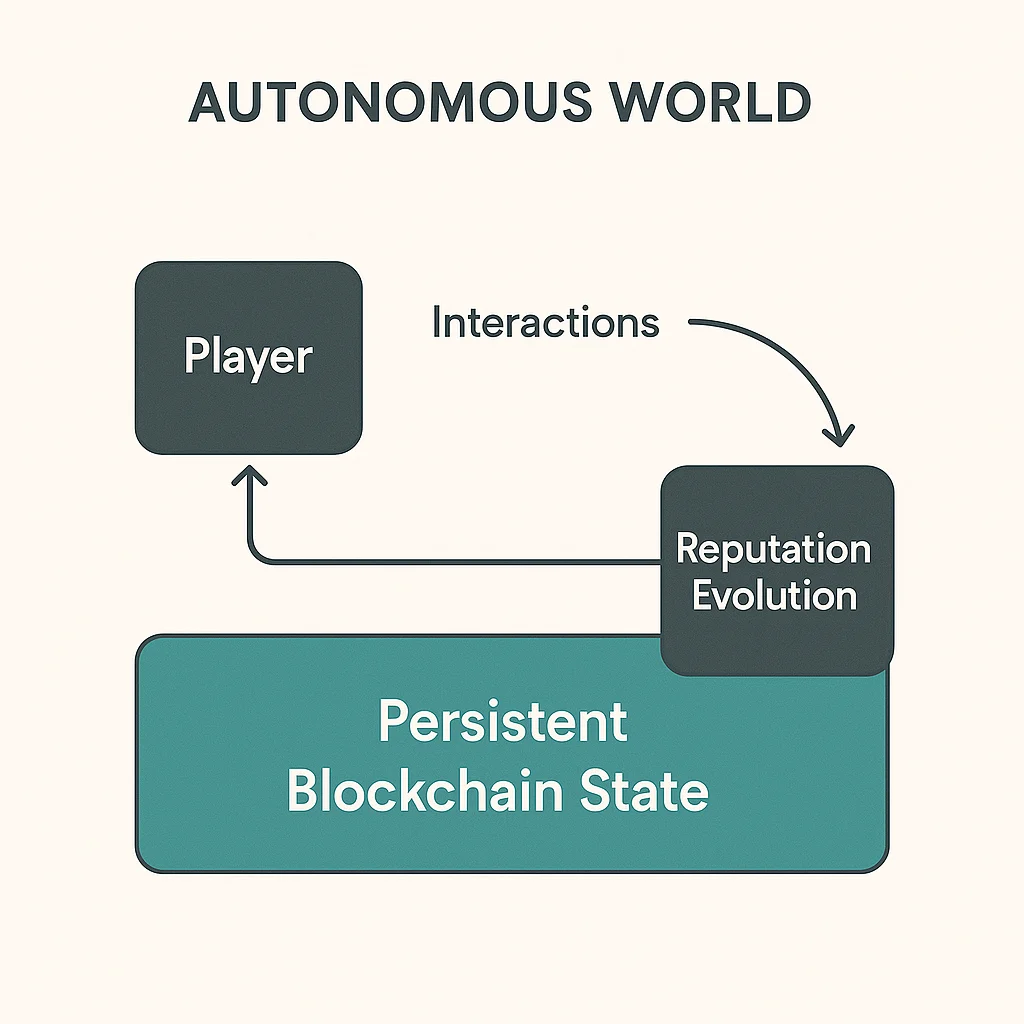
Autonomous world architecture showing player interactions, reputation evolution, and persistent blockchain state enabling independent system behavior.

Real-World Examples

  • Dark Forest – Space exploration game that runs entirely on-chain with hidden information
  • Loot derivatives creating persistent fantasy worlds based on text-based NFTs
  • MUD engine provides infrastructure for building complex autonomous worlds

Why Beginners Should Care

True ownership of virtual assets and land that can’t be taken away by game companies going out of business or changing policies.

Persistent value creation where time and effort invested in virtual worlds retains value indefinitely through blockchain permanence.

Experimental economics as autonomous worlds become laboratories for testing new forms of governance, economics, and social organization.

Related Terms: Metaverse, On-Chain Gaming, Virtual Real Estate, Persistence

Back to Crypto Glossary

Similar Posts

  • MEV Protection

    MEV Protection: Defending Against Value ExtractionMEV protection shields users from having value extracted from their transactions by sophisticated bots and arbitrageurs. It's like having bodyguards that protect you from pickpockets in a crowded market.MEV protection refers to techniques and services that prevent or minimize Maximal Extractable Value extraction from user transactions. These solutions help users get…

  • Ledger

    Ledger: Hardware Wallet Security Leader Ledger is a leading hardware wallet company that provides secure offline storage for cryptocurrency private keys. They’re like the Fort Knox of crypto storage devices. Ledger is a hardware wallet manufacturer that creates secure devices for storing cryptocurrency private keys offline, protecting them from online threats and hacking attempts. These…

  • Throughput

    Throughput: Network Processing CapacityThroughput measures how many transactions a blockchain network can process per second. It's like measuring how many cars can drive through a highway during rush hour.Throughput refers to the number of transactions a blockchain network can process within a given time period, typically measured in transactions per second (TPS). Higher throughput enables more…

  • Protocol Revenue

    Protocol Revenue: Earning from Network ActivityProtocol revenue refers to income generated by blockchain protocols through transaction fees, service charges, or other value capture mechanisms. It's like toll roads that collect fees from everyone who uses the infrastructure.Protocol revenue encompasses all income streams generated by blockchain protocols including transaction fees, service charges, governance fees, and other…

  • Cross-Chain Protocol

    Cross-Chain Protocol: Blockchain Communication StandardsCross-chain protocols establish standardized methods for different blockchain networks to communicate and transfer assets safely. They're like diplomatic translation services that enable countries speaking different languages to negotiate treaties and trade agreements.Cross-chain protocols are standardized communication frameworks that enable different blockchain networks to exchange information, transfer assets, and coordinate operations across…

  • DEX

    DEX: Decentralized ExchangeA DEX is a cryptocurrency exchange that operates without central authority through smart contracts. It's like a marketplace where buyers and sellers trade directly without a middleman.A decentralized exchange (DEX) is a cryptocurrency trading platform that facilitates peer-to-peer trading through smart contracts without requiring a central operator or intermediary. Users maintain control of their…