
Real Yield

Real Yield: Sustainable Revenue-Based Returns

Real yield comes from actual protocol revenue rather than token emissions or inflationary rewards. It’s the difference between earning from productive business activity versus printing more money.

Real yield refers to returns generated from genuine protocol revenue, fees, or value creation rather than token inflation or emissions. These yields can theoretically continue indefinitely since they’re backed by actual economic activity.

How Real Yield Works

Revenue generation from protocol fees, transaction costs, or service charges creates income that gets distributed to token holders or stakers.

Fee sharing mechanisms redirect a portion of protocol revenue to participants who provide value like liquidity, governance, or security services.

Sustainable economics enable long-term yield generation without depending on new money entering the system to pay existing participants.
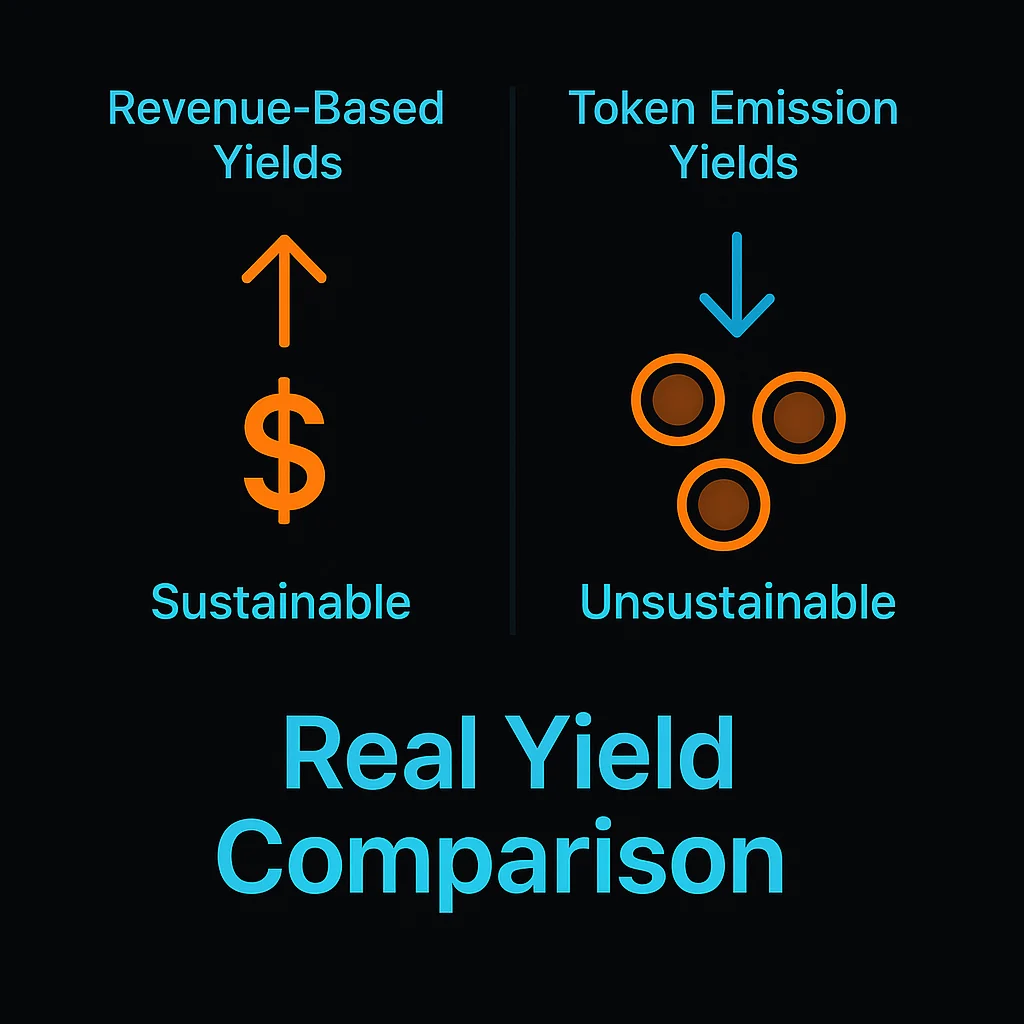
Real yield comparison showing revenue-based sustainable yields versus token emission-based unsustainable yields

Real-World Examples

  • GMX distributes trading fees to token stakers from actual platform revenue
  • Synthetix shares trading fees from synthetic asset exchanges with SNX stakers
  • MakerDAO distributes stability fees from DAI borrowing to MKR holders

Why Beginners Should Care

Sustainability assessment helps distinguish between temporary incentive programs and genuinely profitable protocols that can maintain yields long-term.

Lower but stable returns compared to high-emission farming programs that typically decrease as token prices fall or incentives end.

Business model validation as real yield demonstrates that protocols create genuine value worth paying for rather than existing purely for speculation.

Related Terms: Protocol Revenue, Fee Sharing, Sustainable Yield, Token Emissions

Back to Crypto Glossary

Similar Posts

  • DEX Aggregator

    DEX Aggregator: Optimal Trading Route FinderDEX aggregators find the best prices across multiple decentralized exchanges for cryptocurrency trades. They're like price comparison websites that automatically execute trades at the best available rates.A DEX aggregator is a service that compares prices and liquidity across multiple decentralized exchanges to find optimal trading routes for cryptocurrency swaps. These platforms…

  • Gas Refund Token

    Gas Refund Token: Optimizing Transaction Costs Gas refund tokens exploit Ethereum’s gas refund mechanism to reduce transaction costs by clearing unused storage. They’re like getting paid to clean up the blockchain. A gas refund token uses Ethereum’s gas refund mechanism to partially offset transaction costs by clearing unused contract storage during token transfers. The protocol…

  • Exit Scam

    Exit Scam: When Projects Disappear With Your Money Exit scams occur when project teams abandon their platforms after raising funds, taking investor money and disappearing. It’s the digital equivalent of skipping town with the cash register. An exit scam is when cryptocurrency project developers abandon their project after raising funds from investors, typically taking user…

  • Economic Security

    Economic Security: Financial Incentive ProtectionEconomic security refers to protection mechanisms that use financial incentives and penalties to secure blockchain networks and protocols. It's like having a security system where guards are paid well for protecting property and fined heavily for allowing break-ins.Economic security describes protection mechanisms that use financial incentives, stake requirements, and economic penalties…

  • Public Ledger

    Public Ledger: Transparent Transaction Records Public ledgers record all transactions transparently where anyone can verify the complete history of asset movements. It’s like having a bank statement that everyone can read but no one can forge. A public ledger is a distributed database that records all transactions transparently, allowing anyone to verify and audit the…

  • Yield Stacking

    Yield Stacking: Combining Multiple Income StreamsYield stacking involves combining multiple yield-generating strategies to maximize returns on cryptocurrency investments. It's like having several part-time jobs that all pay into the same bank account.Yield stacking refers to the strategy of combining multiple yield-generating opportunities across different protocols, assets, and mechanisms to maximize overall returns. This approach leverages various…