
Anti-Sybil Mechanism

Anti-Sybil Mechanism: Preventing Fake Identity Attacks

Anti-Sybil mechanisms prevent individuals from creating multiple fake identities to gain unfair advantages in voting, airdrops, or governance systems. They’re like requiring photo ID to prevent ballot stuffing.

Anti-Sybil mechanisms are systems designed to prevent or detect when single entities create multiple fake identities to manipulate voting, governance, or reward distribution systems. These defenses ensure one person equals one vote or allocation.

How Anti-Sybil Mechanisms Work

Identity verification through various means like social graphs, proof of humanity protocols, or proof of unique human presence that’s difficult to fake.

Economic barriers require significant stake or cost to participate, making it expensive to create multiple identities for attacks.

Behavioral analysis identifies patterns suggesting coordinated fake accounts through timing, transaction history, or interaction patterns.
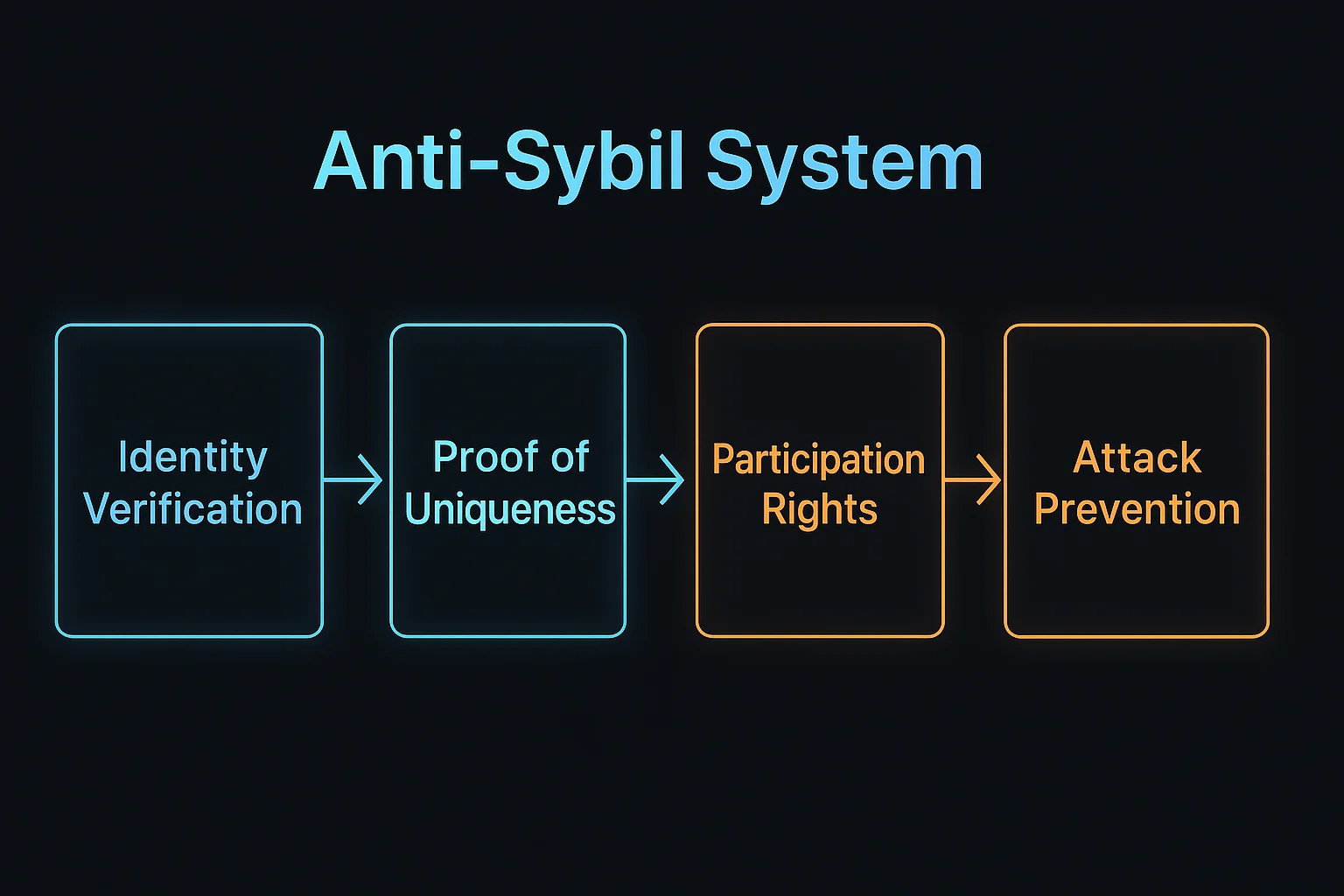
Anti-Sybil system diagram showing identity verification, uniqueness proof, participation rights, and attack prevention

Real-World Examples

  • Gitcoin Grants uses Gitcoin Passport to verify unique human participants in quadratic funding
  • Proof of Humanity creates registries of verified unique humans for various applications
  • BrightID provides decentralized identity verification through social graph analysis

Why Beginners Should Care

Fair distribution depends on anti-Sybil measures to prevent wealthy actors from claiming multiple shares of airdrops or governance power.

Privacy trade-offs as effective anti-Sybil systems often require revealing personal information or social connections.

System integrity for democratic governance and fair resource allocation across crypto protocols and DAOs.

Related Terms: Sybil Attack, Quadratic Funding, Governance

Back to Crypto Glossary

Similar Posts

  • Social Recovery

    Social Recovery: Community-Based Account RecoverySocial recovery allows regaining access to cryptocurrency accounts through trusted contacts rather than relying solely on seed phrases. It's like having friends hold spare keys to your house.Social recovery is a wallet security mechanism that enables account recovery through a network of trusted contacts rather than requiring users to manage seed…

  • Merkle Tree

    Merkle Tree: Efficient Data Verification Merkle trees enable efficient verification of large datasets without downloading everything. They’re like having a fingerprint for an entire library that proves any book belongs. A Merkle tree is a binary tree structure where each leaf represents a data element and each branch contains cryptographic hashes of its children. The…

  • Quadratic Funding

    Quadratic Funding: Democratic Resource AllocationQuadratic funding uses mathematical formulas to allocate resources based on community preferences while preventing wealthy individuals from dominating funding decisions. It's democracy with math.Quadratic funding is a mechanism for allocating resources that gives more weight to the number of contributors than the amount contributed, using quadratic formulas to prevent wealthy individuals…

  • zkSync

    zkSync: Ethereum’s Zero-Knowledge Scaling zkSync is a Layer 2 scaling solution that uses zero-knowledge proofs to bundle transactions while maintaining Ethereum’s security. It’s like having an express lane that’s mathematically guaranteed to follow traffic laws. zkSync is a zero-knowledge rollup that scales Ethereum by processing transactions off-chain and submitting cryptographic proofs of validity to the…

  • Consensus Rules

    Consensus Rules: Network Agreement ProtocolsConsensus rules define how blockchain networks validate transactions and maintain agreement about the ledger state. They're like the constitution for digital money systems.Consensus rules are the specific protocols and requirements that all network participants must follow to validate transactions, create blocks, and maintain agreement about the blockchain's current state. These rules ensure…

  • Rebase Token

    Rebase Token: Algorithmic Supply Adjustment Rebase tokens automatically adjust their total supply to maintain target prices or economic conditions. It’s like having money that multiplies or divides to keep its buying power constant. A rebase token automatically increases or decreases the total token supply held by all users proportionally to achieve specific economic targets like…