
Liquidity Sniping

Liquidity Sniping: Front-Running New Pools

Liquidity sniping involves immediately buying tokens when new liquidity pools are created, often using bots to front-run regular users. It’s like cutting in line at the grand opening sale.

Liquidity sniping is the practice of using automated systems to immediately purchase tokens as soon as new liquidity pools go live, taking advantage of low initial prices before regular users can react. This often involves MEV extraction and front-running techniques.

How Liquidity Sniping Works

Pool monitoring tracks new token launches and liquidity additions across decentralized exchanges to identify sniping opportunities.

Automated execution uses bots with high gas prices to ensure transactions get included immediately when new pools become active.

Price arbitrage captures value from initial price inefficiencies before markets reach equilibrium through normal trading activity.
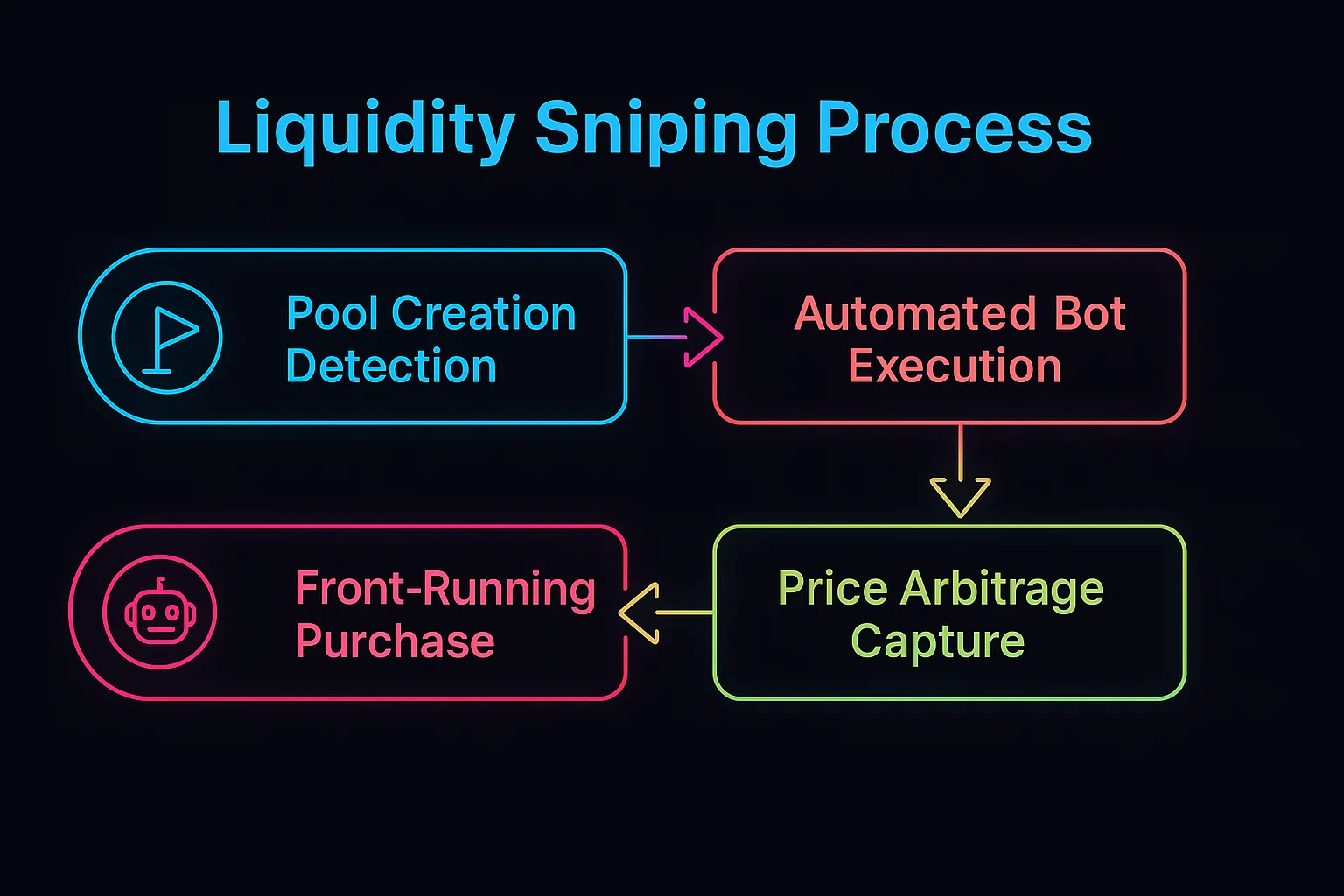
Liquidity sniping flow showing pool creation detection, automated bot execution, front-running purchase, and price arbitrage capture

Real-World Examples

  • New token launches on Uniswap frequently face sniping bots that buy tokens within the same block
  • Sandwich attacks during pool creation that manipulate prices for sniping profits
  • MEV bot networks specialized in detecting and exploiting new liquidity opportunities

Why Beginners Should Care

Unfair advantages for sophisticated actors with automated systems over retail users trying to participate in new token launches.

Price impact from sniping can dramatically affect initial token prices and distribution fairness for legitimate users.

Protection strategies include using private mempools, delayed launches, or anti-MEV mechanisms to reduce sniping effectiveness.

Related Terms: MEV, Front-Running, Liquidity Pool, Bot Trading

Back to Crypto Glossary

Similar Posts

  • Hard Fork

    Hard Fork: Splitting the Blockchain Hard forks create permanent splits in blockchain networks, often resulting in two separate cryptocurrencies. They’re like corporate divorces – messy, dramatic, and usually involving lots of arguing about money. A hard fork is a permanent change to a blockchain’s protocol that makes previously invalid blocks valid, or vice versa, requiring…

  • Multichain Router

    Multichain Router: Cross-Chain Navigation Multichain routers find optimal paths for moving assets between different blockchain networks. They’re like GPS for cross-chain transactions, finding the cheapest and fastest routes. A multichain router is a protocol that automatically finds the best path for transferring assets between different blockchain networks. It compares routes across multiple bridges and chains…

  • Flash Loan

    Flash Loan: Borrowing Millions Without Collateral Flash loans let you borrow millions of dollars without putting up collateral, but you must pay it back in the same transaction. It’s DeFi’s most mind-bending innovation. A flash loan is an uncollateralized loan that must be borrowed and repaid within a single blockchain transaction. If you can’t repay…

  • Transparency

    Transparency: Open Information AccessTransparency in cryptocurrency refers to the open, verifiable nature of blockchain data that allows anyone to inspect transactions and network operations. It's like having buildings made entirely of glass where you can see exactly what's happening inside every room.Transparency describes the property of blockchain systems that makes transaction data, network operations, and…

  • Cryptographic Proof

    Cryptographic Proof: Mathematical VerificationCryptographic proof provides mathematical certainty about the validity of information without revealing sensitive details. It's like proving you know a secret without actually telling anyone what the secret is.Cryptographic proof refers to mathematical techniques that verify the authenticity, integrity, or validity of information using cryptographic methods. These proofs enable trust and verification without…

  • Proof of Burn

    Proof of Burn: Destroying Value for Consensus Proof of Burn requires destroying cryptocurrency to participate in consensus or gain network benefits. It’s like burning money to prove you’re serious about network security. Proof of Burn is a consensus mechanism where participants destroy cryptocurrency by sending it to unrecoverable addresses to gain mining rights or network…