
Decentralization

Decentralization: Power to the People

Decentralization distributes control away from single authorities across many independent participants. It’s the difference between having one king versus a thousand voters making decisions.

Decentralization refers to the distribution of power, control, and decision-making away from central authorities to a network of independent participants. In blockchain systems, this means no single entity controls the network, transactions, or governance decisions.

How Decentralization Works

Distributed control spreads network operations across thousands of independent nodes, miners, or validators who collectively maintain system integrity without central coordination.

Consensus mechanisms enable distributed networks to agree on valid transactions and network state without requiring trust in central authorities or intermediaries.

Resistance benefits make decentralized systems harder to shut down, censor, or manipulate since attackers would need to compromise many independent participants simultaneously.
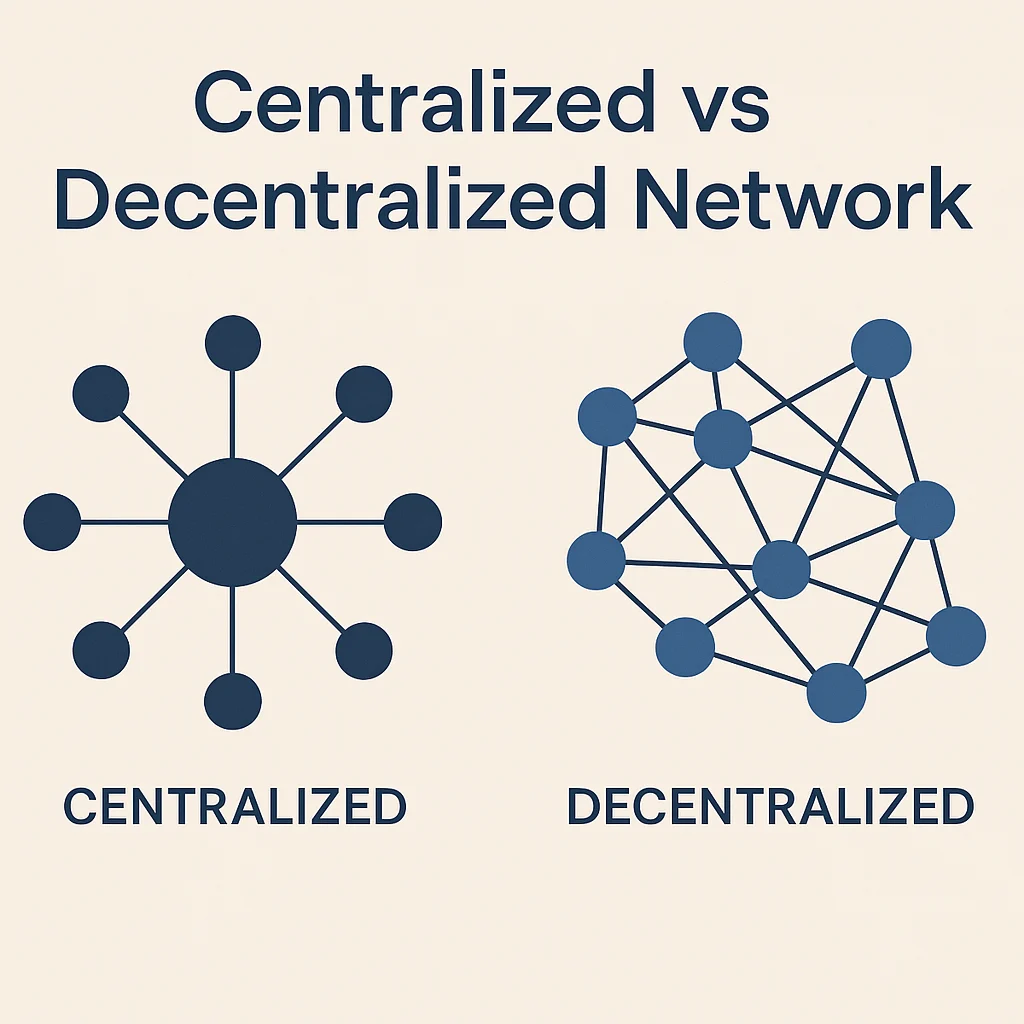
Infographic comparing centralized hub-and-spoke topology with a distributed mesh of interconnected nodes to illustrate decentralization

Real-World Examples

  • Bitcoin network operates through thousands of independent miners and nodes worldwide
  • Ethereum validators secure the network through distributed proof-of-stake consensus
  • Traditional internet vs decentralized protocols like IPFS for file storage

Why Beginners Should Care

Censorship resistance means decentralized networks can operate even when governments or corporations try to shut them down or restrict access.

Reduced single points of failure create more robust systems that continue operating even when some participants go offline or become unreliable.

Trade-off awareness as decentralization often means slower decision-making and coordination compared to centralized systems, but with greater resilience and fairness.

Related Terms: Consensus Mechanism, Node, Peer-to-Peer, Governance

Back to Crypto Glossary

Similar Posts

  • Token Burn

    Token Burn: Destroying Supply for Value Token burns permanently remove cryptocurrency from circulation by sending it to addresses where it can never be recovered. It’s digital deflation in action. Token burn is the permanent removal of cryptocurrency tokens from circulation by sending them to an unusable address or smart contract that destroys them. This reduces…

  • Gas Price

    Gas Price: Cost of Ethereum ComputingGas price determines how much you pay per unit of computational work on Ethereum. It's like setting the hourly rate for blockchain computing services.Gas price is the amount of cryptocurrency (usually measured in gwei) that users are willing to pay for each unit of gas consumed by their Ethereum transactions. Higher…

  • Soft Fork

    Soft Fork: Backward-Compatible Upgrades Soft forks tighten blockchain rules without breaking compatibility. They’re the diplomatic approach to network upgrades – everyone can still participate even if they don’t upgrade immediately. A soft fork is a backward-compatible change to blockchain protocol rules that makes previously valid blocks invalid while keeping previously invalid blocks invalid. Old nodes…

  • UTXO

    UTXO: Unspent Transaction OutputsUTXOs are like digital coins in your wallet that you haven't spent yet. Bitcoin tracks every unspent "coin" to prevent double-spending and maintain accurate balances.UTXO stands for Unspent Transaction Output – pieces of bitcoin that remain after a transaction and can be used as inputs for future transactions. Think of them as individual…

  • Yield Optimization

    Yield Optimization: Maximizing Investment ReturnsYield optimization involves strategies and protocols that automatically maximize returns on cryptocurrency investments through dynamic allocation and compounding. It's like having a financial advisor that works 24/7 to find the best returns.Yield optimization refers to automated strategies that maximize returns on cryptocurrency investments by continuously monitoring opportunities and reallocating funds to…

  • On-Chain Gaming

    On-Chain Gaming: Fully Decentralized Games On-chain gaming runs game logic entirely on blockchain networks rather than traditional servers. It’s like having board games where the rules are enforced by mathematics instead of human referees. On-chain gaming executes all game logic, state management, and interactions through smart contracts on blockchain networks. Unlike traditional games with centralized…