
Public Key

Public Key: Your Crypto Receiving Address

Your public key is like your email address for crypto – you can share it freely without security concerns.

A public key is cryptographically derived from your private key and generates your wallet addresses where others can send you cryptocurrency. It’s mathematically linked to your private key but reveals nothing about it.

How Public Keys Work

Your private key mathematically generates your public key through one-way cryptographic functions. This public key then creates your wallet addresses.

Anyone can use your public key to verify that transactions were actually signed by your private key, but they can’t work backwards to discover your private key.

It’s like a mathematical lock that only your private key can open, but everyone can verify the lock belongs to you.
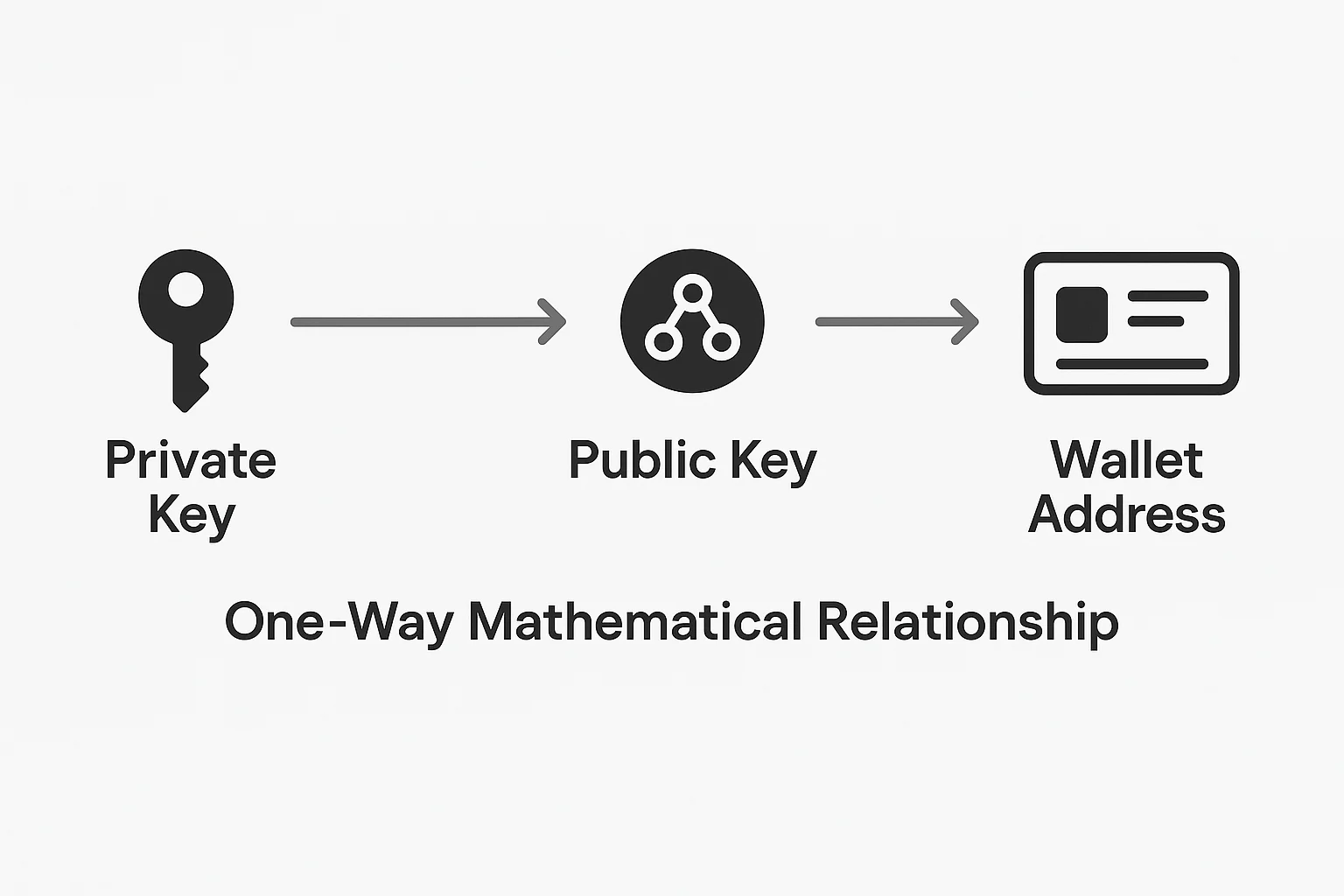
Diagram showing one-way cryptographic relationship from private key to public key to wallet address

Real-World Examples

  • Bitcoin addresses start with 1, 3, or bc1 and are derived from public keys
  • Ethereum addresses are 42-character strings starting with 0x
  • QR codes often encode public keys for easy mobile payments

Why Beginners Should Care

Understanding the private key/public key relationship helps you grasp crypto security fundamentals. Your public information (addresses) can be shared freely, while your private information (keys) must remain secret.

This cryptographic system enables trustless transactions. People can send you crypto without knowing anything about you except your public address.

Related Terms: Private Key, Wallet Address, Digital Signature, Cryptography

Back to Crypto Glossary

Similar Posts

  • Flash Loan Attack

    Flash Loan Attack: Exploiting DeFi with Borrowed CapitalFlash loan attacks use uncollateralized loans to exploit vulnerabilities in DeFi protocols for profit extraction. They're like using borrowed money to pull off elaborate heists in seconds.A flash loan attack is an exploit that uses flash loans to manipulate DeFi protocols, typically by borrowing large amounts, executing complex…

  • Supply Shock

    Supply Shock: Sudden Token Availability ChangesA supply shock occurs when cryptocurrency token supply changes dramatically and unexpectedly, often causing significant price volatility. It's like suddenly discovering a new oil field or losing access to existing reserves.A supply shock refers to a sudden, significant change in cryptocurrency token supply that disrupts market equilibrium and typically causes…

  • EVM Compatibility

    EVM Compatibility: Ethereum Code EverywhereEVM compatibility allows blockchain networks to run Ethereum applications without modification. It's like having different computers that can all run the same software.EVM compatibility refers to blockchain networks that can execute Ethereum smart contracts and support Ethereum-based applications without requiring code changes. This enables easy migration and cross-deployment of Ethereum applications.How EVM…

  • Team Doxxing

    Team Doxxing: Revealing Anonymous IdentitiesTeam doxxing involves revealing the real identities of previously anonymous cryptocurrency project team members. It's like unmasking superheroes to show who's really behind the project.Team doxxing refers to the disclosure of real identities, backgrounds, and personal information of cryptocurrency project team members who were previously anonymous or pseudonymous. This can be voluntary…

  • Wei

    Wei: Ethereum's Smallest UnitWei is the smallest denomination of Ethereum, similar to how cents are the smallest unit of dollars. It's like measuring distances in millimeters when you need precision, even though we usually think in meters or kilometers.Wei represents the smallest possible unit of Ethereum (ETH), with one ETH equal to 1,000,000,000,000,000,000 (10^18) wei. This…

  • Rebase Token

    Rebase Token: Algorithmic Supply Adjustment Rebase tokens automatically adjust their total supply to maintain target prices or economic conditions. It’s like having money that multiplies or divides to keep its buying power constant. A rebase token automatically increases or decreases the total token supply held by all users proportionally to achieve specific economic targets like…