
Staking

Staking: Earning Rewards by Holding Crypto

Staking turns your crypto into a money-making machine. Hold tokens, earn more tokens – it’s that simple. But the devil’s in the details.

Staking is the process of locking up cryptocurrency tokens to support a blockchain network’s operations and earning rewards in return. Think of it as earning interest on your crypto savings account, except the “bank” is a decentralized network.

How Staking Works

Proof-of-Stake blockchains use staking instead of energy-intensive mining. Token holders lock up their coins as collateral to validate transactions and secure the network.

The network randomly selects validators to create new blocks based on their stake size. Bigger stakes mean more chances to be chosen and earn rewards.

Staking rewards come from transaction fees and newly minted tokens. Annual yields typically range from 5-20% depending on the network and how many people are staking.
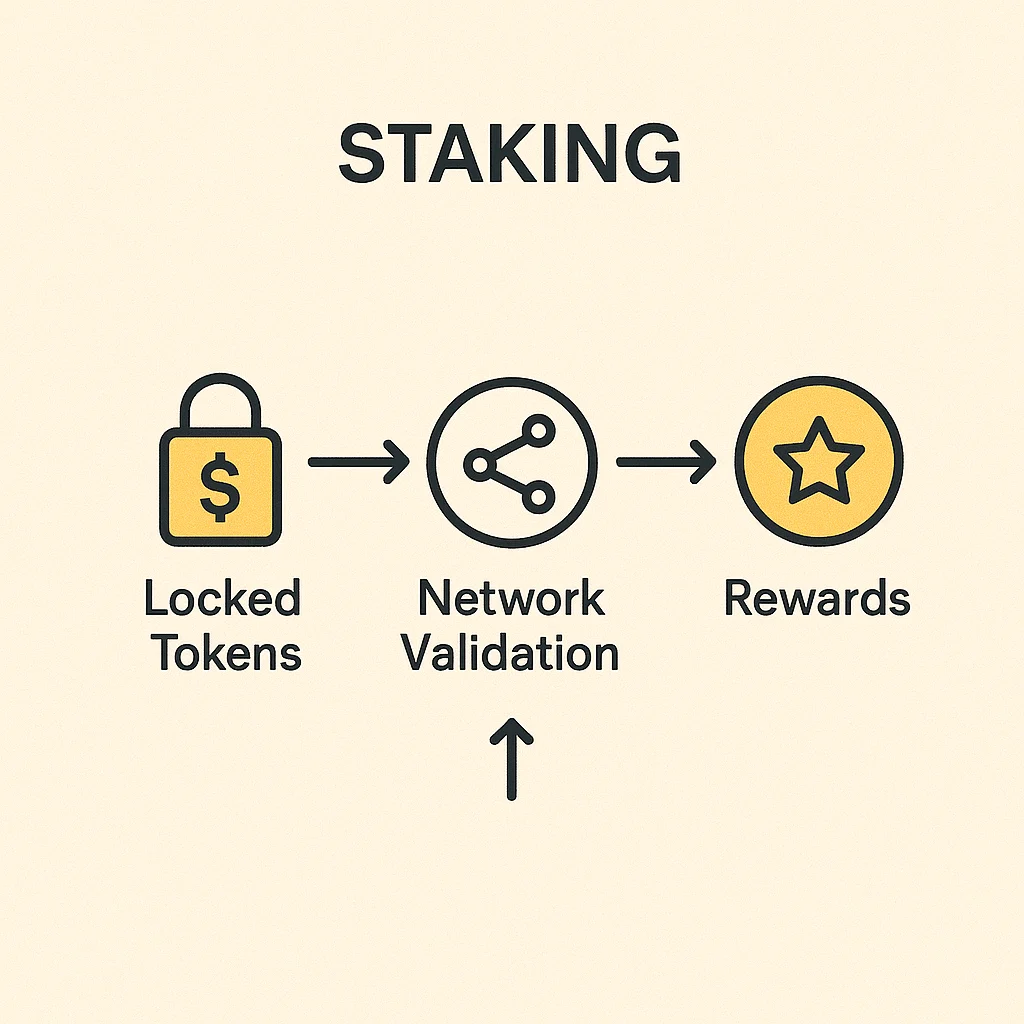
Infographic showing the staking process with locked tokens, network validation, and reward distribution

Real-World Examples

  • Ethereum 2.0 – Stake 32 ETH to run a validator node, earn ~5% annually
  • Cardano (ADA) – Delegate stake to pools, earn ~4-6% with no lockup period
  • Solana (SOL) – Stake with validators for ~6-8% rewards

Why Beginners Should Care

Staking lets your crypto work for you instead of sitting idle. It’s generally safer than yield farming because you’re supporting established networks rather than experimental protocols.

Some platforms offer liquid staking, giving you tokens representing your staked position that you can trade or use in DeFi while still earning staking rewards.

Related Terms: Proof of Stake, Validator, Yield Farming, Liquid Staking

Back to Crypto Glossary

Similar Posts

  • Secure Element

    Secure Element: Hardware Security ChipA secure element is a tamper-resistant hardware chip designed to store sensitive information like private keys. It's like having a tiny vault built into your device that's extremely difficult to break into.A secure element is a specialized hardware component designed to provide isolated, tamper-resistant storage and processing for sensitive data such…

  • Layer Separation

    Layer Separation: Modular Blockchain ArchitectureLayer separation divides blockchain functionality into distinct layers that can be optimized independently. It's like having specialized departments in a company that each focus on what they do best.Layer separation refers to blockchain architectures that divide functionality into distinct layers such as consensus, execution, and data availability, enabling independent optimization and…

  • Data Availability Layer

    Data Availability Layer: Ensuring Information Access Data availability layers ensure that blockchain data remains accessible for verification without requiring full nodes to store everything. It’s like having a library system where you can verify any book exists without storing them all. A data availability layer guarantees that blockchain transaction data is published and remains accessible…

  • Solver Network

    Solver Network: Optimized Transaction ExecutionA solver network consists of specialized entities that find optimal execution paths for complex transactions across multiple protocols and chains. They're like GPS systems that find the best routes for your crypto transactions.A solver network comprises specialized services that analyze and execute complex transactions by finding optimal paths across multiple protocols,…

  • Scaling

    Scaling: Handling More TransactionsScaling refers to increasing a blockchain network's capacity to handle more transactions per second without sacrificing security or decentralization. It's the holy grail of blockchain development.Scaling in blockchain technology involves improving transaction throughput, reducing costs, and maintaining performance as networks grow in size and usage. This typically requires technical solutions that balance speed,…

  • KYC (Know Your Customer)

    KYC (Know Your Customer): The Identity Check KYC is crypto’s concession to traditional finance. Exchanges collect your personal information to comply with government regulations and prevent money laundering. Know Your Customer (KYC) is the process of verifying customer identities through government-issued documents and personal information. Most regulated cryptocurrency exchanges require KYC before allowing significant trading…