
Halving

Halving: Cutting Block Rewards in Half

Halving events reduce block rewards by 50%, creating artificial scarcity that historically triggers major bull markets. It’s like cutting gold mining output in half overnight.

Halving is a pre-programmed event that reduces block rewards by half, typically occurring every four years or after a specific number of blocks. This mechanism controls inflation and maintains scarcity as networks mature and adoption grows.

How Halving Works

Scheduled reductions follow predetermined algorithms rather than human decisions, ensuring predictable monetary policy that can’t be manipulated by central authorities.

Supply shock occurs as new token creation suddenly drops by 50% while demand often remains constant or increases, creating upward pressure on prices.

Miner economics get disrupted as revenue cuts in half overnight. Less efficient miners may shut down, temporarily reducing network hash rate until difficulty adjusts.
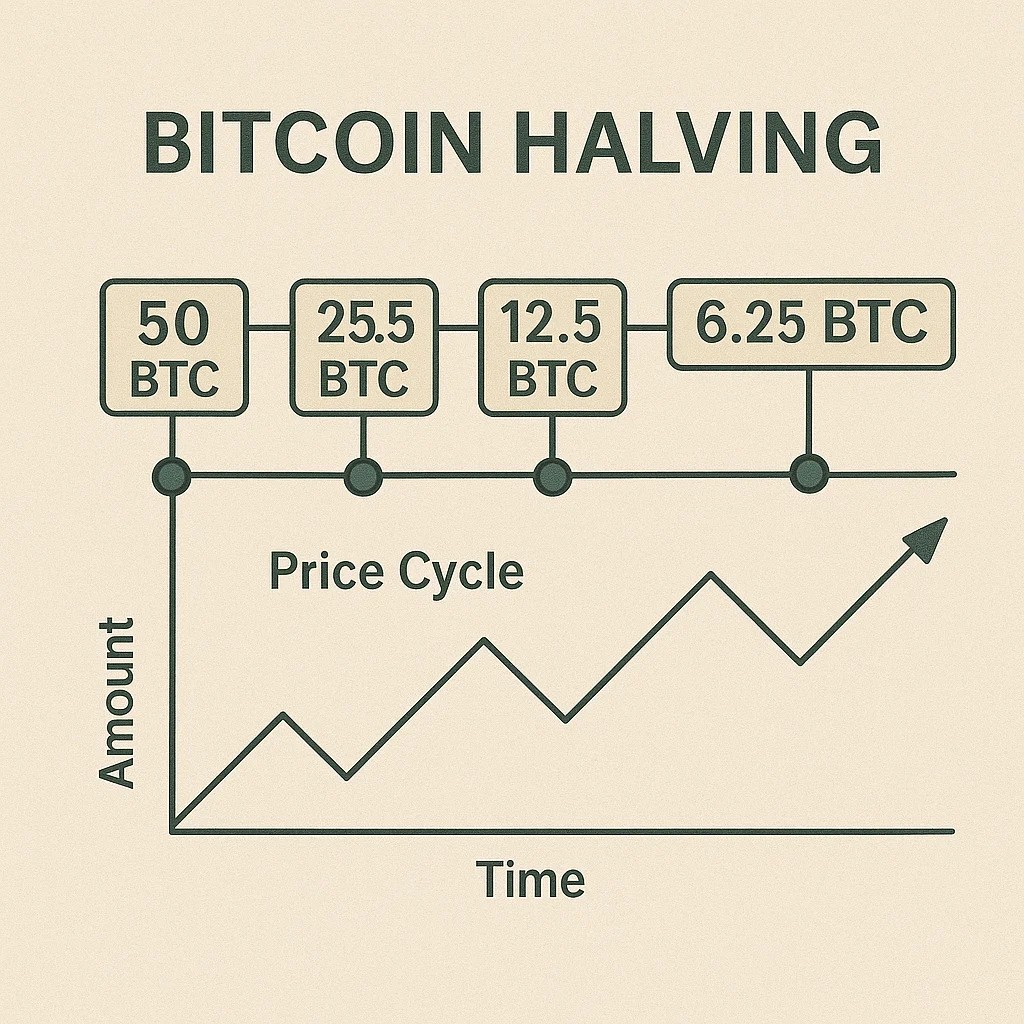
Infographic showing Bitcoin halving events with block rewards dropping from 50 to 25 to 12.5 to 6.25 BTC, along with a rising price cycle chart

Real-World Examples

  • Bitcoin halvings in 2012, 2016, and 2020 each preceded major bull markets with 10-100x price increases
  • Litecoin halving events follow similar patterns with smaller market impact due to lower adoption
  • Bitcoin Cash inherited Bitcoin’s halving schedule after the 2017 fork

Why Beginners Should Care

Price speculation often surrounds halving events as reduced supply meets existing demand, though past performance doesn’t guarantee future results.

Market timing strategies attempt to position for halving-driven price increases, but timing markets remains extremely difficult even with predictable supply changes.

Long-term scarcity increases through halving until block rewards become negligible and transaction fees become the primary miner incentive.

Related Terms: Block Reward, Mining, Supply Shock, Bull Market

Back to Crypto Glossary

Similar Posts

  • Exit Scam

    Exit Scam: When Projects Disappear With Your Money Exit scams occur when project teams abandon their platforms after raising funds, taking investor money and disappearing. It’s the digital equivalent of skipping town with the cash register. An exit scam is when cryptocurrency project developers abandon their project after raising funds from investors, typically taking user…

  • HODL

    HODL: The Art of Doing Nothing HODL started as a typo but became crypto’s most important investment strategy. Sometimes the best move is not moving at all. HODL means holding cryptocurrency long-term regardless of short-term price volatility, derived from a misspelled “hold” in a 2013 Bitcoin forum post. It represents the strategy of buying and…

  • Risk Management

    Risk Management: Protecting Your InvestmentsRisk management involves identifying, assessing, and controlling potential losses in cryptocurrency investments and activities. It's like wearing a seatbelt while driving through volatile markets.Risk management encompasses strategies and practices used to minimize potential losses and protect capital while participating in cryptocurrency markets. Effective risk management balances potential returns with acceptable loss levels.How…

  • Yield Optimization

    Yield Optimization: Maximizing Investment ReturnsYield optimization involves strategically managing cryptocurrency investments to maximize returns through automated rebalancing and strategy switching. It's like having a financial advisor that works 24/7 to find the best returns.Yield optimization refers to automated strategies and protocols that maximize returns on cryptocurrency investments by continuously monitoring and switching between different yield-generating…

  • Token Economics

    Token Economics: Digital Asset Value DesignToken economics encompasses the economic principles and mechanisms that govern cryptocurrency token value, distribution, and utility. It's like designing the economic system for a digital nation.Token economics (tokenomics) refers to the study and design of economic systems around cryptocurrency tokens, including supply mechanisms, distribution models, utility functions, and incentive structures. Good…

  • Rehypothecation

    Rehypothecation: Reusing Collateral Multiple Times Rehypothecation involves using the same collateral to back multiple obligations simultaneously. It’s like using your house as collateral for three different loans at the same time. Rehypothecation is the practice of using customer assets as collateral for the institution’s own borrowing or trading activities. In DeFi, this creates leverage and…