
Delegated Proof of Stake (DPoS)

Delegated Proof of Stake (DPoS): Democratic Validation

DPoS lets token holders vote for validators who secure the network on their behalf. It’s like electing representatives to Congress, but for blockchain consensus.

Delegated Proof of Stake (DPoS) is a consensus mechanism where token holders vote for a limited number of delegates who validate transactions and secure the network. This creates a more scalable system than pure Proof of Stake while maintaining democratic participation.

How DPoS Works

Voting power corresponds to token holdings, allowing larger stakeholders to have more influence over delegate selection while still enabling smaller holders to participate.

Fixed validator sets typically include 21-101 elected delegates who take turns producing blocks, creating faster consensus than systems with thousands of validators.

Continuous elections let token holders change their votes at any time, removing poorly performing delegates and encouraging good behavior through threat of replacement.
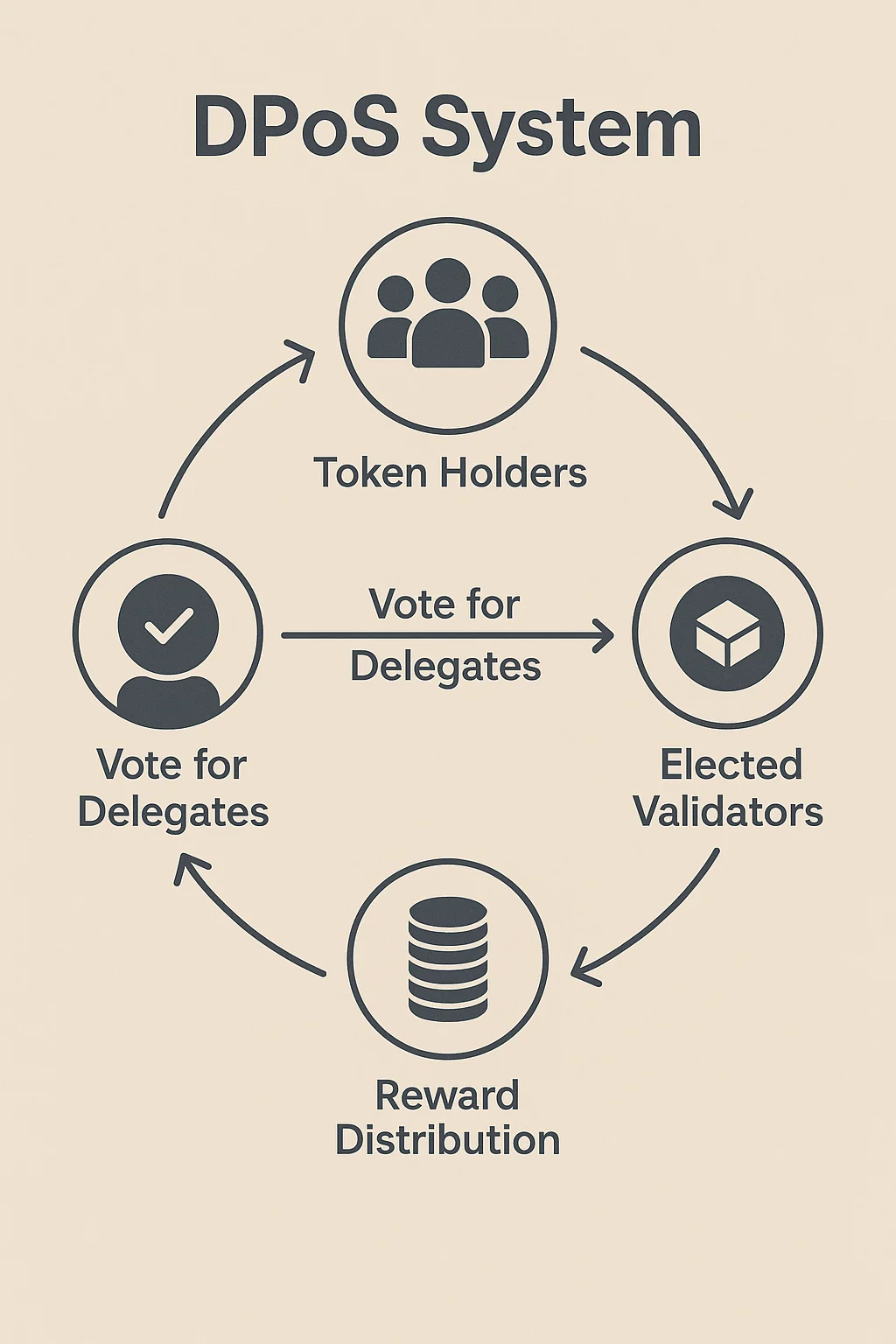
Infographic showing how Delegated Proof of Stake works, with token holders voting for delegates who become validators, produce blocks, and distribute rewards

Real-World Examples

  • EOS blockchain uses 21 elected block producers chosen by token holder voting
  • Tron (TRX) employs 27 Super Representatives elected through continuous voting
  • Lisk uses 101 delegates selected by stakeholder voting for network validation

Why Beginners Should Care

Faster transactions result from smaller validator sets that can reach consensus more quickly than systems requiring agreement from thousands of nodes.

Political dynamics emerge as delegates campaign for votes, form alliances, and compete for positions, sometimes leading to centralization concerns.

Voter apathy can concentrate power among a few large stakeholders if smaller token holders don’t actively participate in delegate selection.

Related Terms: Proof of Stake, Validator, Consensus Mechanism, Governance

Back to Crypto Glossary

Similar Posts

  • State Channel

    State Channel: Off-Chain Interaction Highways State channels enable instant, low-cost transactions between parties by moving interactions off-chain while maintaining blockchain security. It’s like having a private highway between two cities. A state channel is a two-way communication channel between blockchain users that enables off-chain transactions with on-chain security guarantees. Participants can transact instantly and cheaply,…

  • Play-to-Earn (P2E)

    Play-to-Earn (P2E): Gaming Meets Income Play-to-earn games let players earn cryptocurrency and NFTs through gameplay. It’s turned gaming from entertainment expense into potential income source for millions worldwide. Play-to-earn (P2E) is a gaming model where players earn cryptocurrency tokens, NFTs, or other digital assets with real-world value through gameplay activities. Players own in-game assets that…

  • Sequencer

    Sequencer: Transaction Order ControllerA sequencer determines the order in which transactions are processed in Layer 2 networks and some blockchain systems. It's like the traffic controller that decides which cars go through the intersection first.A sequencer is a component in Layer 2 scaling solutions that collects, orders, and batches transactions before submitting them to the…

  • Custom Blockchain

    Custom Blockchain: Purpose-Built NetworksA custom blockchain is a network designed for specific use cases rather than general-purpose applications. It's like building a specialized tool for a particular job instead of using a multi-purpose tool.A custom blockchain is a purpose-built blockchain network designed to meet specific requirements for particular applications or use cases. These networks optimize for…

  • Stable Yield

    Stable Yield: Predictable DeFi Returns Stable yield refers to DeFi strategies that provide consistent returns with lower volatility than traditional yield farming. It’s like finding the boring but reliable investment in a casino full of slot machines. Stable yield strategies focus on generating consistent returns from DeFi protocols with lower risk and volatility than high-APY…

  • Supply Schedule

    Supply Schedule: Token Issuance TimelineA supply schedule defines when and how many new tokens will be created over time. It's like a release calendar that shows exactly when new cryptocurrency will enter circulation.A supply schedule is a predetermined plan that specifies the timing and quantity of new token issuance over time. This schedule provides transparency about…