
Ledger

Ledger: Hardware Wallet Security Leader

Ledger is a leading hardware wallet company that provides secure offline storage for cryptocurrency private keys. They’re like the Fort Knox of crypto storage devices.

Ledger is a hardware wallet manufacturer that creates secure devices for storing cryptocurrency private keys offline, protecting them from online threats and hacking attempts. These devices enable secure transaction signing without exposing sensitive information.

How Ledger Devices Work

Secure element chips store private keys in tamper-resistant hardware that prevents extraction even with physical access to the device.

Offline transaction signing enables authorizing cryptocurrency transactions without connecting private keys to internet-connected computers.

Recovery mechanisms through seed phrases allow restoring wallet access if the hardware device is lost, stolen, or damaged.
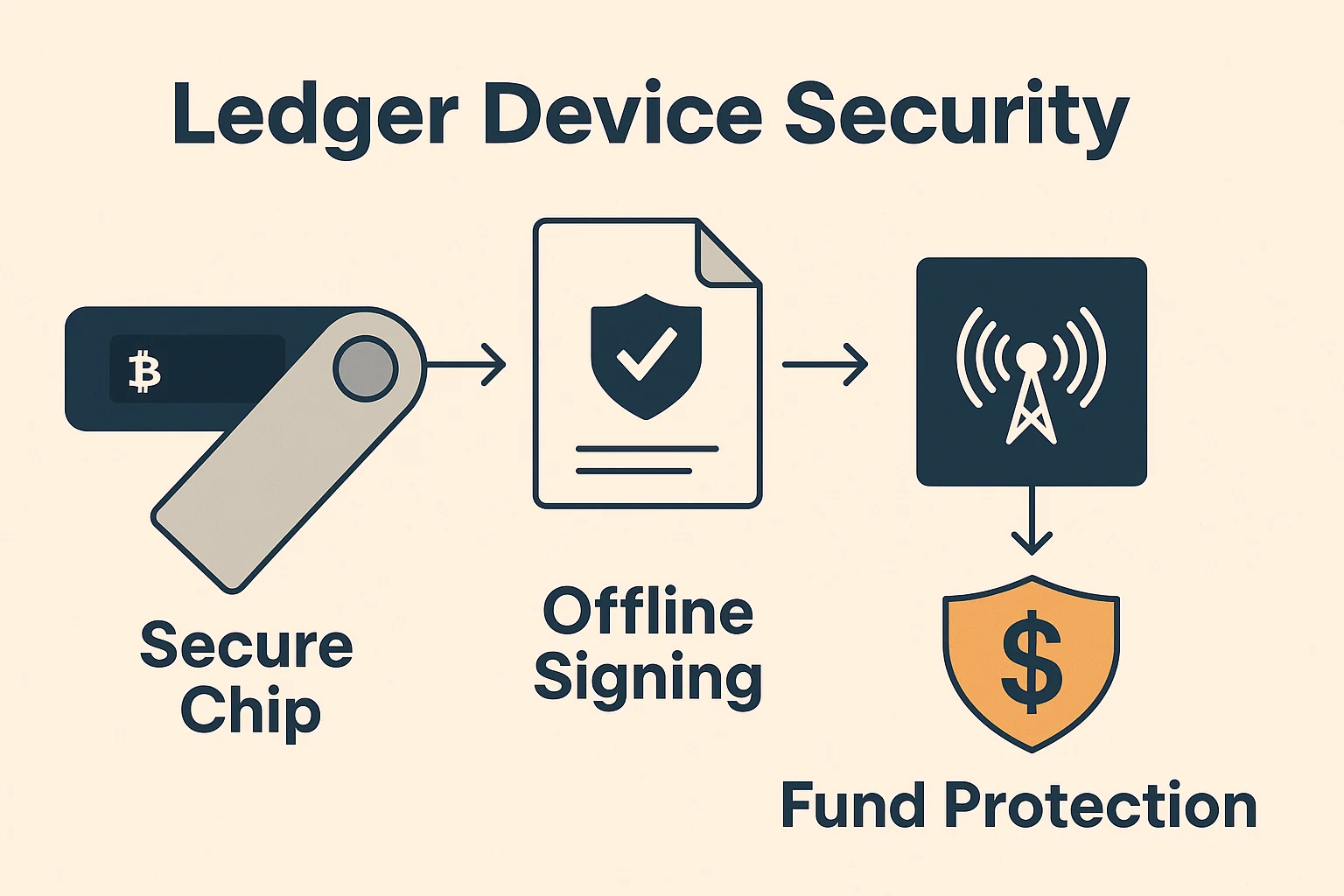
Infographic showing Ledger device flow: secure chip, offline signing, transaction broadcast, and fund protection

Real-World Examples

  • Ledger Nano S Plus provides affordable cold storage for multiple cryptocurrencies
  • Ledger Nano X offers Bluetooth connectivity for mobile device integration
  • Ledger Stax features advanced display and user interface capabilities

Why Beginners Should Care

Security enhancement over software wallets by keeping private keys offline and away from potential malware or hacking attempts.

Multi-currency support enables storing various cryptocurrencies on a single device with official wallet applications.

Industry reputation as Ledger devices are widely trusted by both beginners and institutional users for secure cryptocurrency storage.

Related Terms: Hardware Wallet, Cold Storage, Private Key, Secure Element

Back to Crypto Glossary

Similar Posts

  • Consensus Mechanism

    Consensus Mechanism: How Networks Agree Consensus mechanisms solve the fundamental problem of getting thousands of independent computers to agree on a single version of truth without central authority. A consensus mechanism is the process by which a distributed network of nodes agrees on the validity of transactions and the current state of the blockchain. It…

  • Wei

    Wei: Ethereum's Smallest UnitWei is the smallest denomination of Ethereum, similar to how cents are the smallest unit of dollars. It's like measuring distances in millimeters when you need precision, even though we usually think in meters or kilometers.Wei represents the smallest possible unit of Ethereum (ETH), with one ETH equal to 1,000,000,000,000,000,000 (10^18) wei. This…

  • Premium

    Premium: Price Above Fair ValuePremium refers to the amount by which an asset's price exceeds its underlying value or reference price. It's like paying extra for convenience or brand name compared to the basic product cost.Premium is the additional amount paid above an asset's fair value, net asset value, or reference price. In cryptocurrency markets, premiums…

  • Cryptography

    Cryptography: Mathematical Security FoundationCryptography is the mathematical science of securing information through encryption, digital signatures, and other techniques. It's the foundation that makes cryptocurrencies and blockchain technology secure and trustworthy.Cryptography refers to mathematical techniques for securing information, enabling authentication, and protecting data confidentiality through algorithms and protocols. Modern cryptocurrency systems depend entirely on cryptographic security for…

  • Airdrop

    Airdrop: Free Tokens From the Sky Airdrops distribute free tokens to wallet addresses, usually to reward early users or generate buzz for new projects. Some are worth pennies, others change lives. An airdrop is the distribution of free cryptocurrency tokens to wallet addresses, typically as a marketing strategy, reward for early adoption, or method of…

  • Rollups

    Rollups: Scaling Through Bundling Rollups process hundreds of transactions off-chain then bundle the results into single on-chain transactions. It’s like carpooling for blockchain transactions – everyone shares the gas costs. Rollups are Layer 2 scaling solutions that execute transactions off the main blockchain but post transaction data on-chain for security. They inherit the security of…