
Atomic Swap

Atomic Swap: Trustless Cross-Chain Trading

Atomic swaps enable direct trading between different cryptocurrencies without exchanges or intermediaries. Either both trades complete successfully, or neither happens – no middle ground.

An atomic swap is a smart contract technology that enables the exchange of cryptocurrencies from different blockchains without requiring a trusted third party. The swap either completes entirely for both parties or fails completely, preventing partial execution.

How Atomic Swaps Work

Hash time-locked contracts (HTLCs) create conditional payments that require cryptographic proof to unlock funds within specific time limits. This ensures both parties fulfill their obligations.

Cross-chain compatibility requires both cryptocurrencies to support the same hashing algorithm and basic smart contract functionality for the swap mechanism to work.

Time locks prevent one party from receiving funds without completing their side of the trade. If the swap isn’t completed within the time limit, both parties can reclaim their original funds.
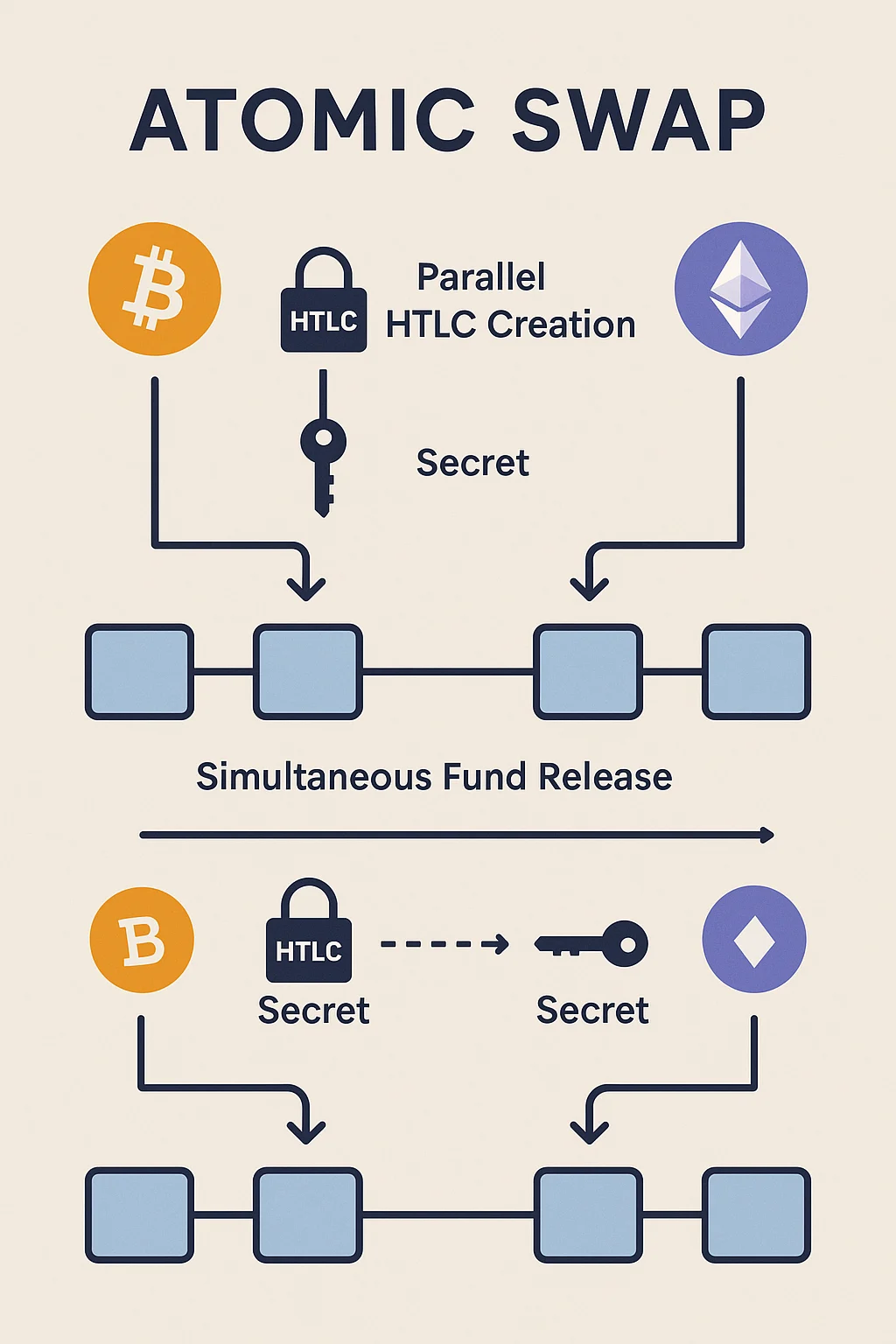
Infographic showing the atomic swap process: parallel HTLC creation, secret revelation, and simultaneous fund release on two blockchains

Real-World Examples

  • Lightning Network enables Bitcoin atomic swaps with compatible cryptocurrencies
  • Komodo pioneered atomic swap technology for cross-chain decentralized exchange
  • Ethereum-Bitcoin swaps require specialized implementations due to different scripting capabilities

Why Beginners Should Care

Decentralized trading eliminates counterparty risk from centralized exchanges while enabling direct peer-to-peer cryptocurrency exchanges across different blockchains.

Technical limitations currently restrict atomic swaps to cryptocurrencies with compatible features, excluding many popular tokens from direct swap capabilities.

User experience remains complex compared to centralized exchanges, requiring technical knowledge and longer settlement times for successful swaps.

Related Terms: Smart Contract, Cross-Chain, HTLC, DEX

Back to Crypto Glossary

Similar Posts

  • Price Manipulation

    Price Manipulation: Artificial Market DistortionPrice manipulation involves artificially influencing asset prices through coordinated trading, false information, or market abuse. It's financial fraud adapted for the crypto age.Price manipulation refers to illegal or unethical activities designed to artificially inflate or deflate cryptocurrency prices for profit. These activities exploit market inefficiencies and harm other investors through deceptive practices.How…

  • Token Launch

    Token Launch: Cryptocurrency Project DebutA token launch is the initial release of a new cryptocurrency token to the public market. It's like a product launch where a company introduces a new product, but for digital currencies instead of physical goods.Token launch refers to the process of introducing a new cryptocurrency token to the market, including…

  • Market Cycle

    Market Cycle: Recurring Price PatternsMarket cycles are recurring patterns of price movements in cryptocurrency markets driven by investor psychology and market dynamics. They're like seasons that markets go through repeatedly over time.Market cycles refer to recurring patterns of price appreciation and depreciation in cryptocurrency markets driven by alternating periods of optimism and pessimism among investors. These…

  • Mobile Wallet

    Mobile Wallet: Cryptocurrency on Your PhoneMobile wallets are smartphone applications that store, send, and receive cryptocurrency. They're like having a digital bank in your pocket with global reach.A mobile wallet is a smartphone application that enables users to store, manage, and transact with cryptocurrencies directly from their mobile devices. These wallets prioritize convenience and accessibility for…

  • Consensus Mechanism

    Consensus Mechanism: How Networks Agree Consensus mechanisms solve the fundamental problem of getting thousands of independent computers to agree on a single version of truth without central authority. A consensus mechanism is the process by which a distributed network of nodes agrees on the validity of transactions and the current state of the blockchain. It…

  • Treasury

    Treasury: Protocol Fund ManagementA treasury is a fund controlled by cryptocurrency projects or DAOs for development, operations, and community initiatives. It's like a company's bank account that's managed by community voting instead of executives.A treasury refers to cryptocurrency funds held and managed by protocols, DAOs, or projects for operational expenses, development funding, and community initiatives. These…