
AI Coins

AI Coins: Cryptocurrency Meets Artificial Intelligence

AI coins are cryptocurrencies focused on artificial intelligence applications, data marketplaces, or computational resources for machine learning. They’re betting that AI and crypto will merge into something bigger than both.

AI coins are cryptocurrencies that facilitate artificial intelligence development, deployment, or monetization through decentralized networks. These tokens enable AI model training, data sharing, computational marketplace access, or AI-generated content creation.

How AI Coins Work

Computational marketplaces connect users who need AI processing power with providers who have idle GPU resources, using tokens for payment.

Data monetization enables individuals to sell training data for AI models while maintaining privacy through cryptographic techniques.

Decentralized AI models can be trained and operated across distributed networks, with token incentives for participants who contribute resources.
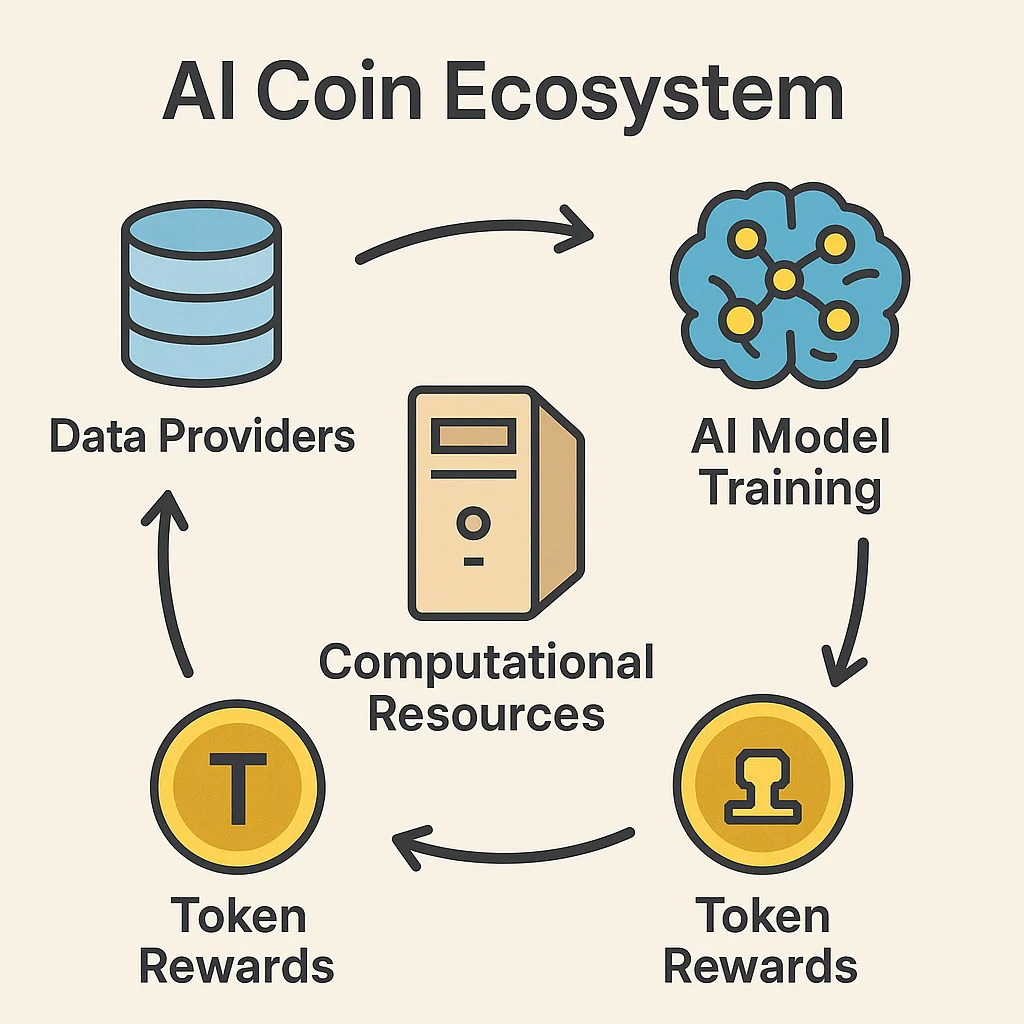
Infographic showing AI coin ecosystem with data providers, computational resources, AI model training, and token rewards flow

Real-World Examples

  • Render Network (RNDR) provides distributed GPU rendering for AI and graphics applications
  • Ocean Protocol creates data marketplaces for AI training while preserving privacy
  • Fetch.ai builds autonomous economic agents that use tokens for AI-driven services

Why Beginners Should Care

Early speculation on AI coin valuations often outpaces actual utility development, creating high volatility and risk for investors.

Real utility potential exists as AI development requires massive computational resources and data that decentralized networks could provide more efficiently.

Regulatory uncertainty around both AI development and cryptocurrency creates additional complexity for projects operating in both spaces.

Related Terms: Utility Token, Data Marketplace, Computational Mining, Decentralized Computing

Back to Crypto Glossary

Similar Posts

  • Bonding Curve

    Bonding Curve: Algorithmic Token Pricing Bonding curves use mathematical formulas to automatically price tokens based on supply. As more tokens get bought, prices increase predictably according to the curve’s formula. A bonding curve is an algorithmic pricing mechanism that determines token price based on token supply through a mathematical function. Prices increase as supply grows…

  • Native Interop

    Native Interop: Built-in Cross-Chain CommunicationNative interoperability refers to blockchain networks designed from the ground up to communicate with other chains without requiring external bridges or intermediaries. It's like speaking multiple languages fluently.Native interoperability describes blockchain architectures that include cross-chain communication capabilities as core features rather than external additions. These systems can interact with other networks through…

  • Secure Element

    Secure Element: Hardware Security ChipA secure element is a tamper-resistant hardware chip designed to store sensitive information like private keys. It's like having a tiny vault built into your device that's extremely difficult to break into.A secure element is a specialized hardware component designed to provide isolated, tamper-resistant storage and processing for sensitive data such…

  • KYC (Know Your Customer)

    KYC (Know Your Customer): The Identity Check KYC is crypto’s concession to traditional finance. Exchanges collect your personal information to comply with government regulations and prevent money laundering. Know Your Customer (KYC) is the process of verifying customer identities through government-issued documents and personal information. Most regulated cryptocurrency exchanges require KYC before allowing significant trading…

  • Staking

    Staking: Earning Rewards by Holding Crypto Staking turns your crypto into a money-making machine. Hold tokens, earn more tokens – it’s that simple. But the devil’s in the details. Staking is the process of locking up cryptocurrency tokens to support a blockchain network’s operations and earning rewards in return. Think of it as earning interest…

  • Time-Weighted Average Price (TWAP)

    Time-Weighted Average Price (TWAP): Manipulation-Resistant Pricing TWAP calculates asset prices over extended time periods to resist manipulation and provide more stable price references for protocols. It’s like taking your temperature every hour instead of just once. Time-Weighted Average Price (TWAP) is a pricing mechanism that calculates the average price of an asset over a specific…