
Data Availability Layer

Data Availability Layer: Ensuring Information Access

Data availability layers ensure that blockchain data remains accessible for verification without requiring full nodes to store everything. It’s like having a library system where you can verify any book exists without storing them all.

A data availability layer guarantees that blockchain transaction data is published and remains accessible for verification, even if not all nodes store complete copies. This enables scalable architectures while maintaining security guarantees.

How Data Availability Works

Data publication requires block producers to make transaction data publicly available, even if execution happens elsewhere or in summarized form.

Availability proofs use cryptographic techniques like data availability sampling to verify data accessibility without downloading complete datasets.

Fraud prevention ensures malicious actors cannot hide transaction data that would enable verification of incorrect state transitions or invalid blocks.
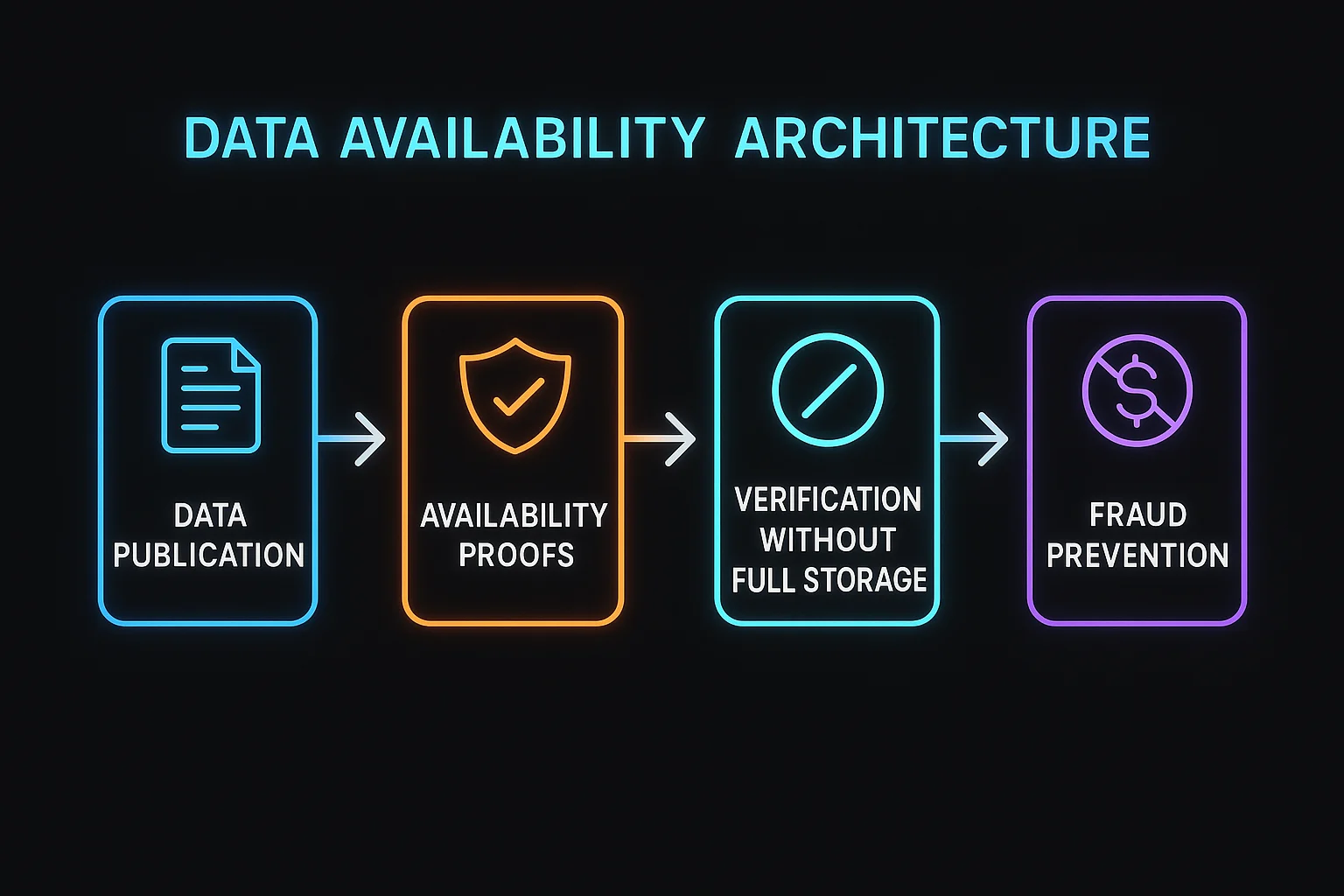
Data availability architecture showing data publication, availability proofs, verification without full storage, and fraud prevention

Real-World Examples

  • Celestia provides dedicated data availability services for modular blockchain architectures
  • Ethereum serves as a data availability layer for various Layer 2 rollup solutions
  • Polygon Avail offers scalable data availability for sovereign blockchain networks

Why Beginners Should Care

Scalability enablement through data availability layers that support much higher transaction throughput than traditional blockchain architectures.

Security preservation maintains verification capabilities and fraud detection without requiring all participants to store complete blockchain histories.

Technical complexity in understanding how data availability relates to overall blockchain security and decentralization properties.

Related Terms: Modular Blockchain, Data Sampling, Fraud Proof, Scalability

Back to Crypto Glossary

Similar Posts

  • 51% Attack

    51% Attack: When Consensus Gets Hijacked A 51% attack occurs when a single entity controls the majority of a network’s mining power or stake, allowing them to manipulate transactions and double-spend coins. A 51% attack is when an individual or group controls more than half of a blockchain network’s mining hash rate or staking power,…

  • Two Way Peg

    Two Way Peg: Bidirectional Asset TransferA two-way peg enables moving assets between different blockchain networks in both directions while maintaining value equivalence. It's like having a currency exchange that works both ways between different countries.A two-way peg is a mechanism that allows assets to move freely between two blockchain networks while maintaining equivalent value on…

  • Storage Rent

    Storage Rent: Pay-per-Use Blockchain StorageStorage rent is a proposed mechanism where users pay ongoing fees for maintaining data on blockchain networks. It's like paying monthly rent for keeping files in cloud storage instead of a one-time purchase.Storage rent refers to fee mechanisms that charge users for ongoing blockchain storage rather than allowing permanent storage after…

  • Gwei

    Gwei: Ethereum’s Gas Price Unit Gwei is the denomination used for Ethereum gas prices. Understanding gwei helps you avoid overpaying for transactions when the network gets congested. Gwei (gigawei) is a unit of Ethereum’s native currency equal to one billionth of an ETH (10^-9 ETH). It’s the standard unit for expressing gas prices, making it…

  • Token Lockup

    Token Lockup: Preventing Early Selling Token lockups prevent allocated tokens from being sold or transferred for specific time periods. It’s like putting your poker winnings in a time-locked safe to prevent impulse spending. Token lockup is a mechanism that prevents token holders from selling, transferring, or accessing their tokens until predetermined conditions are met. Lockups…

  • Transaction Cost

    Transaction Cost: The Price of Blockchain OperationsTransaction cost refers to the total expense of executing operations on blockchain networks, including fees, gas, and opportunity costs. It's the price you pay for using decentralized financial infrastructure.Transaction cost encompasses all expenses associated with executing blockchain operations, including network fees, gas costs, slippage, and time value. Understanding total transaction…