
Decentralized Exchange (DEX)

Decentralized Exchange (DEX): Trading Without Middlemen

DEXs are what happens when you remove the corporate overlords from crypto trading. No account required, no permission needed – just you, your wallet, and the market.

A decentralized exchange (DEX) is a cryptocurrency trading platform that operates without a central authority controlling user funds. You trade directly from your wallet using smart contracts that automatically execute trades when conditions are met.

How DEXs Work

Instead of depositing funds into an exchange account, you connect your wallet directly to the DEX. Smart contracts hold the trading logic and automatically swap tokens when you make a trade.

Liquidity pools replace traditional order books. Users deposit token pairs into pools, earning fees when others trade against their liquidity. No market makers, no trading desks – just code and math.

Your funds never leave your control until the exact moment of the trade. No KYC forms, no account freezes, no “maintenance” that locks you out during market crashes.
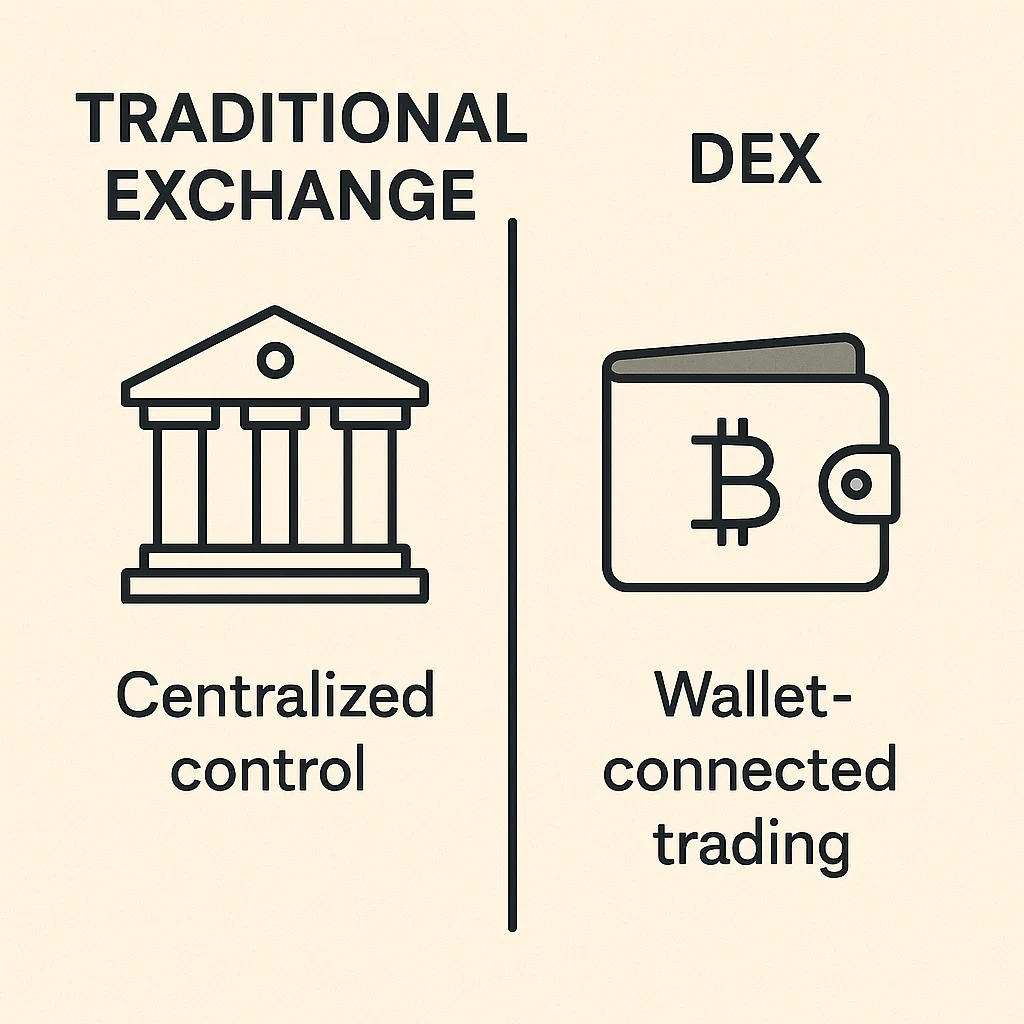
Side-by-side comparison of a traditional crypto exchange and a DEX, showing centralized control vs wallet-connected trading

Real-World Examples

  • Uniswap – Largest DEX on Ethereum with billions in trading volume
  • PancakeSwap – Popular DEX on Binance Smart Chain with lower fees
  • SushiSwap – Community-owned DEX with governance tokens

Why Beginners Should Care

DEXs give you true financial sovereignty. No exchange can freeze your account, require additional verification, or shut down withdrawals when markets get volatile.

The trade-off is complexity – DEX interfaces assume you understand gas fees, slippage, and wallet management. Start small and practice before committing serious money.

Related Terms: Smart Contract, Liquidity Pool, Gas Fees, Exchange

Back to Crypto Glossary

Similar Posts

  • NFT Gaming

    NFT Gaming: Blockchain-Based Digital GamingNFT gaming integrates non-fungible tokens into video games to enable true ownership of in-game assets. It's like owning actual collectible cards that you can trade with anyone, use in multiple games, and keep forever regardless of what happens to the original game.NFT gaming refers to video games that utilize non-fungible tokens…

  • Layer Separation

    Layer Separation: Modular Blockchain ArchitectureLayer separation divides blockchain functionality into distinct layers that can be optimized independently. It's like having specialized departments in a company that each focus on what they do best.Layer separation refers to blockchain architectures that divide functionality into distinct layers such as consensus, execution, and data availability, enabling independent optimization and…

  • Recovery

    Recovery: Restoring Access to Crypto AssetsRecovery refers to methods for regaining access to cryptocurrency wallets and accounts when primary access methods are lost or compromised. It's like having spare keys for your digital vault.Recovery encompasses various mechanisms for restoring access to cryptocurrency wallets, accounts, or assets when primary authentication methods like passwords or devices are…

  • UTXO

    UTXO: Unspent Transaction OutputsUTXOs are like digital coins in your wallet that you haven't spent yet. Bitcoin tracks every unspent "coin" to prevent double-spending and maintain accurate balances.UTXO stands for Unspent Transaction Output – pieces of bitcoin that remain after a transaction and can be used as inputs for future transactions. Think of them as individual…

  • Delegation

    Delegation: Assigning Voting or Staking RightsDelegation allows token holders to assign their voting power or staking rights to other participants while retaining ownership. It's like giving someone your vote without giving them your tokens.Delegation refers to assigning voting rights, staking authority, or other token-based powers to third parties while maintaining ownership of the underlying tokens. This…

  • Time-Weighted Average Price (TWAP)

    Time-Weighted Average Price (TWAP): Manipulation-Resistant Pricing TWAP calculates asset prices over extended time periods to resist manipulation and provide more stable price references for protocols. It’s like taking your temperature every hour instead of just once. Time-Weighted Average Price (TWAP) is a pricing mechanism that calculates the average price of an asset over a specific…