
Total Value Locked (TVL)

Total Value Locked (TVL): DeFi’s Scorecard

TVL measures how much money is deposited in DeFi protocols. It’s like measuring the size of a bank by its total deposits – bigger usually means more trust and activity.

Total Value Locked (TVL) is the aggregate value of all assets deposited in a DeFi protocol or across the entire DeFi ecosystem. It represents how much capital users have entrusted to smart contracts for lending, trading, or yield farming.

How TVL Works

Asset valuation uses current market prices to calculate the dollar value of all deposited tokens. A protocol holding 1000 ETH at $2000 per ETH has $2 million TVL.

Double counting can inflate numbers when protocols build on each other. If Protocol A deposits funds into Protocol B, both might count the same assets toward their TVL.

TVL growth indicates increasing user confidence and adoption. Protocols with growing TVL typically offer competitive yields or innovative features attracting more deposits.
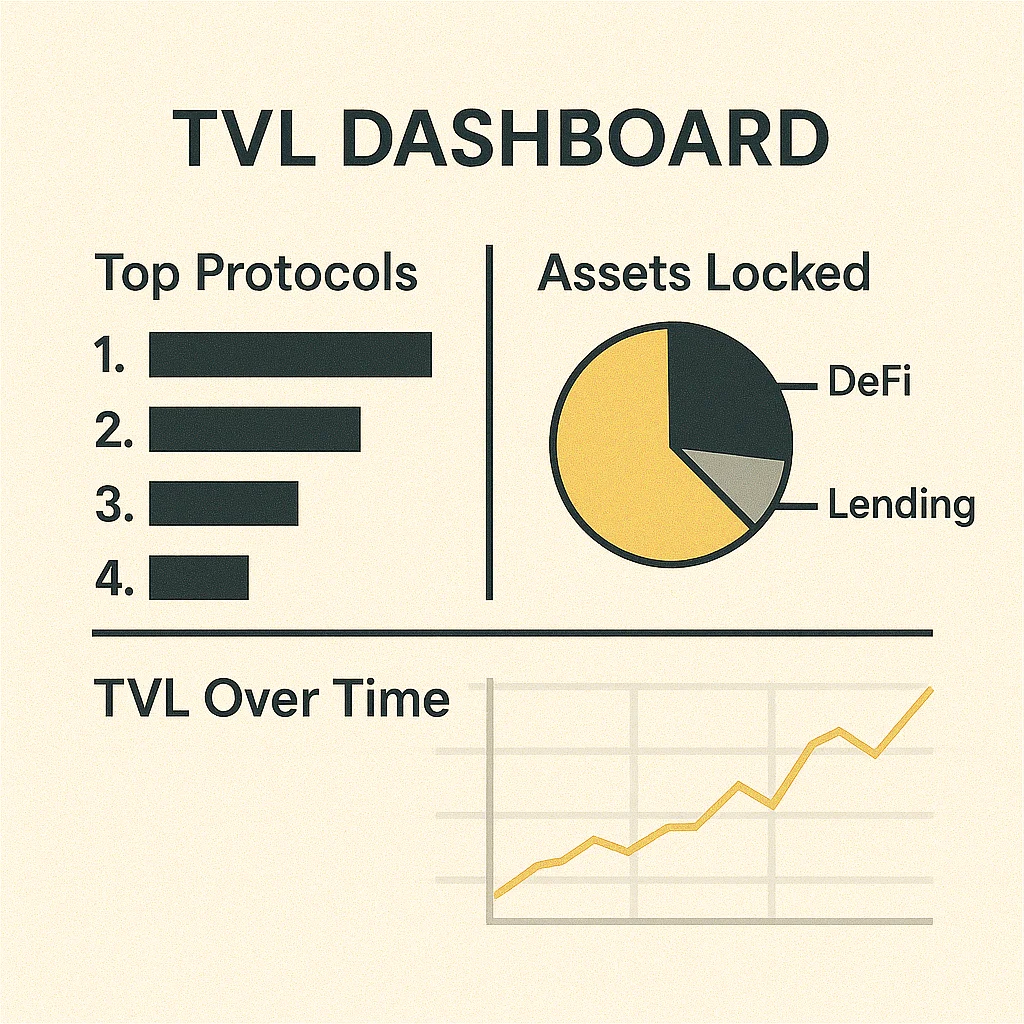
Infographic dashboard showing TVL rankings by protocol, asset categories (DeFi, Lending), and a historical growth line chart

Real-World Examples

  • Aave – Leading lending protocol with $10+ billion TVL across multiple chains
  • Uniswap – Largest DEX with $4+ billion in liquidity pools
  • Total DeFi TVL peaked at $180+ billion in 2021, currently around $50 billion

Why Beginners Should Care

TVL indicates protocol maturity and user trust. Protocols with higher TVL have more battle-tested smart contracts and established user bases.

Yield dilution often accompanies TVL growth. Early adopters earn higher yields that decrease as more users deposit funds and compete for the same rewards.

TVL crashes during bear markets or protocol exploits can signal fundamental problems or broader market stress affecting the entire DeFi ecosystem.

Related Terms: DeFi, Liquidity Pool, Yield Farming, Smart Contract

Back to Crypto Glossary

Similar Posts

  • Order Book

    Order Book: Market Trading QueueAn order book displays all buy and sell orders for a trading pair, showing market depth and price discovery. It's like a transparent auction house where everyone can see all bids and offers.An order book is a real-time list of buy and sell orders for a specific trading pair, organized by…

  • Structured Products

    Structured Products: Complex Financial InstrumentsStructured products combine multiple financial instruments to create customized risk-return profiles for specific investment objectives. They're like elaborate recipe combinations that mix different financial ingredients to create unique investment flavors tailored to particular tastes.Structured products are complex financial instruments that combine derivatives, traditional assets, or cryptocurrencies to create customized investment products…

  • Rollup-as-a-Service (RaaS)

    Rollup-as-a-Service (RaaS): Custom Blockchain Infrastructure RaaS platforms provide infrastructure for deploying custom rollups without building all the technical components from scratch. It’s like having a franchise model for blockchain networks. Rollup-as-a-Service (RaaS) provides infrastructure and tooling for organizations to deploy their own application-specific rollups without deep blockchain development expertise. These platforms handle the technical complexity…

  • Decentralized Identity (DID)

    Decentralized Identity (DID): Self-Sovereign Digital Identity DIDs give users control over their digital identity without relying on centralized authorities like governments or tech companies. It’s like having a passport that you issue and control yourself. Decentralized Identity (DID) is a digital identity framework that gives individuals control over their personal data and identity verification without…

  • Price Manipulation

    Price Manipulation: Artificial Market DistortionPrice manipulation involves artificially influencing asset prices through coordinated trading, false information, or market abuse. It's financial fraud adapted for the crypto age.Price manipulation refers to illegal or unethical activities designed to artificially inflate or deflate cryptocurrency prices for profit. These activities exploit market inefficiencies and harm other investors through deceptive practices.How…

  • Tokenization

    Tokenization: Converting Assets into Digital Tokens Tokenization transforms real-world assets into blockchain-based tokens that can be traded, divided, and managed digitally. It’s like turning everything into tradeable game pieces. Tokenization is the process of converting ownership rights to assets into digital tokens on a blockchain. This enables fractional ownership, easier trading, and programmable functionality for…