
DeFi Composability

DeFi Composability: Building Block Finance

DeFi composability allows protocols to integrate seamlessly, creating complex financial products by combining simpler components. It’s like financial Lego blocks that snap together perfectly.

DeFi composability refers to the ability of decentralized finance protocols to interact and build upon each other, creating more complex financial products through modular integration. This enables innovation through combining existing building blocks.

How DeFi Composability Works

Standardized interfaces like ERC-20 tokens and common smart contract patterns enable protocols to interact without custom integration work.

Permissionless innovation allows anyone to build on existing protocols without asking permission, creating rapid ecosystem development.

Yield stacking combines multiple protocols to optimize returns, such as lending tokens that earn yield while being used as collateral elsewhere.
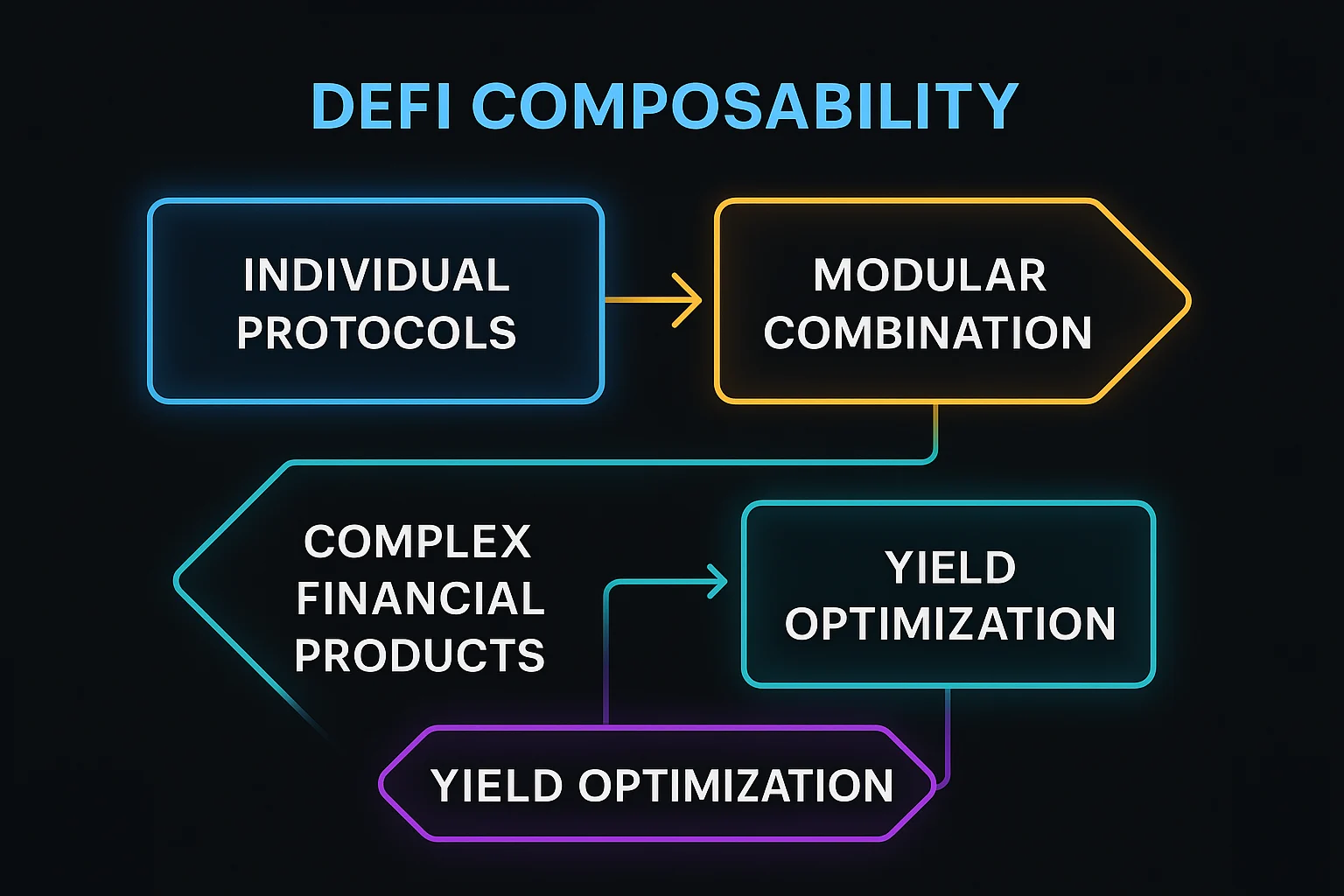
DeFi composability diagram showing individual protocols, modular combination, complex financial products, and yield optimization

Real-World Examples

  • Yearn Finance combines lending, farming, and trading protocols to optimize yields automatically
  • Convex Finance builds on Curve to enhance liquidity mining rewards
  • Index protocols create diversified portfolios using multiple DeFi primitives

Why Beginners Should Care

Innovation acceleration as new protocols can leverage existing infrastructure rather than rebuilding everything from scratch.

Systemic risks from interconnected protocols where failures can cascade across multiple applications and user positions.

Complexity management becomes crucial as composed strategies may be difficult to understand and evaluate for risk.

Related Terms: DeFi Primitives, Yield Stacking, Smart Contract

Back to Crypto Glossary

Similar Posts

  • Supply

    Supply: Total Token Quantity AvailableSupply refers to the total amount of cryptocurrency tokens available, including those in circulation, locked up, or held by various parties. It's a fundamental economic factor affecting token value.Supply encompasses all cryptocurrency tokens that exist or will exist, including circulating supply available for trading and locked supply held by teams, investors,…

  • Token Approval

    Token Approval: Granting Spending PermissionToken approval allows smart contracts to spend tokens on behalf of users through explicit permission mechanisms. It's like giving someone permission to use your credit card with specific spending limits.Token approval is a mechanism that grants smart contracts permission to transfer specific amounts of tokens from user wallets without requiring signatures…

  • Exit Scam

    Exit Scam: When Projects Disappear With Your Money Exit scams occur when project teams abandon their platforms after raising funds, taking investor money and disappearing. It’s the digital equivalent of skipping town with the cash register. An exit scam is when cryptocurrency project developers abandon their project after raising funds from investors, typically taking user…

  • Back Running

    Back Running: Following Profitable TransactionsBack running involves placing transactions immediately after profitable transactions to capture secondary opportunities. It's like following successful traders to pick up the crumbs they leave behind.Back running is a MEV extraction strategy where bots place transactions immediately after profitable transactions to capture residual value or secondary opportunities. This technique exploits the predictable…

  • Satoshi

    Satoshi: Bitcoin's Smallest UnitA satoshi is the smallest unit of bitcoin, equal to 0.00000001 BTC. It's named after Bitcoin's pseudonymous creator and makes bitcoin divisible for everyday transactions.A satoshi (sat) is the smallest divisible unit of bitcoin, representing one hundred millionth of a bitcoin. This granular divisibility enables bitcoin to function as digital cash for transactions…

  • Sidechain

    Sidechain: Independent Chains with Main Chain Connections Sidechains operate independently while maintaining bridges to main blockchains. They’re like having a separate express lane that connects back to the main highway when needed. A sidechain is an independent blockchain that runs parallel to a main blockchain and is connected through a two-way bridge allowing asset transfers….