
Gas Limit

Gas Limit: Setting Your Transaction Budget

Gas limit is the maximum amount of gas you’re willing to spend on a transaction. Set it too low and your transaction fails. Set it too high and you overpay for simple operations.

Gas limit is the maximum amount of computational work (measured in gas units) that a user is willing to pay for when submitting a transaction to the Ethereum network. It acts as a safety mechanism preventing runaway smart contracts from draining your wallet.

How Gas Limit Works

Computational budgeting ensures transactions can’t consume unlimited resources. Each operation in smart contracts has a predefined gas cost, and the total can’t exceed your set limit.

Transaction failure occurs if operations require more gas than your limit allows. You still pay for gas consumed up to the failure point, but the transaction doesn’t complete.

Estimation tools in wallets automatically suggest appropriate gas limits based on transaction complexity, though users can adjust these recommendations manually.
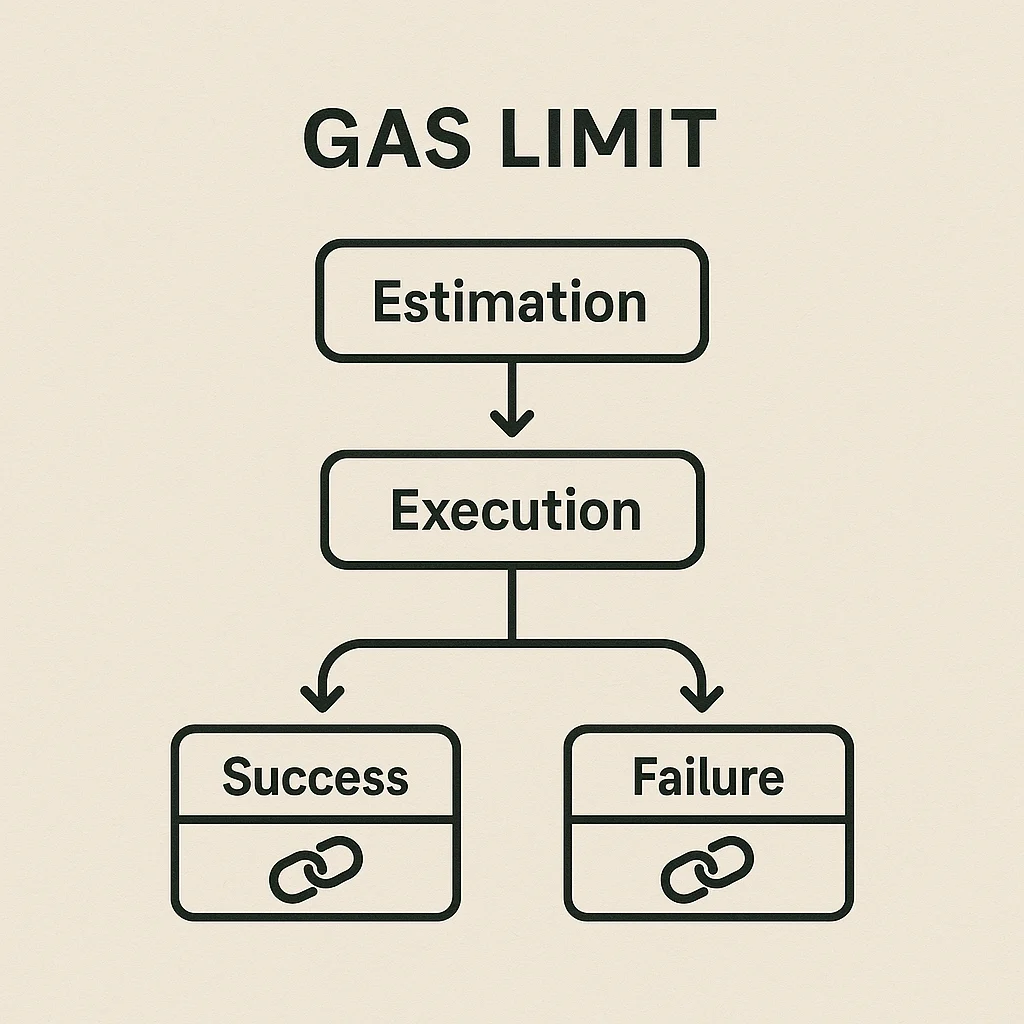
Infographic showing gas limit transaction flow from estimation to execution and outcome of success or failure

Real-World Examples

  • Simple ETH transfers typically need 21,000 gas limit
  • DEX swaps might require 150,000-300,000 gas depending on complexity
  • Complex DeFi operations can need 500,000+ gas for multi-step transactions

Why Beginners Should Care

Failed transactions still cost money if they run out of gas, so understanding appropriate limits prevents wasted fees on unsuccessful operations.

Overpaying happens when gas limits are set much higher than needed. Unused gas gets refunded, but setting reasonable limits prevents tying up excess funds.

Network congestion affects optimal gas limit strategies. During high demand, slightly higher limits can prevent failures when network conditions change between submission and execution.

Related Terms: Gas Fees, Gas Price, Smart Contract, Transaction

Back to Crypto Glossary

Similar Posts

  • Total Value Locked (TVL)

    Total Value Locked (TVL): DeFi’s Scorecard TVL measures how much money is deposited in DeFi protocols. It’s like measuring the size of a bank by its total deposits – bigger usually means more trust and activity. Total Value Locked (TVL) is the aggregate value of all assets deposited in a DeFi protocol or across the…

  • Order Book

    Order Book: Market Trading QueueAn order book displays all buy and sell orders for a trading pair, showing market depth and price discovery. It's like a transparent auction house where everyone can see all bids and offers.An order book is a real-time list of buy and sell orders for a specific trading pair, organized by…

  • Delegation

    Delegation: Assigning Voting or Staking RightsDelegation allows token holders to assign their voting power or staking rights to other participants while retaining ownership. It's like giving someone your vote without giving them your tokens.Delegation refers to assigning voting rights, staking authority, or other token-based powers to third parties while maintaining ownership of the underlying tokens. This…

  • Stealth Address

    Stealth Address: Private Payment DestinationsStealth addresses create unique, one-time addresses for each transaction to enhance privacy by breaking the link between payments and recipient identities. They're like using a different PO box for every package delivery so no one can track all your mail to the same location.Stealth addresses are unique, one-time payment destinations generated…

  • Two Way Peg

    Two Way Peg: Bidirectional Asset TransferA two-way peg enables moving assets between different blockchain networks in both directions while maintaining value equivalence. It's like having a currency exchange that works both ways between different countries.A two-way peg is a mechanism that allows assets to move freely between two blockchain networks while maintaining equivalent value on…

  • zkSync

    zkSync: Ethereum’s Zero-Knowledge Scaling zkSync is a Layer 2 scaling solution that uses zero-knowledge proofs to bundle transactions while maintaining Ethereum’s security. It’s like having an express lane that’s mathematically guaranteed to follow traffic laws. zkSync is a zero-knowledge rollup that scales Ethereum by processing transactions off-chain and submitting cryptographic proofs of validity to the…