
zkSync

zkSync: Ethereum’s Zero-Knowledge Scaling

zkSync is a Layer 2 scaling solution that uses zero-knowledge proofs to bundle transactions while maintaining Ethereum’s security. It’s like having an express lane that’s mathematically guaranteed to follow traffic laws.

zkSync is a zero-knowledge rollup that scales Ethereum by processing transactions off-chain and submitting cryptographic proofs of validity to the main network. It enables faster, cheaper transactions while inheriting Ethereum’s security guarantees.

How zkSync Works

Zero-knowledge proofs validate transaction bundles without revealing individual transaction details, enabling privacy and scalability simultaneously.

Batch processing combines hundreds of transactions into single proofs that get submitted to Ethereum, dramatically reducing per-transaction costs.

EVM compatibility (in zkSync Era) allows existing Ethereum applications to deploy without modification while benefiting from improved performance.
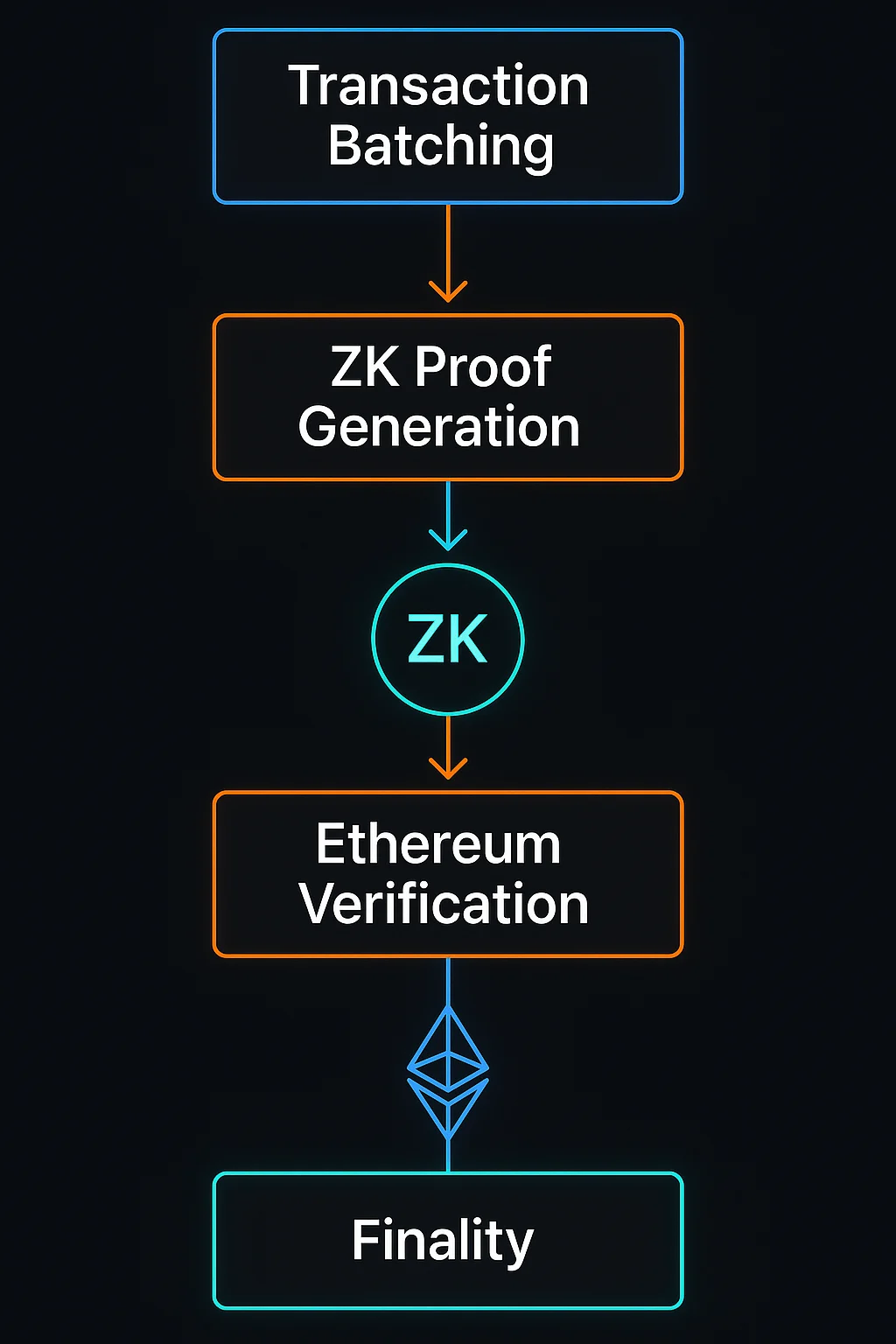
zkSync architecture showing transaction batching, ZK proof generation, Ethereum verification, and finality

Real-World Examples

  • zkSync Era supports full EVM compatibility for seamless dApp migration from Ethereum
  • Major DeFi protocols have deployed on zkSync for lower fees and faster confirmation
  • NFT marketplaces use zkSync to reduce minting and trading costs significantly

Why Beginners Should Care

Significant cost savings compared to Ethereum mainnet while maintaining the same security guarantees through mathematical proofs.

Faster finality for most transactions since ZK proofs provide immediate validity confirmation rather than requiring fraud proof waiting periods.

Technical complexity in ZK proof generation creates different trade-offs compared to optimistic rollups, affecting developer experience and computational requirements.

Related Terms: Zero-Knowledge Proof, Layer 2, Rollups, EVM Compatibility

Back to Crypto Glossary

Similar Posts

  • Rarity

    Rarity: Scarcity-Based Value AssessmentRarity refers to how uncommon or scarce particular traits, items, or attributes are within collections or ecosystems. It's like having a rare baseball card that's valuable because few others like it exist.Rarity describes the relative scarcity of digital assets, particularly NFT traits or characteristics, that affects their perceived value and market pricing. Rarer…

  • zk-STARKs

    zk-STARKs: Advanced Zero-Knowledge Proofszk-STARKs are cryptographic proofs that enable verification of computations without revealing underlying data, offering better scalability than earlier zero-knowledge technologies. They're like magic tricks where you can prove the trick worked perfectly without revealing how it was done, even to expert magicians.zk-STARKs (Zero-Knowledge Scalable Transparent Arguments of Knowledge) are advanced cryptographic proofs…

  • Centralization Risk

    Centralization Risk: Single Point of Failure DangersCentralization risk refers to vulnerabilities created when critical functions are controlled by single entities rather than distributed among many participants. It's like having all eggs in one basket that could break everything at once.Centralization risk encompasses the potential negative impacts when blockchain networks, applications, or services become overly dependent…

  • Session Keys

    Session Keys: Temporary Wallet Permissions Session keys provide temporary, limited permissions for applications to perform specific actions without exposing main wallet private keys. It’s like giving valet keys instead of your full car keys. Session keys are temporary cryptographic keys that grant limited permissions to applications for specific time periods or transaction types. They enable…

  • Reentrancy Attack

    Reentrancy Attack: Exploiting Function Recursion Reentrancy attacks exploit smart contracts by repeatedly calling functions before previous executions complete. It’s like withdrawing money from an ATM that forgets to update your balance between transactions. A reentrancy attack is a smart contract exploit where malicious contracts repeatedly call vulnerable functions before state changes are finalized, potentially draining…

  • Chain Abstraction

    Chain Abstraction: Invisible Multi-Chain Experience Chain abstraction hides blockchain complexity from users, making multi-chain interactions feel like using a single network. It’s like having universal currency that works everywhere without exchange rates. Chain abstraction creates user experiences where interactions with multiple blockchains happen seamlessly without users needing to understand or manage different networks, tokens, or…