
AI Coins

AI Coins: Cryptocurrency Meets Artificial Intelligence

AI coins are cryptocurrencies focused on artificial intelligence applications, data marketplaces, or computational resources for machine learning. They’re betting that AI and crypto will merge into something bigger than both.

AI coins are cryptocurrencies that facilitate artificial intelligence development, deployment, or monetization through decentralized networks. These tokens enable AI model training, data sharing, computational marketplace access, or AI-generated content creation.

How AI Coins Work

Computational marketplaces connect users who need AI processing power with providers who have idle GPU resources, using tokens for payment.

Data monetization enables individuals to sell training data for AI models while maintaining privacy through cryptographic techniques.

Decentralized AI models can be trained and operated across distributed networks, with token incentives for participants who contribute resources.
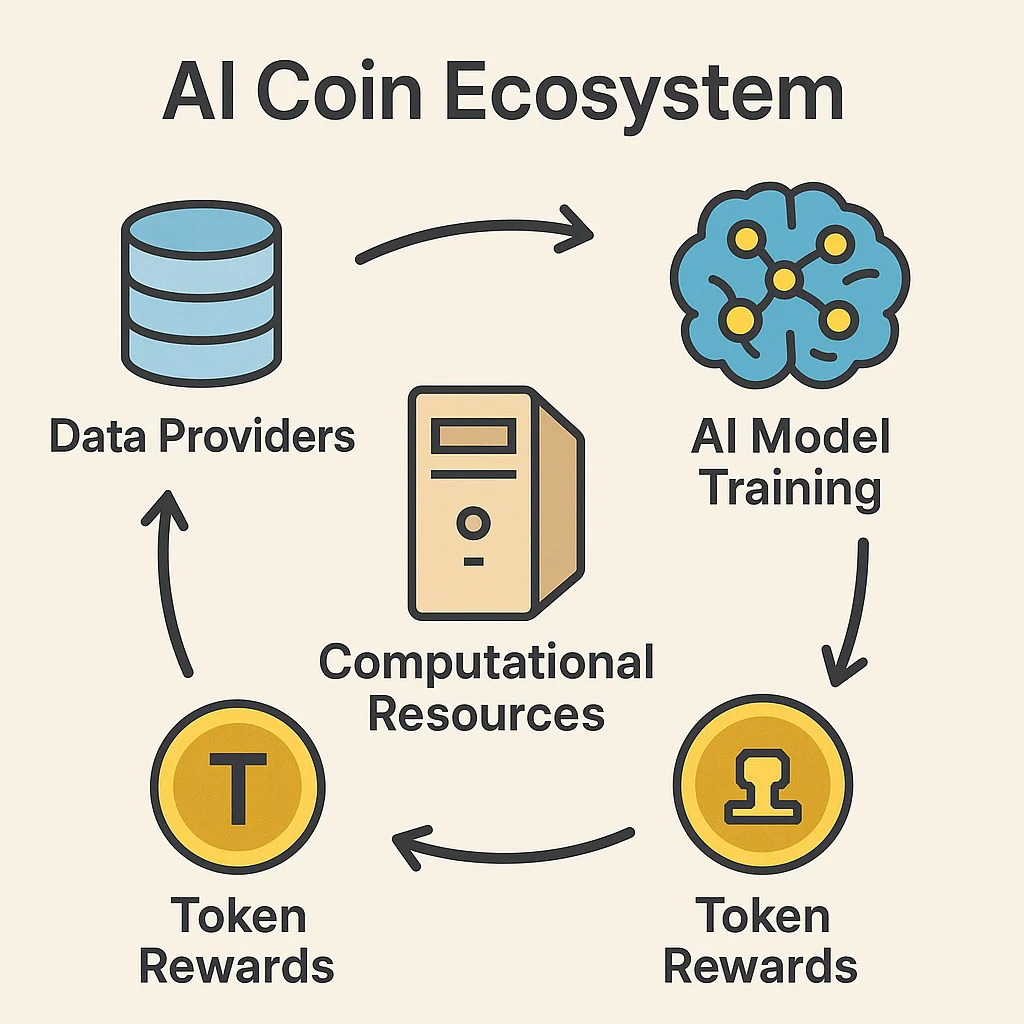
Infographic showing AI coin ecosystem with data providers, computational resources, AI model training, and token rewards flow

Real-World Examples

  • Render Network (RNDR) provides distributed GPU rendering for AI and graphics applications
  • Ocean Protocol creates data marketplaces for AI training while preserving privacy
  • Fetch.ai builds autonomous economic agents that use tokens for AI-driven services

Why Beginners Should Care

Early speculation on AI coin valuations often outpaces actual utility development, creating high volatility and risk for investors.

Real utility potential exists as AI development requires massive computational resources and data that decentralized networks could provide more efficiently.

Regulatory uncertainty around both AI development and cryptocurrency creates additional complexity for projects operating in both spaces.

Related Terms: Utility Token, Data Marketplace, Computational Mining, Decentralized Computing

Back to Crypto Glossary

Similar Posts

  • DAO (Decentralized Autonomous Organization)

    DAO (Decentralized Autonomous Organization): Democracy Meets Code DAOs are how crypto communities govern themselves without traditional corporate structures. They’re experiments in digital democracy where token holders vote on everything. A Decentralized Autonomous Organization (DAO) is a community-governed entity where decisions are made collectively by token holders through blockchain-based voting. Smart contracts execute the community’s decisions…

  • Consensus Mechanism

    Consensus Mechanism: How Networks Agree Consensus mechanisms solve the fundamental problem of getting thousands of independent computers to agree on a single version of truth without central authority. A consensus mechanism is the process by which a distributed network of nodes agrees on the validity of transactions and the current state of the blockchain. It…

  • Whale

    Whale: The Big Players Who Move Markets In crypto, whales are individuals or entities holding massive amounts of cryptocurrency. When whales move, markets tremble. A whale is someone who holds enough cryptocurrency to significantly influence market prices through their trading decisions. For Bitcoin, this typically means holding 1,000+ BTC (worth $30+ million at current prices)….

  • Sovereignty

    Sovereignty: Independent Control and GovernanceSovereignty in blockchain refers to independent control over governance, economics, and technical decisions without external interference. It's like having your own country with its own rules.Sovereignty refers to complete independence and self-governance for blockchain networks, applications, or communities without requiring permission from or dependence on external authorities. This includes technical, economic, and…

  • Yield Stacking

    Yield Stacking: Combining Multiple Income StreamsYield stacking involves combining multiple yield-generating strategies to maximize returns on cryptocurrency investments. It's like having several part-time jobs that all pay into the same bank account.Yield stacking refers to the strategy of combining multiple yield-generating opportunities across different protocols, assets, and mechanisms to maximize overall returns. This approach leverages various…

  • Anti-Sybil Mechanism

    Anti-Sybil Mechanism: Preventing Fake Identity Attacks Anti-Sybil mechanisms prevent individuals from creating multiple fake identities to gain unfair advantages in voting, airdrops, or governance systems. They’re like requiring photo ID to prevent ballot stuffing. Anti-Sybil mechanisms are systems designed to prevent or detect when single entities create multiple fake identities to manipulate voting, governance, or…