
Bonding Curve

Bonding Curve: Algorithmic Token Pricing

Bonding curves use mathematical formulas to automatically price tokens based on supply. As more tokens get bought, prices increase predictably according to the curve’s formula.

A bonding curve is an algorithmic pricing mechanism that determines token price based on token supply through a mathematical function. Prices increase as supply grows and decrease as supply shrinks, creating automatic market making without human intervention.

How Bonding Curves Work

Mathematical formulas like y = x² create predictable price relationships where each additional token costs more than the previous one, generating exponential price growth.

Continuous liquidity exists since the curve itself acts as a market maker, always willing to buy or sell tokens at the current curve price without requiring counterparties.

Price discovery happens algorithmically rather than through order book matching, ensuring tokens always have deterministic prices based on current supply levels.
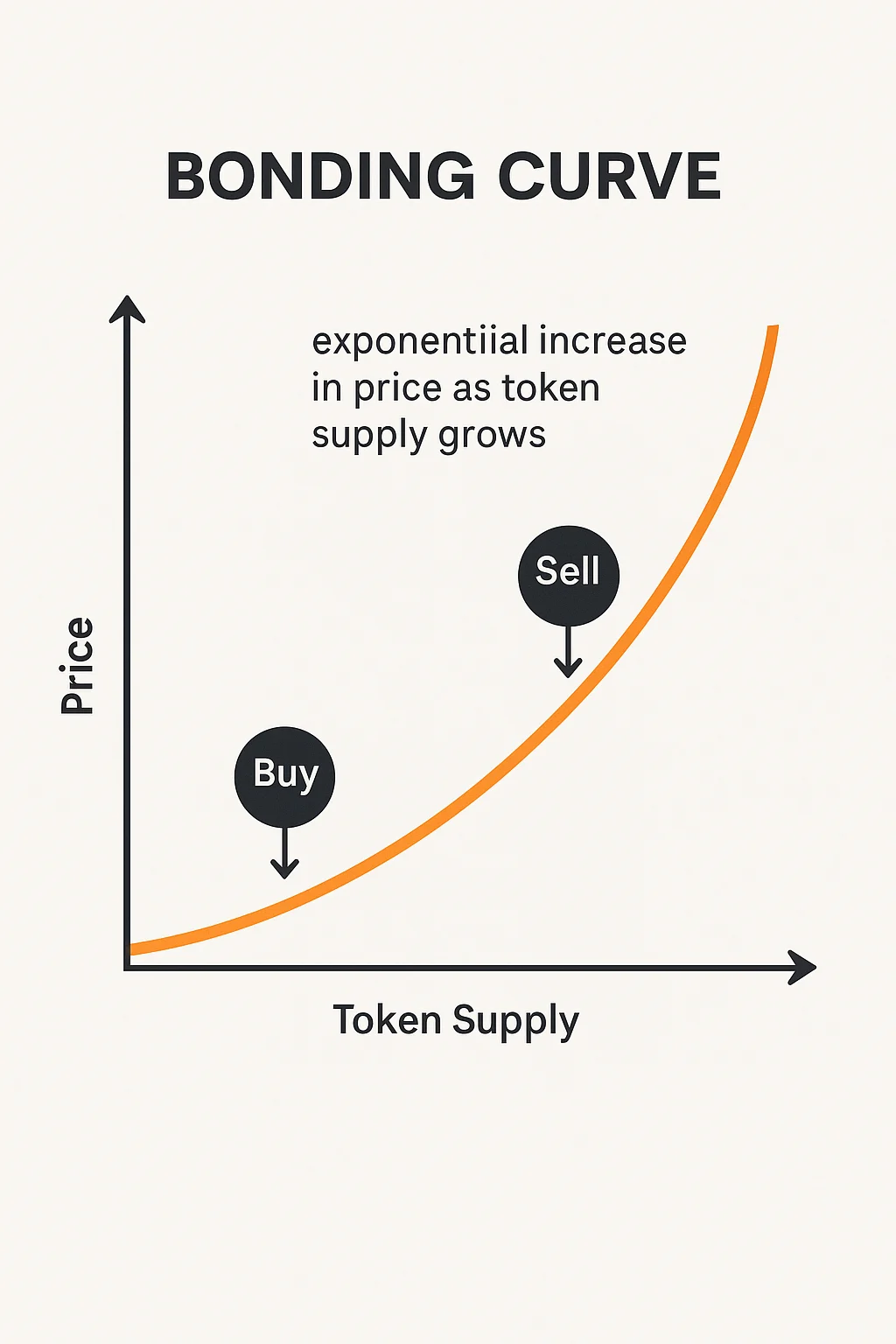
Bonding curve graph showing exponential price increase as token supply grows, with labeled buy and sell points along the curve.

Real-World Examples

  • Bancor protocol pioneered bonding curve AMMs for continuous token liquidity
  • Curation markets use bonding curves to price shares in content or prediction markets
  • Social tokens often launch with bonding curves to bootstrap initial liquidity and price discovery

Why Beginners Should Care

Front-runner advantages exist since early buyers get lower prices while later buyers pay increasingly higher amounts, creating wealth concentration among early adopters.

No liquidity shortages occur with bonding curves since the algorithm always provides liquidity, eliminating concerns about market makers withdrawing support.

Price volatility can be extreme with steep bonding curves where small buy or sell orders create large price movements, especially at low supply levels.

Related Terms: AMM, Price Discovery, Algorithmic Trading, Token Launch

Back to Crypto Glossary

Similar Posts

  • Total Value Locked (TVL)

    Total Value Locked (TVL): DeFi’s Scorecard TVL measures how much money is deposited in DeFi protocols. It’s like measuring the size of a bank by its total deposits – bigger usually means more trust and activity. Total Value Locked (TVL) is the aggregate value of all assets deposited in a DeFi protocol or across the…

  • Exit Strategy

    Exit Strategy: Investment Withdrawal PlanningAn exit strategy is a predetermined plan for selling cryptocurrency investments to realize profits or limit losses. It's like having a fire escape route planned before you need it, so you know exactly what to do when the time comes.Exit strategy refers to a predetermined plan that defines when, how, and…

  • Governance Token

    Governance Token: Voting Rights in CryptoGovernance tokens provide holders with voting rights in decentralized protocols and organizations. They're like shares in a company, but for decentralized projects where the community makes decisions.A governance token is a cryptocurrency that grants holders voting rights over protocol changes, treasury allocation, and other governance decisions in decentralized projects. These tokens…

  • Soulbound Token (SBT)

    Soulbound Token (SBT): Non-Transferable Achievements Soulbound tokens are NFTs that cannot be transferred or sold once received. They represent achievements, credentials, or identity elements that should remain permanently attached to specific individuals. A Soulbound Token (SBT) is a non-fungible token that is permanently bound to a specific wallet address and cannot be transferred or sold….

  • AI Coins

    AI Coins: Cryptocurrency Meets Artificial Intelligence AI coins are cryptocurrencies focused on artificial intelligence applications, data marketplaces, or computational resources for machine learning. They’re betting that AI and crypto will merge into something bigger than both. AI coins are cryptocurrencies that facilitate artificial intelligence development, deployment, or monetization through decentralized networks. These tokens enable AI…

  • |

    Bridgeless Interop

    Bridgeless Interop: Direct Cross-Chain Communication Bridgeless interoperability enables direct communication between blockchains without traditional bridge infrastructure. It’s like having chains that can talk directly to each other instead of using translators. Bridgeless interoperability refers to cross-chain communication methods that don’t rely on traditional bridge protocols, instead using native blockchain features or specialized infrastructure for direct…