
Data Availability Layer

Data Availability Layer: Ensuring Information Access

Data availability layers ensure that blockchain data remains accessible for verification without requiring full nodes to store everything. It’s like having a library system where you can verify any book exists without storing them all.

A data availability layer guarantees that blockchain transaction data is published and remains accessible for verification, even if not all nodes store complete copies. This enables scalable architectures while maintaining security guarantees.

How Data Availability Works

Data publication requires block producers to make transaction data publicly available, even if execution happens elsewhere or in summarized form.

Availability proofs use cryptographic techniques like data availability sampling to verify data accessibility without downloading complete datasets.

Fraud prevention ensures malicious actors cannot hide transaction data that would enable verification of incorrect state transitions or invalid blocks.
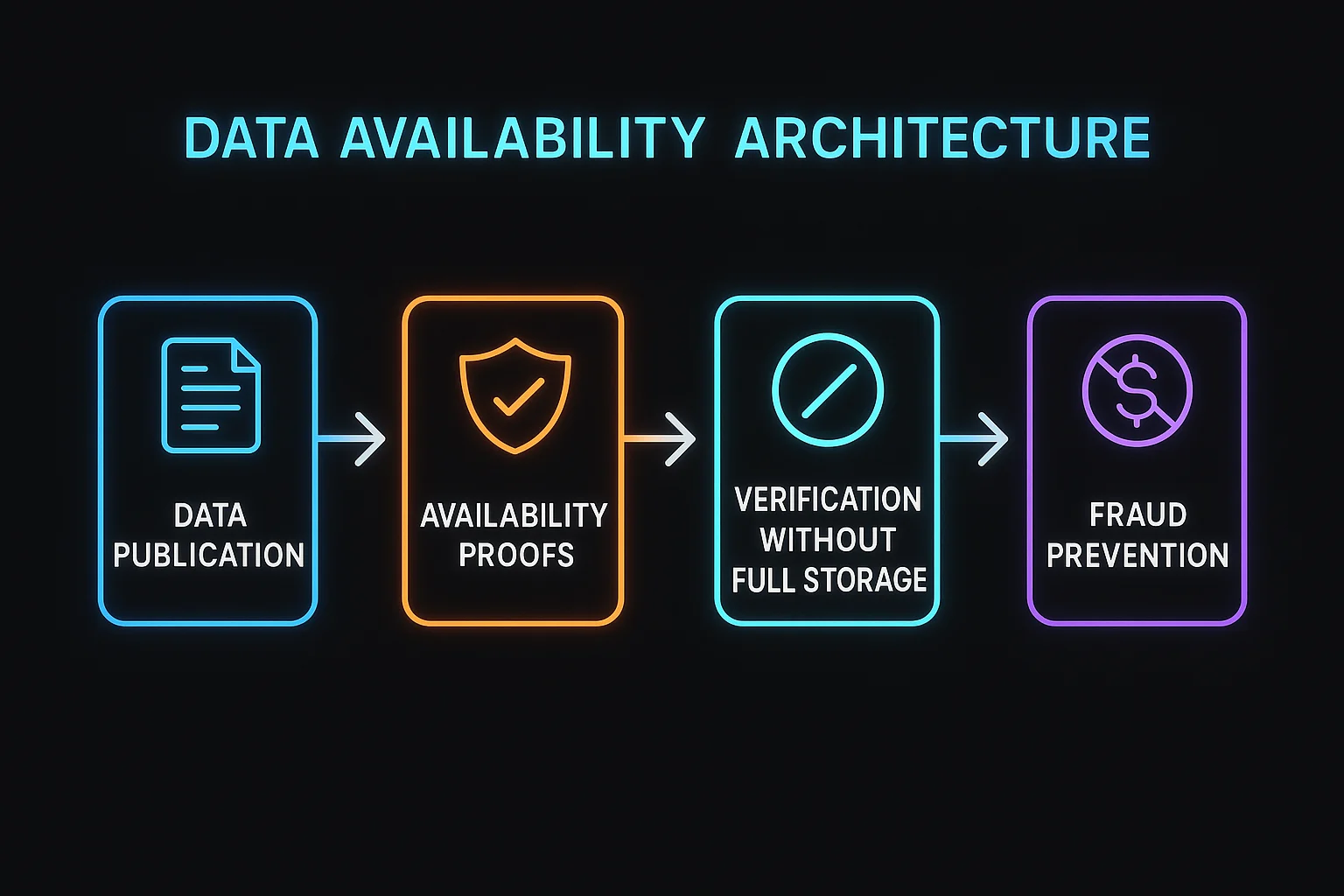
Data availability architecture showing data publication, availability proofs, verification without full storage, and fraud prevention

Real-World Examples

  • Celestia provides dedicated data availability services for modular blockchain architectures
  • Ethereum serves as a data availability layer for various Layer 2 rollup solutions
  • Polygon Avail offers scalable data availability for sovereign blockchain networks

Why Beginners Should Care

Scalability enablement through data availability layers that support much higher transaction throughput than traditional blockchain architectures.

Security preservation maintains verification capabilities and fraud detection without requiring all participants to store complete blockchain histories.

Technical complexity in understanding how data availability relates to overall blockchain security and decentralization properties.

Related Terms: Modular Blockchain, Data Sampling, Fraud Proof, Scalability

Back to Crypto Glossary

Similar Posts

  • Proof of Humanity

    Proof of Humanity: Verifying Human Uniqueness Proof of Humanity creates registries of verified unique humans to prevent Sybil attacks in voting and distribution systems. It’s like having a bouncer who knows everyone isn’t wearing a disguise. Proof of Humanity is a system for creating verifiable registries of unique human beings to prevent individuals from claiming…

  • Secondary Market

    Secondary Market: Resale Trading VenuesSecondary markets enable trading of assets after their initial issuance, providing liquidity and price discovery for existing holdings. They're like used car lots for digital assets.A secondary market is where previously issued assets are bought and sold between investors rather than being purchased directly from the original issuer. These markets provide liquidity…

  • Consensus Layer

    Consensus Layer: Agreement Coordination SystemThe consensus layer coordinates agreement among network participants about the valid state of the blockchain. It's like having a voting system that everyone trusts to make fair decisions.The consensus layer is the component of blockchain architecture responsible for coordinating agreement among network participants about transaction validity and blockchain state. This layer ensures…

  • Regulation

    Regulation: Government Rules for CryptoCryptocurrency regulation involves government rules and oversight for digital assets, exchanges, and blockchain businesses. It's the ongoing battle between innovation and compliance.Regulation refers to government laws, rules, and oversight mechanisms that govern cryptocurrency activities, including trading, taxation, anti-money laundering compliance, and consumer protection. Regulatory approaches vary significantly between jurisdictions.How Crypto Regulation WorksLicensing…

  • Ethereum

    Ethereum: The Smart Contract PlatformEthereum is the blockchain platform that pioneered smart contracts and hosts most decentralized applications. It's like the operating system for programmable money and decentralized apps.Ethereum is a decentralized blockchain platform that enables smart contracts and serves as the foundation for thousands of decentralized applications (dApps). It introduced programmable money and became the…

  • Consensus Rules

    Consensus Rules: Network Agreement ProtocolsConsensus rules define how blockchain networks validate transactions and maintain agreement about the ledger state. They're like the constitution for digital money systems.Consensus rules are the specific protocols and requirements that all network participants must follow to validate transactions, create blocks, and maintain agreement about the blockchain's current state. These rules ensure…