
Ledger

Ledger: Hardware Wallet Security Leader

Ledger is a leading hardware wallet company that provides secure offline storage for cryptocurrency private keys. They’re like the Fort Knox of crypto storage devices.

Ledger is a hardware wallet manufacturer that creates secure devices for storing cryptocurrency private keys offline, protecting them from online threats and hacking attempts. These devices enable secure transaction signing without exposing sensitive information.

How Ledger Devices Work

Secure element chips store private keys in tamper-resistant hardware that prevents extraction even with physical access to the device.

Offline transaction signing enables authorizing cryptocurrency transactions without connecting private keys to internet-connected computers.

Recovery mechanisms through seed phrases allow restoring wallet access if the hardware device is lost, stolen, or damaged.
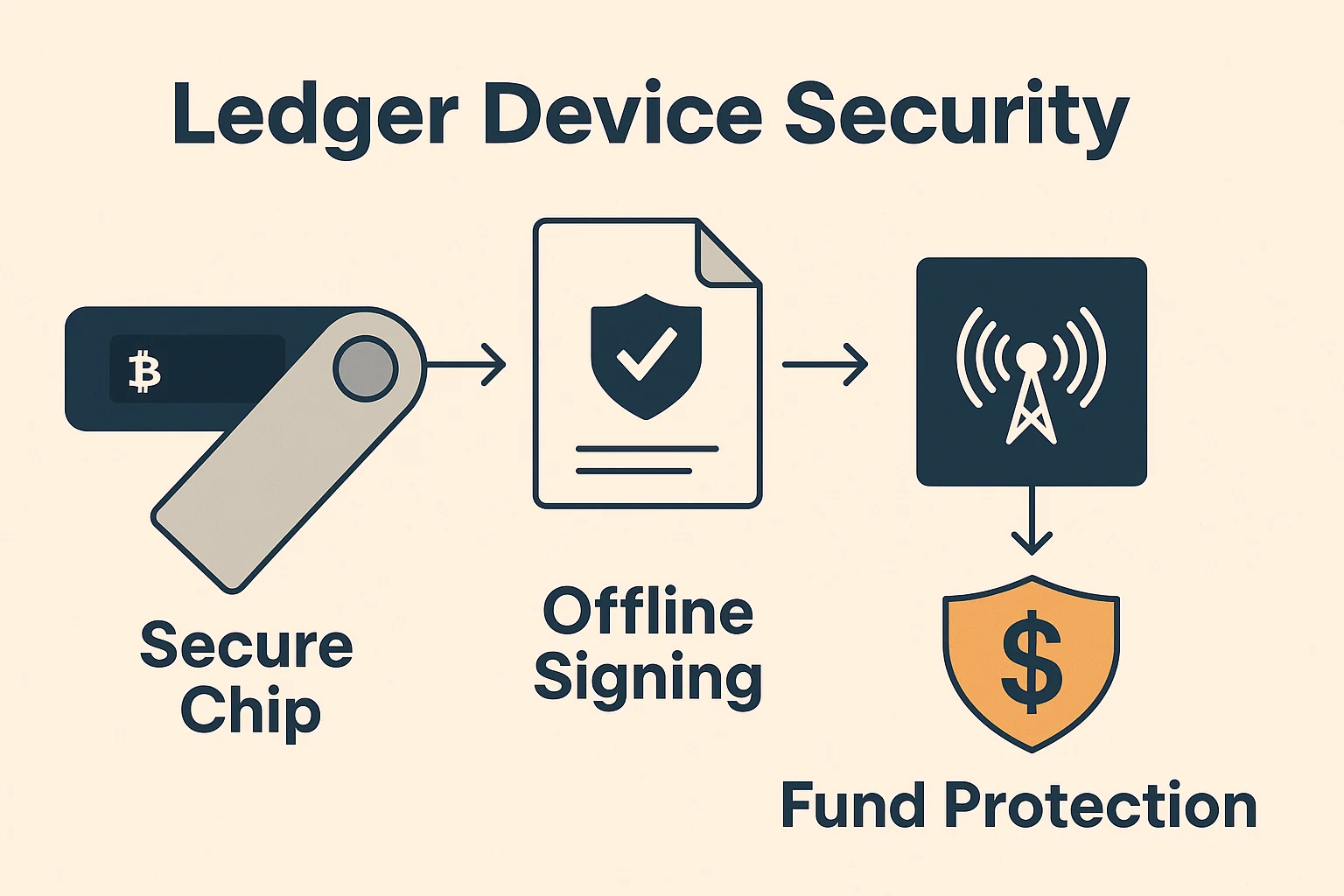
Infographic showing Ledger device flow: secure chip, offline signing, transaction broadcast, and fund protection

Real-World Examples

  • Ledger Nano S Plus provides affordable cold storage for multiple cryptocurrencies
  • Ledger Nano X offers Bluetooth connectivity for mobile device integration
  • Ledger Stax features advanced display and user interface capabilities

Why Beginners Should Care

Security enhancement over software wallets by keeping private keys offline and away from potential malware or hacking attempts.

Multi-currency support enables storing various cryptocurrencies on a single device with official wallet applications.

Industry reputation as Ledger devices are widely trusted by both beginners and institutional users for secure cryptocurrency storage.

Related Terms: Hardware Wallet, Cold Storage, Private Key, Secure Element

Back to Crypto Glossary

Similar Posts

  • Liquidity Lock

    Liquidity Lock: Securing Trading LiquidityLiquidity lock prevents withdrawal of trading liquidity for specified time periods to ensure market stability and prevent rug pulls. It's like putting trading funds in a time-locked safe that can't be opened early.Liquidity lock refers to mechanisms that prevent withdrawal of liquidity provider tokens or trading pair liquidity for predetermined time…

  • Gas Limit

    Gas Limit: Setting Your Transaction Budget Gas limit is the maximum amount of gas you’re willing to spend on a transaction. Set it too low and your transaction fails. Set it too high and you overpay for simple operations. Gas limit is the maximum amount of computational work (measured in gas units) that a user…

  • Marketplace

    Marketplace: Digital Trading PlatformsMarketplaces are platforms where users can buy, sell, and trade digital assets like NFTs, tokens, or services. They're like eBay but for blockchain-based items.A marketplace is a platform that facilitates buying, selling, and trading of digital assets between users, typically including discovery, pricing, and transaction features. These platforms often specialize in specific asset…

  • Modular Execution Layer

    Modular Execution Layer: Specialized Transaction Processing Modular execution layers handle transaction processing separately from consensus and data availability. It’s like having specialized assembly lines instead of one worker doing everything. A modular execution layer is a specialized blockchain component that focuses solely on processing transactions and executing smart contracts while relying on other layers for…

  • Wei

    Wei: Ethereum's Smallest UnitWei is the smallest denomination of Ethereum, similar to how cents are the smallest unit of dollars. It's like measuring distances in millimeters when you need precision, even though we usually think in meters or kilometers.Wei represents the smallest possible unit of Ethereum (ETH), with one ETH equal to 1,000,000,000,000,000,000 (10^18) wei. This…

  • Gas Price

    Gas Price: Cost of Ethereum ComputingGas price determines how much you pay per unit of computational work on Ethereum. It's like setting the hourly rate for blockchain computing services.Gas price is the amount of cryptocurrency (usually measured in gwei) that users are willing to pay for each unit of gas consumed by their Ethereum transactions. Higher…