
Liquid Restaking

Liquid Restaking: Flexible High-Yield Staking

Liquid restaking combines the capital efficiency of liquid staking with additional yield from securing multiple networks. It’s like having your cake and eating it too, but with slashing risks.

Liquid restaking allows staked assets to secure additional protocols while remaining liquid through tokenized representations. Users can earn enhanced yields from multiple sources while maintaining the ability to trade or use their staked positions.

How Liquid Restaking Works

Multiple validation enables staked assets to simultaneously secure the base layer and additional protocols or middleware services.

Liquid tokens represent restaked positions, allowing users to trade or use their staked assets in DeFi while earning enhanced rewards.

Operator delegation lets users choose professional operators to handle the technical complexity of running multiple validation services.
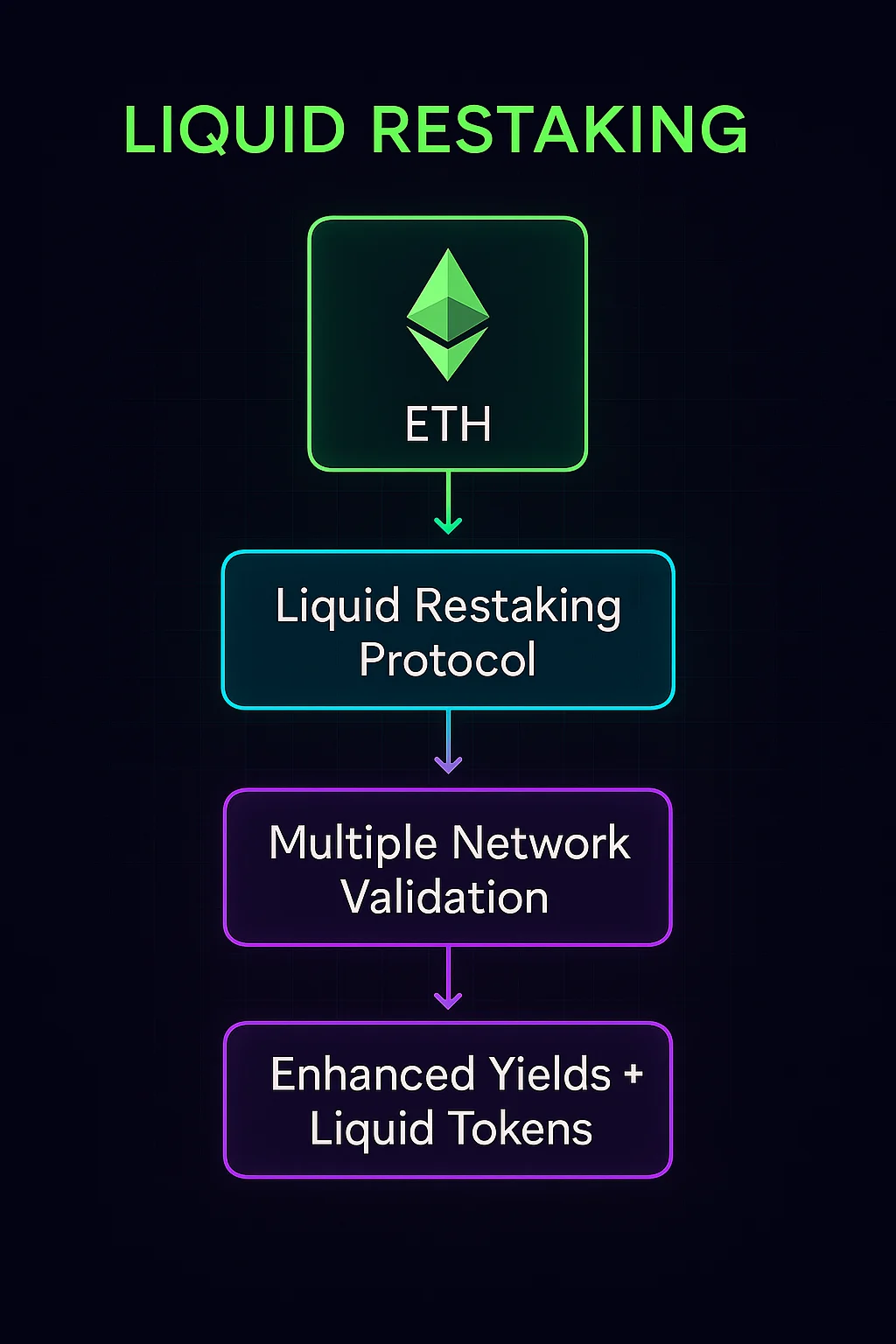
Infographic showing liquid restaking flow: ETH staking into a protocol, multi-network validation, and yield with liquid token issuance

Real-World Examples

  • EigenLayer enables ETH restaking for additional protocol security and yields
  • Liquid restaking protocols build on EigenLayer to provide tokenized restaking positions
  • Professional operators manage restaking infrastructure for delegated stake

Why Beginners Should Care

Enhanced yields from multiple revenue sources can significantly outperform traditional single-protocol staking returns.

Increased complexity and slashing risks from multiple protocols make liquid restaking suitable for more sophisticated users willing to accept additional risks.

Capital efficiency maximizes the productive use of staked assets rather than having them earn only base layer rewards.

Related Terms: Restaking, Liquid Staking, EigenLayer, Slashing

Back to Crypto Glossary

Similar Posts

  • Smart Contract

    Smart Contract: Code That Enforces Agreements Smart contracts are why crypto is bigger than just digital money. They’re agreements that execute themselves automatically when conditions are met. A smart contract is computer code that automatically executes agreement terms when predetermined conditions are satisfied. No lawyers, no courts, no arguing – just math and code enforcing…

  • DeFi Lending

    DeFi Lending: Decentralized Borrowing and LendingDeFi lending enables cryptocurrency borrowing and lending without traditional financial intermediaries through smart contracts. It's like peer-to-peer banking powered by code instead of humans.DeFi lending refers to decentralized finance protocols that enable users to lend and borrow cryptocurrencies through smart contracts without requiring traditional banks or credit checks. These systems operate…

  • AML (Anti-Money Laundering)

    AML (Anti-Money Laundering): Fighting Financial Crime AML regulations force crypto businesses to monitor and report suspicious activities. It’s the government’s attempt to prevent crypto from becoming a money laundering paradise. Anti-Money Laundering (AML) refers to laws, regulations, and procedures designed to prevent criminals from disguising illegally obtained funds as legitimate income. Crypto exchanges and businesses…

  • Metadata

    Metadata: Data About DataMetadata provides information about other data, such as describing what an NFT represents, when it was created, or what properties it has. It's like the label on a file folder that tells you what's inside.Metadata refers to descriptive information about digital assets, transactions, or other data that provides context, properties, and characteristics…

  • Regulatory Risk

    Regulatory Risk: Government Policy UncertaintyRegulatory risk refers to potential losses from government policy changes affecting cryptocurrency legality, taxation, or usage restrictions. It's like the risk that traffic laws might change and make your car illegal to drive.Regulatory risk encompasses potential negative impacts from government actions including bans, restrictions, taxation changes, or new compliance requirements affecting…

  • Proof of Burn

    Proof of Burn: Destroying Value for Consensus Proof of Burn requires destroying cryptocurrency to participate in consensus or gain network benefits. It’s like burning money to prove you’re serious about network security. Proof of Burn is a consensus mechanism where participants destroy cryptocurrency by sending it to unrecoverable addresses to gain mining rights or network…