
Restaking

Restaking: Double-Duty for Staked Assets

Restaking allows already-staked cryptocurrency to secure additional networks and earn extra rewards. It’s like getting paid twice for the same job, but with twice the risk.

Restaking is a mechanism that allows staked cryptocurrency to simultaneously secure multiple networks or protocols, earning additional rewards beyond the base staking yield. Validators can opt into additional services while their stake continues securing the original network.

How Restaking Works

Dual security provisions enable staked assets to validate transactions on the primary network while also securing additional protocols or middleware services.

Slashing multiplication means validators face penalties from multiple sources if they misbehave, creating stronger incentives for honest behavior but higher risk exposure.

Reward stacking allows earning base staking rewards plus additional compensation from each extra service the validator provides to the ecosystem.
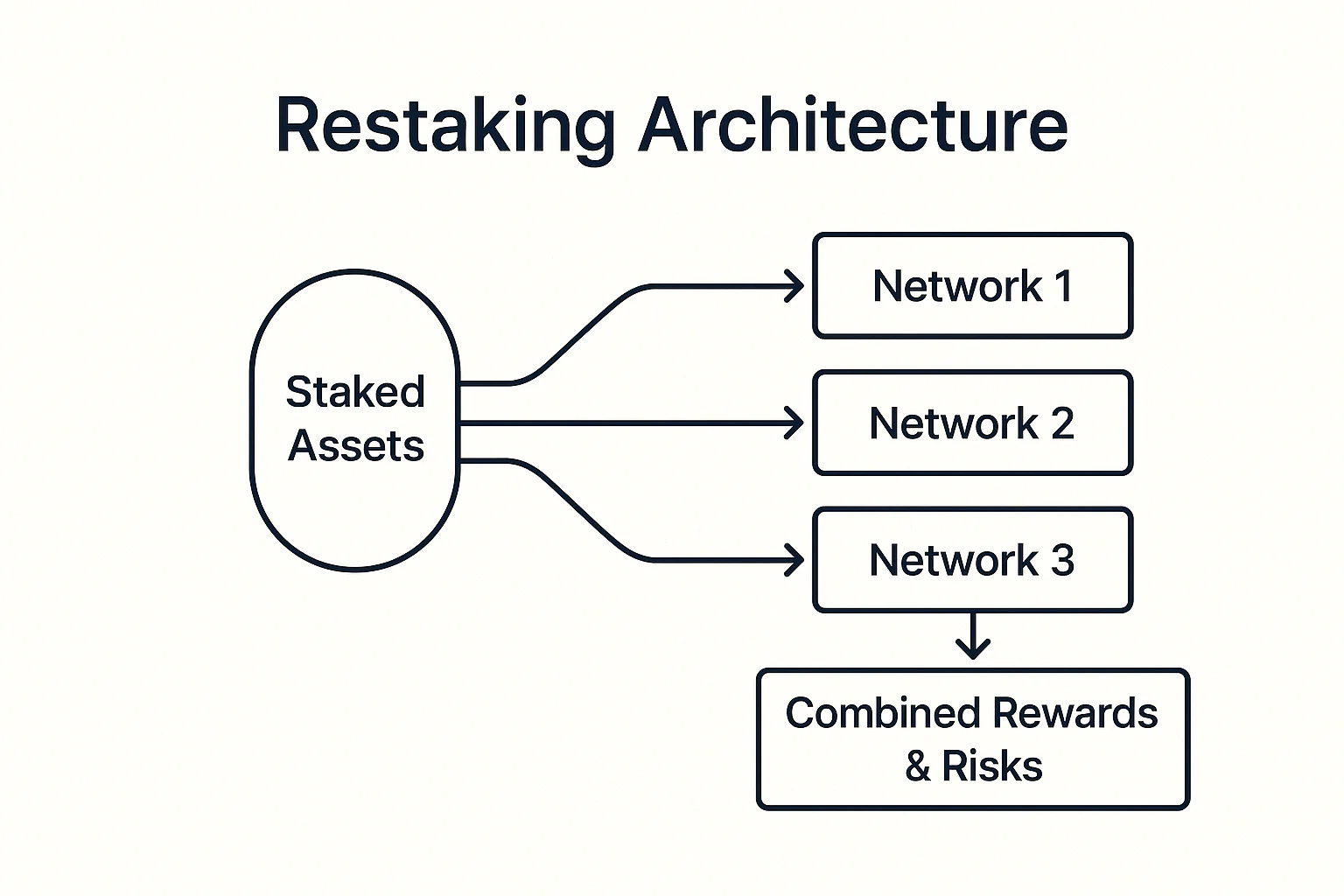
Restaking architecture diagram showing staked assets securing multiple networks with combined rewards and risks.

Real-World Examples

  • EigenLayer enables Ethereum validators to restake ETH for securing additional protocols
  • Babylon allows Bitcoin holders to stake their BTC for securing Proof-of-Stake networks
  • Middleware protocols use restaking to bootstrap security from established validator sets

Why Beginners Should Care

Higher yields from restaking can significantly improve returns on staked assets, but come with proportionally increased risk of slashing penalties.

Complexity increases with multiple slashing conditions and service requirements that validators must understand and manage properly.

Early experimentation makes restaking protocols less proven than traditional staking, requiring careful risk assessment before committing significant funds.

Related Terms: Staking, Slashing, Validator, Yield Stacking

Back to Crypto Glossary

Similar Posts

  • Liquidity Sniping

    Liquidity Sniping: Front-Running New Pools Liquidity sniping involves immediately buying tokens when new liquidity pools are created, often using bots to front-run regular users. It’s like cutting in line at the grand opening sale. Liquidity sniping is the practice of using automated systems to immediately purchase tokens as soon as new liquidity pools go live,…

  • DEX

    DEX: Decentralized ExchangeA DEX is a cryptocurrency exchange that operates without central authority through smart contracts. It's like a marketplace where buyers and sellers trade directly without a middleman.A decentralized exchange (DEX) is a cryptocurrency trading platform that facilitates peer-to-peer trading through smart contracts without requiring a central operator or intermediary. Users maintain control of their…

  • Encrypted Mempool

    Encrypted Mempool: Private Transaction Pools Encrypted mempools hide transaction details until inclusion in blocks, preventing front-running and MEV extraction. It’s like sending sealed bids instead of announcing your strategy publicly. An encrypted mempool contains pending transactions that are cryptographically hidden from public view until block inclusion. This prevents sophisticated actors from front-running or extracting MEV…

  • Pump and Dump

    Pump and Dump: Coordinated Market Manipulation Pump and dump schemes are crypto’s version of old-school stock manipulation. Coordinated groups artificially inflate prices, then dump on unsuspecting victims. A pump and dump is a form of market manipulation where a group artificially inflates an asset’s price through coordinated buying and false promotion, then sells at peak…

  • Tokenomics

    Tokenomics: The Economics of Digital Assets Tokenomics determines how cryptocurrencies create, distribute, and maintain value over time. It’s the difference between digital money and digital monopoly money. Tokenomics refers to the economic design and mechanics of a cryptocurrency token, including supply schedules, distribution methods, utility functions, and incentive structures. Good tokenomics align stakeholder interests while…

  • Gas Optimization

    Gas Optimization: Reducing Transaction CostsGas optimization involves techniques to minimize the computational cost of blockchain transactions and smart contracts. It's like finding the most fuel-efficient route for your digital transactions.Gas optimization refers to practices and techniques used to reduce the gas consumption of blockchain transactions and smart contract operations. This minimizes transaction costs and improves application…