
Single-Sided Staking

Single-Sided Staking: Simplified Yield Farming

Single-sided staking lets you earn yield on individual tokens without providing liquidity pairs or facing impermanent loss. It’s like earning interest on a savings account without loan risk.

Single-sided staking allows users to stake individual tokens to earn rewards without needing to provide paired assets or manage liquidity pool positions. This eliminates impermanent loss while still generating yield from token holdings.

How Single-Sided Staking Works

Protocol rewards come from token emissions, revenue sharing, or other sources that don’t require users to provide trading liquidity.

No pairing requirements mean users can stake popular tokens like ETH or BTC without needing to acquire and manage secondary tokens for liquidity provision.

Simplified risk eliminates impermanent loss concerns since users maintain exposure to only their chosen token rather than token pairs.
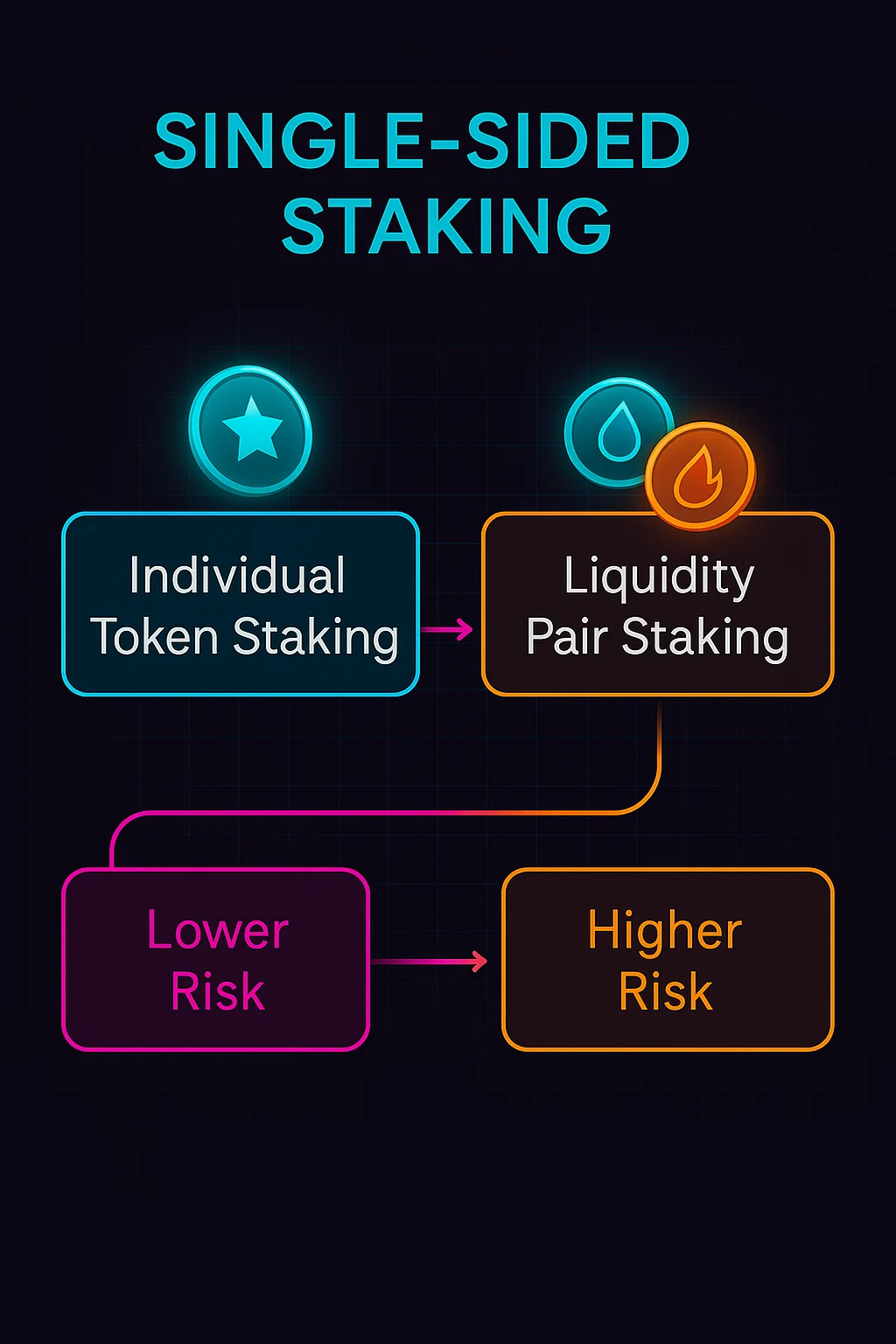
Infographic comparing individual token staking with liquidity pair staking, highlighting the difference in risk levels between the two methods

Real-World Examples

  • Ethereum 2.0 staking provides ~6% APY for holding ETH without impermanent loss risks
  • Lido liquid staking enables ETH staking with tradeable stETH tokens
  • Rocket Pool offers decentralized ETH staking with rETH liquid staking tokens

Why Beginners Should Care

Lower complexity makes single-sided staking more accessible than complex DeFi strategies requiring multiple tokens and risk management.

Predictable exposure maintains your chosen token allocation without the price ratio risks inherent in liquidity pool strategies.

Generally lower yields compared to liquidity mining since protocols don’t need to incentivize users to provide trading infrastructure.

Related Terms: Staking, Liquid Staking, Impermanent Loss, Yield Farming

Back to Crypto Glossary

Similar Posts

  • Address Clustering

    Address Clustering: Connecting Wallet IdentitiesAddress clustering analyzes blockchain transactions to identify which addresses likely belong to the same user or entity. It's like detective work for digital money trails.Address clustering is a blockchain analysis technique that groups cryptocurrency addresses believed to belong to the same user or entity based on transaction patterns and shared inputs. This…

  • Cross-Chain Bridge

    Cross-Chain Bridge: Connecting Blockchain Islands Cross-chain bridges move assets between different blockchains, connecting isolated cryptocurrency ecosystems. They’re the highways between blockchain cities, but sometimes the bridges collapse. A cross-chain bridge is a protocol that enables the transfer of tokens, data, or smart contract calls between different blockchain networks. Bridges solve blockchain interoperability by creating connections…

  • Sequencer

    Sequencer: Transaction Order ControllerA sequencer determines the order in which transactions are processed in Layer 2 networks and some blockchain systems. It's like the traffic controller that decides which cars go through the intersection first.A sequencer is a component in Layer 2 scaling solutions that collects, orders, and batches transactions before submitting them to the…

  • Protocol Security

    Protocol Security: Protecting Blockchain InfrastructureProtocol security involves designing and maintaining blockchain networks to resist attacks, prevent exploits, and ensure reliable operation. It's like building a fortress with multiple defensive layers.Protocol security encompasses all measures taken to protect blockchain networks from technical attacks, economic manipulation, and operational failures. This includes consensus security, smart contract auditing, and network…

  • AML (Anti-Money Laundering)

    AML (Anti-Money Laundering): Fighting Financial Crime AML regulations force crypto businesses to monitor and report suspicious activities. It’s the government’s attempt to prevent crypto from becoming a money laundering paradise. Anti-Money Laundering (AML) refers to laws, regulations, and procedures designed to prevent criminals from disguising illegally obtained funds as legitimate income. Crypto exchanges and businesses…

  • Social Token

    Social Token: Community-Powered Digital CurrencySocial tokens represent value within communities and enable creators to monetize their audience directly. They're like membership cards that have real value and can be traded.Social tokens are cryptocurrencies created by individuals, communities, or organizations to represent membership, access rights, or value within specific social ecosystems. These tokens enable direct monetization and…