
Liquid Restaking

Liquid Restaking: Flexible High-Yield Staking

Liquid restaking combines the capital efficiency of liquid staking with additional yield from securing multiple networks. It’s like having your cake and eating it too, but with slashing risks.

Liquid restaking allows staked assets to secure additional protocols while remaining liquid through tokenized representations. Users can earn enhanced yields from multiple sources while maintaining the ability to trade or use their staked positions.

How Liquid Restaking Works

Multiple validation enables staked assets to simultaneously secure the base layer and additional protocols or middleware services.

Liquid tokens represent restaked positions, allowing users to trade or use their staked assets in DeFi while earning enhanced rewards.

Operator delegation lets users choose professional operators to handle the technical complexity of running multiple validation services.
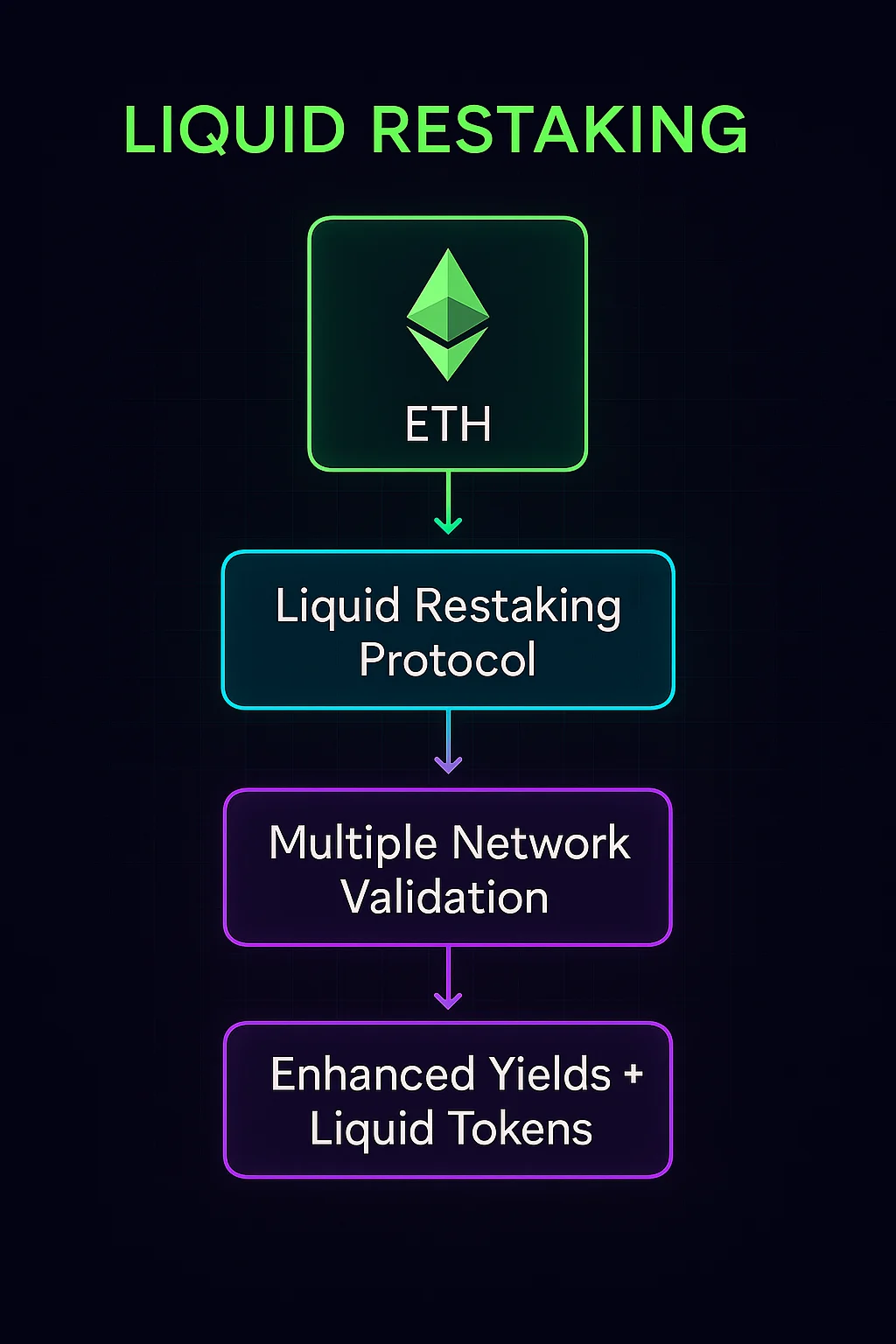
Infographic showing liquid restaking flow: ETH staking into a protocol, multi-network validation, and yield with liquid token issuance

Real-World Examples

  • EigenLayer enables ETH restaking for additional protocol security and yields
  • Liquid restaking protocols build on EigenLayer to provide tokenized restaking positions
  • Professional operators manage restaking infrastructure for delegated stake

Why Beginners Should Care

Enhanced yields from multiple revenue sources can significantly outperform traditional single-protocol staking returns.

Increased complexity and slashing risks from multiple protocols make liquid restaking suitable for more sophisticated users willing to accept additional risks.

Capital efficiency maximizes the productive use of staked assets rather than having them earn only base layer rewards.

Related Terms: Restaking, Liquid Staking, EigenLayer, Slashing

Back to Crypto Glossary

Similar Posts

  • Flashbots

    Flashbots: MEV Infrastructure Flashbots is a research and development organization that builds infrastructure to mitigate the negative externalities of MEV. They’re trying to make the blockchain economy more fair and transparent. Flashbots develops tools and infrastructure to democratize MEV extraction and reduce its harmful effects on regular users. Their products include private mempools, MEV-protected transaction…

  • On-Chain Reputation

    On-Chain Reputation: Verifiable Digital Standing On-chain reputation tracks user behavior and achievements through permanent blockchain records. It’s like having a credit score built from your entire crypto transaction history. On-chain reputation systems create verifiable records of user behavior, achievements, and interactions that persist across applications and can’t be faked or manipulated. These systems enable trust…

  • Consensus Layer

    Consensus Layer: Network Agreement FoundationThe consensus layer handles how blockchain networks achieve agreement on valid transactions and network state. It's the democratic voting system that keeps everyone on the same page.The consensus layer is the component of blockchain architecture responsible for coordinating agreement among network participants about transaction validity and blockchain state. This layer ensures all…

  • HTLC

    HTLC: Hash Time-Locked ContractsHTLCs are smart contracts that lock cryptocurrency until specific conditions are met within time limits. They're like escrow services with built-in deadlines that automatically return funds if deals fall through.Hash Time-Locked Contracts (HTLCs) are smart contracts that require both cryptographic proof and time-based conditions to be met before cryptocurrency can be accessed. These…

  • Two-Factor Authentication (2FA)

    Two-Factor Authentication (2FA): Your Crypto’s Second Lock 2FA is the minimum security standard for any crypto account worth protecting. If you’re not using it, you’re basically leaving your front door unlocked. Two-factor authentication (2FA) requires two different verification methods to access your account – typically something you know (password) plus something you have (phone or…

  • Consensus Layer

    Consensus Layer: Agreement Coordination SystemThe consensus layer coordinates agreement among network participants about the valid state of the blockchain. It's like having a voting system that everyone trusts to make fair decisions.The consensus layer is the component of blockchain architecture responsible for coordinating agreement among network participants about transaction validity and blockchain state. This layer ensures…