
Proof of Burn

Proof of Burn: Destroying Value for Consensus

Proof of Burn requires destroying cryptocurrency to participate in consensus or gain network benefits. It’s like burning money to prove you’re serious about network security.

Proof of Burn is a consensus mechanism where participants destroy cryptocurrency by sending it to unrecoverable addresses to gain mining rights or network privileges. The economic cost of burned tokens incentivizes honest behavior.

How Proof of Burn Works

Token destruction sends cryptocurrency to addresses with no known private keys, permanently removing it from circulation as proof of economic commitment.

Mining rights are awarded based on the value of recently burned tokens, with more burns providing higher chances of being selected to create blocks.

Economic incentives align participant interests with network security since dishonest behavior would waste the burned tokens without rewards.
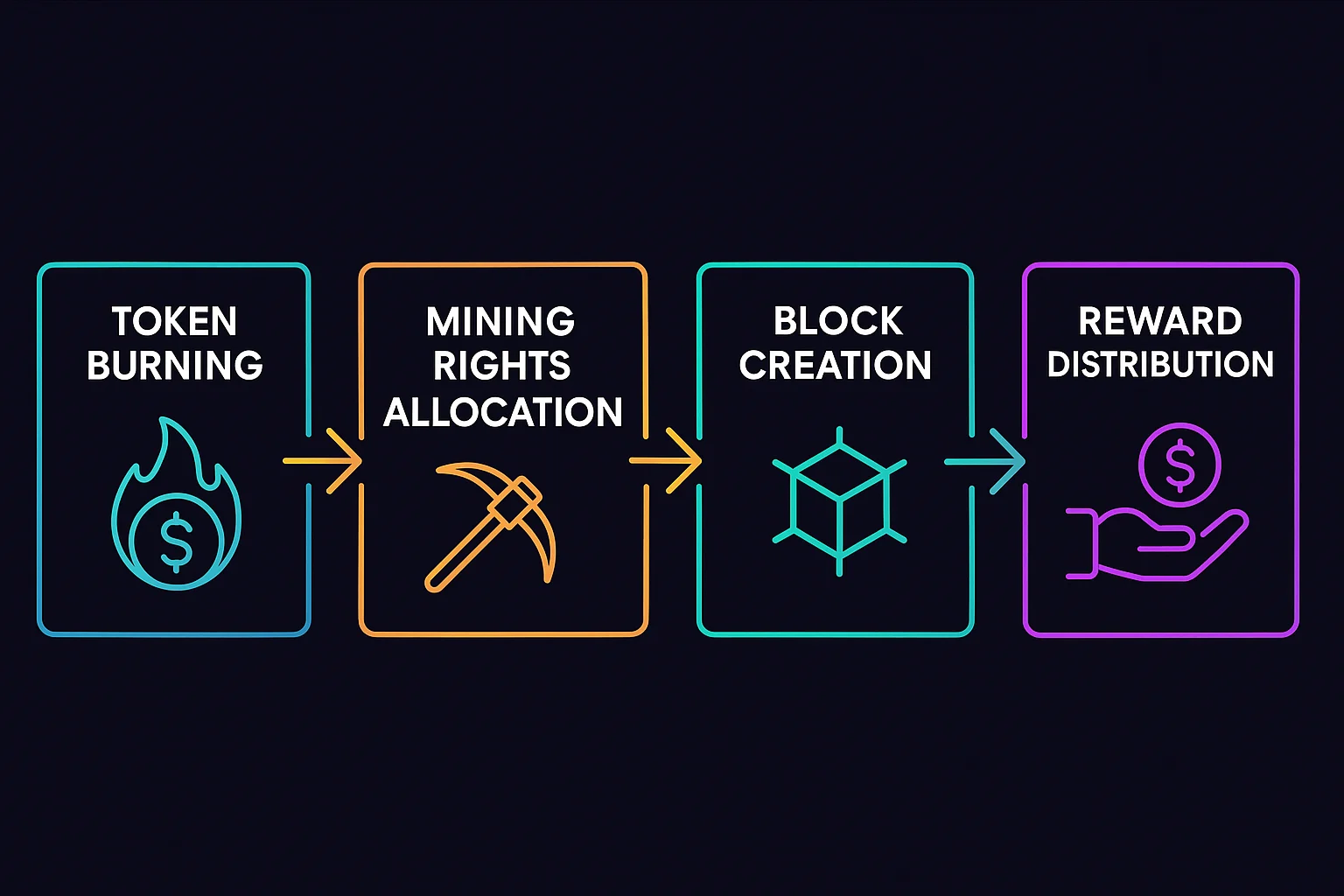
Proof of Burn process showing token burning, mining rights allocation, block creation, and reward distribution

Real-World Examples

  • Counterparty used Bitcoin burning to distribute XCP tokens during its initial launch
  • Slimcoin implements Proof of Burn as part of its hybrid consensus mechanism
  • Various token launches have used burning mechanisms to create fair distribution

Why Beginners Should Care

Environmental efficiency compared to Proof of Work since burning doesn’t require ongoing energy consumption for mining operations.

Economic sustainability questions about whether participants will continue burning tokens when rewards don’t justify the costs.

Limited adoption as most networks prefer Proof of Stake or other alternatives that don’t require permanent value destruction.

Related Terms: Consensus Mechanism, Token Burn, Economic Security

Back to Crypto Glossary

Similar Posts

  • Self-Custody

    Self-Custody: Direct Asset ControlSelf-custody means personally controlling your cryptocurrency private keys rather than trusting third parties to hold your assets. It's like keeping cash in your own safe instead of depositing it in someone else's bank account.Self-custody refers to the practice of personally maintaining control over cryptocurrency private keys and digital assets without relying on…

  • Intent-Based

    Intent-Based: Goal-Oriented Transaction DesignIntent-based systems allow users to specify desired outcomes rather than exact transaction steps, with the system automatically determining optimal execution paths. It's like telling a travel agent your destination and preferences, then letting them handle all the complex booking details and connections.Intent-based refers to blockchain systems where users express their desired outcomes…

  • CoinJoin

    CoinJoin: Bitcoin Transaction MixingCoinJoin combines multiple Bitcoin transactions into single transactions to obscure the connection between inputs and outputs. It's like mixing your laundry with other people's to make it harder to tell which clothes belong to whom.CoinJoin is a Bitcoin privacy technique that combines multiple transactions from different users into a single transaction, making…

  • zk-SNARKs

    zk-SNARKs: Zero-Knowledge Proof Technologyzk-SNARKs are cryptographic proofs that verify information without revealing the underlying data. They're like proving you know a secret without telling anyone what the secret actually is.zk-SNARKs (Zero-Knowledge Succinct Non-Interactive Arguments of Knowledge) are cryptographic proofs that allow verification of computations without revealing the inputs or intermediate steps. This enables privacy and scalability…

  • Timelock

    Timelock: Time-Based Access ControlTimelock mechanisms prevent access to funds or functions until predetermined time conditions are met. It's like having a safe that only opens at specific times.A timelock is a smart contract feature that restricts access to funds, functions, or actions until a specified time period has elapsed. These mechanisms provide security through delayed execution…

  • Total Value Locked (TVL)

    Total Value Locked (TVL): DeFi’s Scorecard TVL measures how much money is deposited in DeFi protocols. It’s like measuring the size of a bank by its total deposits – bigger usually means more trust and activity. Total Value Locked (TVL) is the aggregate value of all assets deposited in a DeFi protocol or across the…