
Real Yield

Real Yield: Sustainable Revenue-Based Returns

Real yield comes from actual protocol revenue rather than token emissions or inflationary rewards. It’s the difference between earning from productive business activity versus printing more money.

Real yield refers to returns generated from genuine protocol revenue, fees, or value creation rather than token inflation or emissions. These yields can theoretically continue indefinitely since they’re backed by actual economic activity.

How Real Yield Works

Revenue generation from protocol fees, transaction costs, or service charges creates income that gets distributed to token holders or stakers.

Fee sharing mechanisms redirect a portion of protocol revenue to participants who provide value like liquidity, governance, or security services.

Sustainable economics enable long-term yield generation without depending on new money entering the system to pay existing participants.
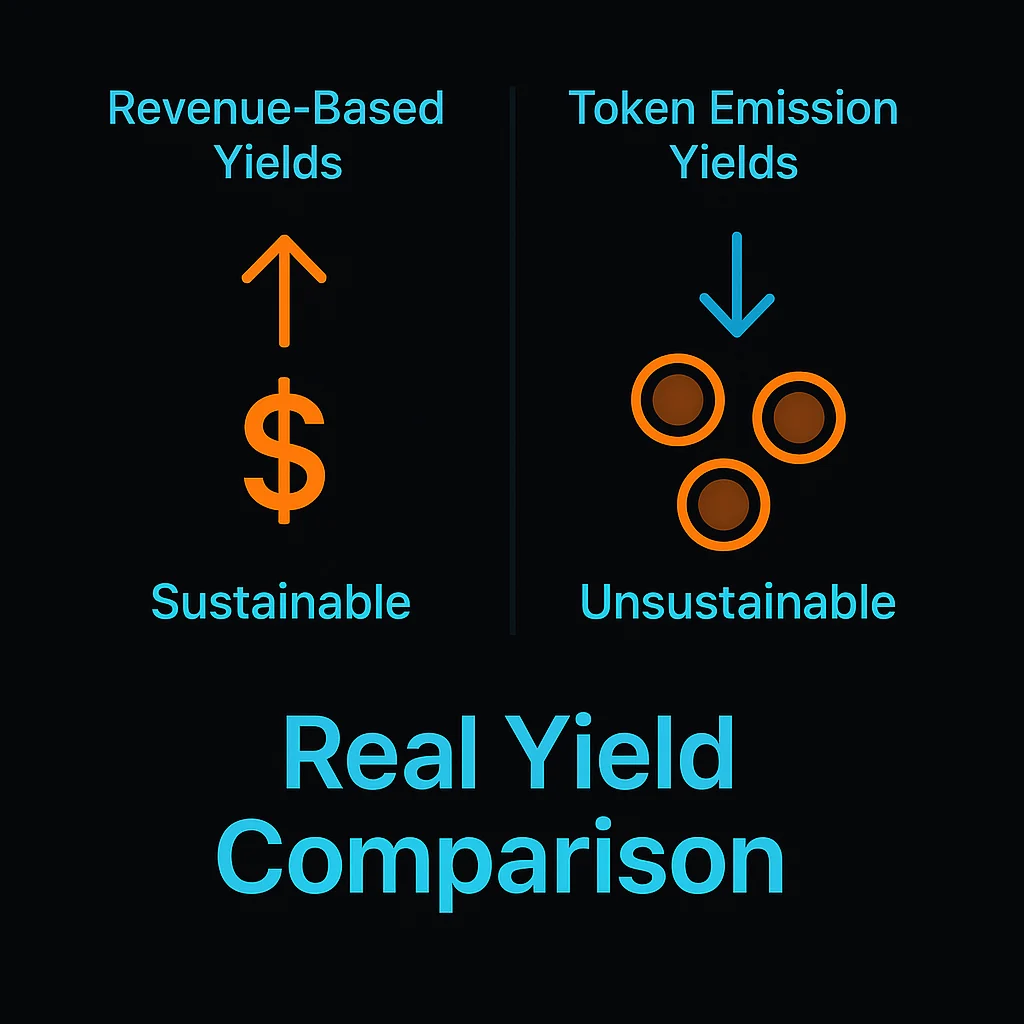
Real yield comparison showing revenue-based sustainable yields versus token emission-based unsustainable yields

Real-World Examples

  • GMX distributes trading fees to token stakers from actual platform revenue
  • Synthetix shares trading fees from synthetic asset exchanges with SNX stakers
  • MakerDAO distributes stability fees from DAI borrowing to MKR holders

Why Beginners Should Care

Sustainability assessment helps distinguish between temporary incentive programs and genuinely profitable protocols that can maintain yields long-term.

Lower but stable returns compared to high-emission farming programs that typically decrease as token prices fall or incentives end.

Business model validation as real yield demonstrates that protocols create genuine value worth paying for rather than existing purely for speculation.

Related Terms: Protocol Revenue, Fee Sharing, Sustainable Yield, Token Emissions

Back to Crypto Glossary

Similar Posts

  • Consensus Layer

    Consensus Layer: Agreement Coordination SystemThe consensus layer coordinates agreement among network participants about the valid state of the blockchain. It's like having a voting system that everyone trusts to make fair decisions.The consensus layer is the component of blockchain architecture responsible for coordinating agreement among network participants about transaction validity and blockchain state. This layer ensures…

  • Market Maker

    Market Maker: Providing Trading LiquidityMarket makers provide continuous buy and sell orders to ensure trading liquidity and narrow bid-ask spreads. They're like the vendors at a farmer's market who are always ready to trade.A market maker is an individual or entity that provides liquidity to trading markets by continuously offering to buy and sell assets…

  • 51% Attack

    51% Attack: When Consensus Gets Hijacked A 51% attack occurs when a single entity controls the majority of a network’s mining power or stake, allowing them to manipulate transactions and double-spend coins. A 51% attack is when an individual or group controls more than half of a blockchain network’s mining hash rate or staking power,…

  • Proof of Stake (PoS)

    Proof of Stake (PoS): Energy-Efficient Consensus Proof of Stake secures blockchain networks through economic staking rather than energy-intensive mining. It’s like replacing a gold rush with a security deposit system. Proof of Stake (PoS) is a consensus mechanism where validators are chosen to create new blocks based on their stake in the network rather than…

  • Bear Market

    Bear Market: When Reality Hits Crypto Bear markets separate tourists from residents. Prices fall, optimism dies, and everyone learns who was swimming naked when the tide goes out. A bear market is a sustained period of declining cryptocurrency prices accompanied by widespread investor pessimism. During bear markets, even strong projects can lose 80-90% of their…

  • Halving

    Halving: Cutting Block Rewards in Half Halving events reduce block rewards by 50%, creating artificial scarcity that historically triggers major bull markets. It’s like cutting gold mining output in half overnight. Halving is a pre-programmed event that reduces block rewards by half, typically occurring every four years or after a specific number of blocks. This…