
Restaking

Restaking: Double-Duty for Staked Assets

Restaking allows already-staked cryptocurrency to secure additional networks and earn extra rewards. It’s like getting paid twice for the same job, but with twice the risk.

Restaking is a mechanism that allows staked cryptocurrency to simultaneously secure multiple networks or protocols, earning additional rewards beyond the base staking yield. Validators can opt into additional services while their stake continues securing the original network.

How Restaking Works

Dual security provisions enable staked assets to validate transactions on the primary network while also securing additional protocols or middleware services.

Slashing multiplication means validators face penalties from multiple sources if they misbehave, creating stronger incentives for honest behavior but higher risk exposure.

Reward stacking allows earning base staking rewards plus additional compensation from each extra service the validator provides to the ecosystem.
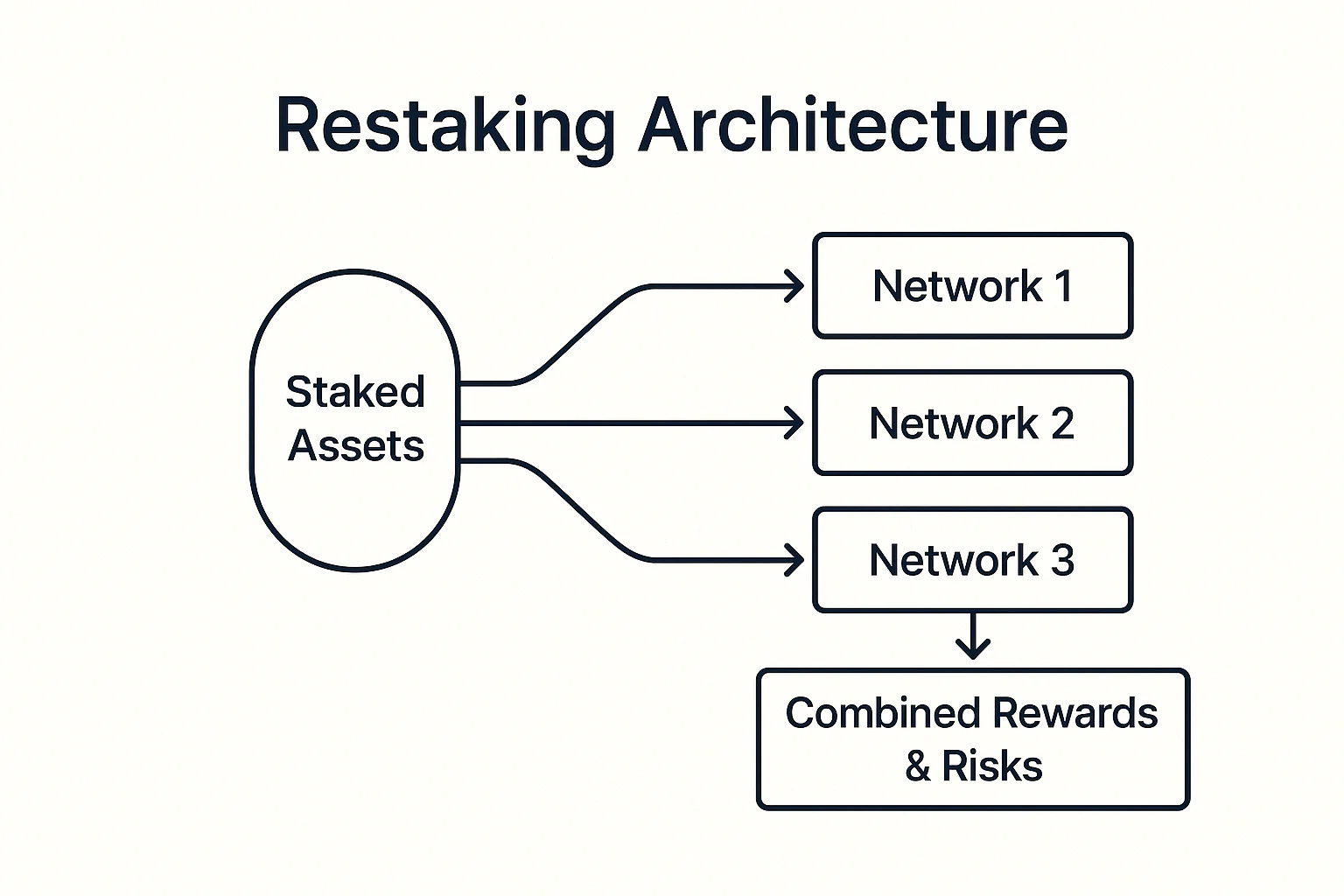
Restaking architecture diagram showing staked assets securing multiple networks with combined rewards and risks.

Real-World Examples

  • EigenLayer enables Ethereum validators to restake ETH for securing additional protocols
  • Babylon allows Bitcoin holders to stake their BTC for securing Proof-of-Stake networks
  • Middleware protocols use restaking to bootstrap security from established validator sets

Why Beginners Should Care

Higher yields from restaking can significantly improve returns on staked assets, but come with proportionally increased risk of slashing penalties.

Complexity increases with multiple slashing conditions and service requirements that validators must understand and manage properly.

Early experimentation makes restaking protocols less proven than traditional staking, requiring careful risk assessment before committing significant funds.

Related Terms: Staking, Slashing, Validator, Yield Stacking

Back to Crypto Glossary

Similar Posts

  • Staking Rewards

    Staking Rewards: Earning from Network Security Staking rewards compensate users for locking up cryptocurrency to help secure proof-of-stake networks. It’s like earning interest for helping guard the bank vault. Staking rewards are cryptocurrency payments earned by users who lock up tokens to participate in proof-of-stake network consensus and security. These rewards incentivize honest participation while…

  • Public Ledger

    Public Ledger: Transparent Transaction Records Public ledgers record all transactions transparently where anyone can verify the complete history of asset movements. It’s like having a bank statement that everyone can read but no one can forge. A public ledger is a distributed database that records all transactions transparently, allowing anyone to verify and audit the…

  • Trading Pairs

    Trading Pairs: Currency Exchange MarketsTrading pairs represent the exchange rate between two different cryptocurrencies or assets. They're like forex pairs but for digital currencies.A trading pair consists of two assets that can be traded against each other, showing the exchange rate between them. Trading pairs enable price discovery and liquidity for cryptocurrency markets.How Trading Pairs WorkBase…

  • DeFi Primitives

    DeFi Primitives: Basic Building BlocksDeFi primitives are fundamental financial functions like lending, borrowing, and trading that serve as building blocks for more complex decentralized finance applications. They're like Lego blocks for financial services.DeFi primitives refer to basic financial functions implemented as smart contracts that can be combined to create more complex financial products and services. These…

  • DeFi Security

    DeFi Security: Protecting Decentralized FinanceDeFi security involves protecting decentralized finance protocols and users from smart contract vulnerabilities, economic attacks, and operational risks. It's cybersecurity for programmable money.DeFi security encompasses the practices, technologies, and protocols used to protect decentralized finance applications from hacks, exploits, and other security threats. This includes smart contract auditing, economic security, and user…

  • Block Reward

    Block Reward: Miner and Validator Compensation Block rewards are the cryptocurrency payments that miners and validators receive for successfully adding new blocks to the blockchain. It’s how networks incentivize security without charging transaction fees. Block reward is the amount of cryptocurrency awarded to miners or validators for successfully creating and validating a new block on…