
Smart Order Routing

Smart Order Routing: Optimal Trade Execution

Smart order routing automatically finds the best prices across multiple exchanges and liquidity sources for each trade. It’s like having a shopping bot that checks every store for the best deal.

Smart order routing is an algorithmic system that automatically splits and routes orders across multiple trading venues to achieve optimal execution prices and minimize market impact. This technology maximizes value for traders by finding the best available liquidity.

How Smart Order Routing Works

Liquidity aggregation scans multiple exchanges, DEXs, and market makers to identify the best available prices for required trade sizes.

Order splitting divides large trades into smaller pieces distributed across multiple venues to reduce price impact and improve overall execution.

Real-time optimization continuously adjusts routing decisions based on changing market conditions, fees, and liquidity availability.
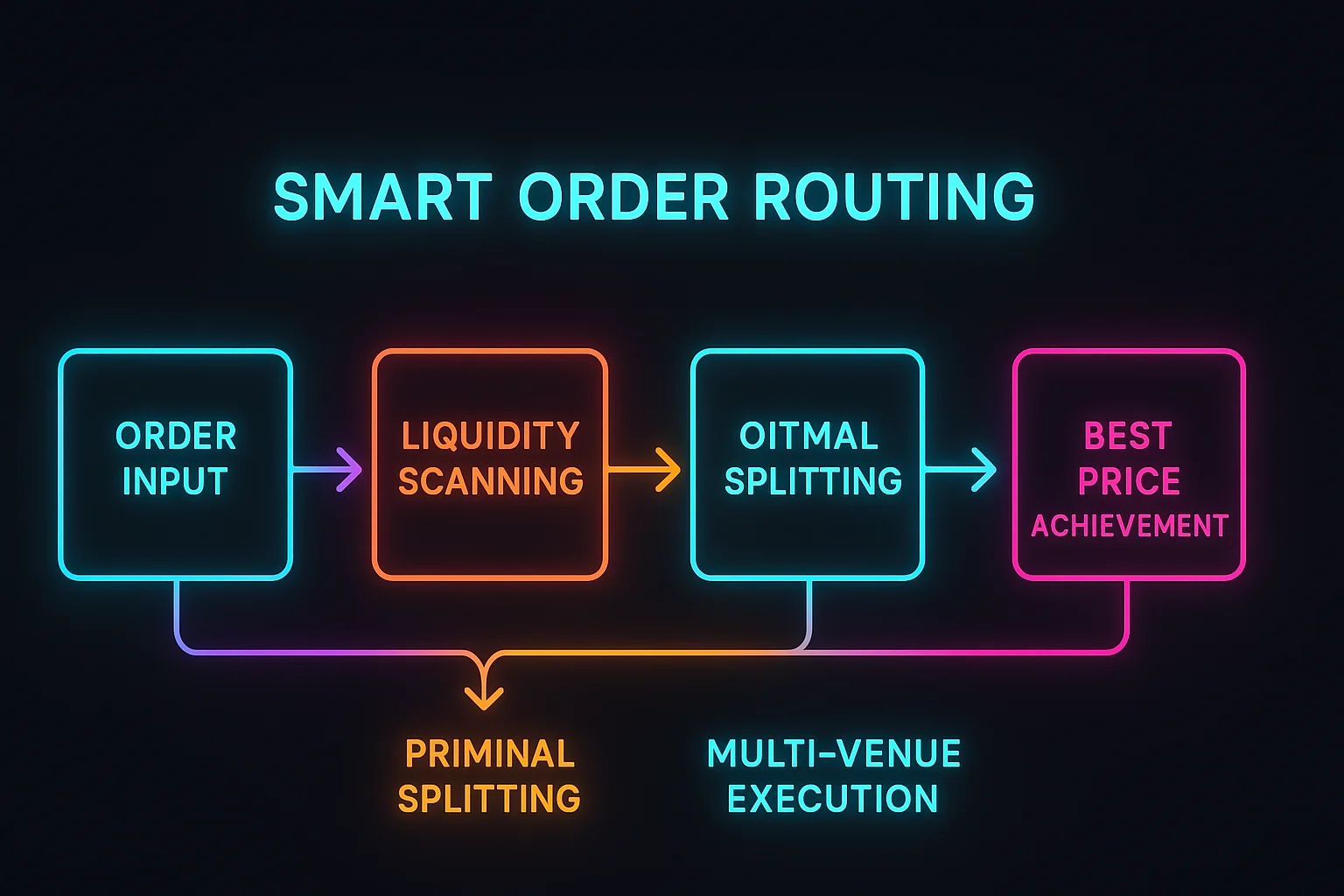
Smart order routing diagram showing order input, liquidity scanning, optimal splitting, multi-venue execution, and best price achievement

Real-World Examples

  • 1inch aggregates DEX liquidity to find optimal trading routes across DeFi protocols
  • CoW Protocol uses batch auctions and routing to improve execution quality
  • Traditional finance has used smart order routing for decades to optimize institutional trading

Why Beginners Should Care

Better prices through automatic optimization that individual traders couldn’t achieve manually across multiple platforms.

Reduced slippage by splitting large orders and finding optimal liquidity sources rather than dumping orders on single exchanges.

Complexity abstraction hides sophisticated routing logic behind simple trading interfaces that anyone can use.

Related Terms: DEX Aggregator, Slippage, Liquidity, Price Impact

Back to Crypto Glossary

Similar Posts

  • Token Delisting

    Token Delisting: Removal from Trading PlatformsToken delisting occurs when exchanges remove cryptocurrencies from their trading platforms. It's like a store deciding to stop selling a particular product and removing it from their shelves.Token delisting refers to the removal of cryptocurrency tokens from exchange trading platforms, making them unavailable for purchase or sale on those specific…

  • Validator Jailing

    Validator Jailing: Temporary Network Punishment Validator jailing temporarily removes misbehaving validators from consensus participation while allowing them to return after penalties. It’s like being sent to the penalty box in hockey. Validator jailing is a punishment mechanism that temporarily excludes validators from consensus participation and rewards due to violations like extended downtime or rule infractions….

  • Atomic Transaction

    Atomic Transaction: All-or-Nothing OperationsAn atomic transaction either completes entirely or fails completely, with no partial execution possible. It's like a package deal where you get everything or nothing at all.An atomic transaction is an operation that either succeeds completely or fails entirely, ensuring that all components of a complex transaction execute together or none execute…

  • Value Capture

    Value Capture: Extracting Economic BenefitsValue capture refers to mechanisms that extract and redirect economic value from ecosystem activity to specific stakeholders or protocols. It's like having toll booths that collect fees from traffic flowing through valuable infrastructure.Value capture describes mechanisms that extract economic value from ecosystem activity and redirect it to token holders, protocols, or…

  • DPoS

    DPoS: Democratic Blockchain GovernanceDelegated Proof of Stake (DPoS) is a consensus mechanism where token holders vote for representatives who validate transactions on their behalf. It's like electing politicians to make decisions for the community.Delegated Proof of Stake (DPoS) is a consensus mechanism where token holders vote for a limited number of delegates who are responsible…

  • |

    Bridgeless Interop

    Bridgeless Interop: Direct Cross-Chain Communication Bridgeless interoperability enables direct communication between blockchains without traditional bridge infrastructure. It’s like having chains that can talk directly to each other instead of using translators. Bridgeless interoperability refers to cross-chain communication methods that don’t rely on traditional bridge protocols, instead using native blockchain features or specialized infrastructure for direct…