
Sniper Bot

Sniper Bot: Automated MEV Extraction

Sniper bots automatically execute trades ahead of other users to capture arbitrage opportunities and extract MEV. They’re the high-frequency traders of DeFi, but without regulatory oversight.

A sniper bot is an automated program that monitors blockchain mempools for profitable trading opportunities and executes transactions faster than human traders. These bots specialize in front-running, arbitrage, and MEV extraction across DeFi protocols.

How Sniper Bots Work

Mempool monitoring tracks pending transactions before they’re included in blocks, identifying profitable opportunities like large trades that will move prices.

Gas price optimization ensures bot transactions get prioritized by miners through higher fees, often paying 10-100x normal gas prices for speed advantages.

Atomic execution combines multiple trades into single transactions that either complete entirely or fail completely, eliminating partial execution risks.
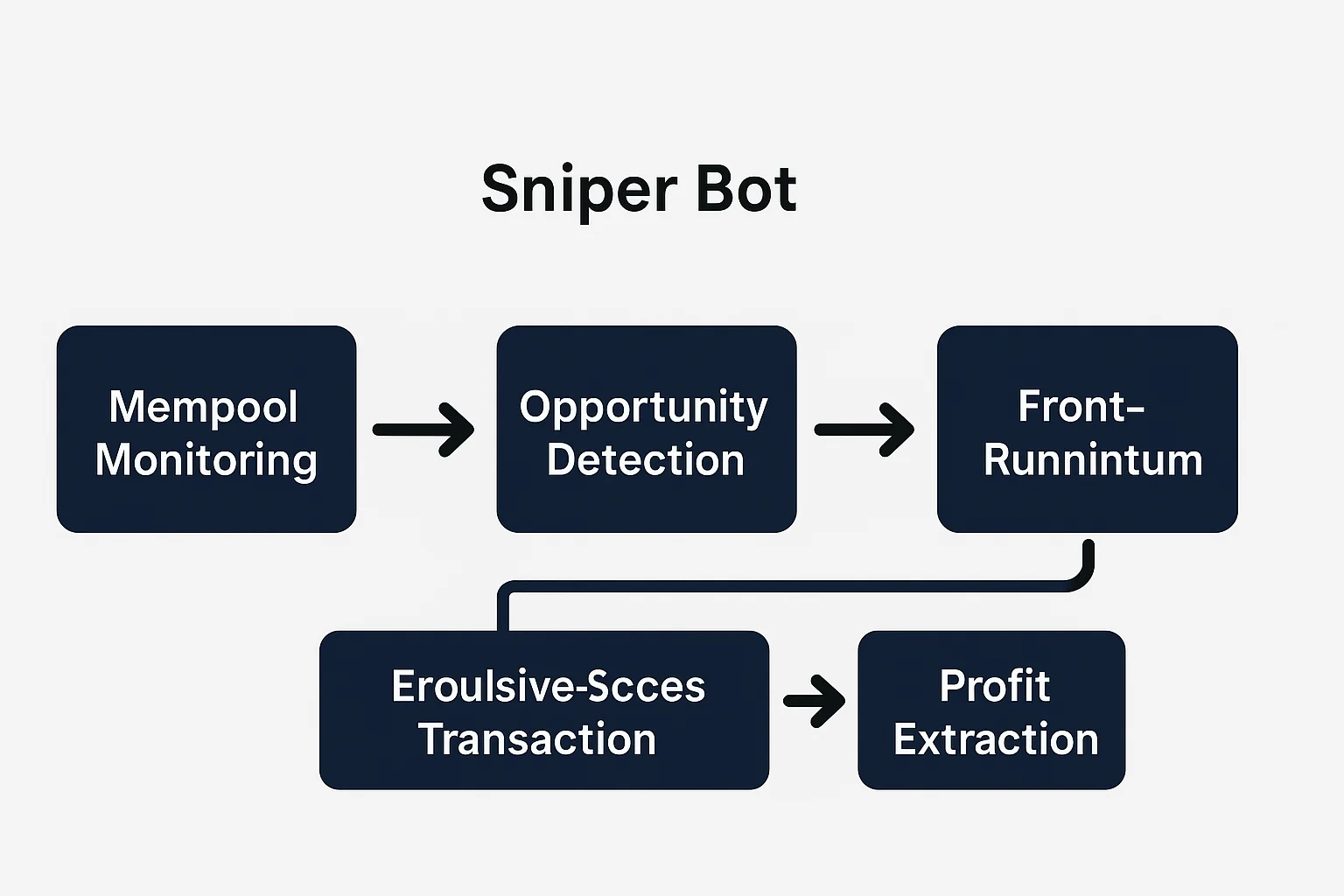
Sniper bot operation flowchart showing mempool monitoring, opportunity detection, front-running, and profit extraction steps.

Real-World Examples

  • DEX arbitrage bots exploit price differences between Uniswap, SushiSwap, and other exchanges
  • Liquidation bots compete to liquidate undercollateralized positions for profit
  • NFT sniping involves bots purchasing underpriced NFTs milliseconds after listing

Why Beginners Should Care

Hidden tax on regular users as sniper bots extract value from almost every large DeFi transaction through increased slippage and worse execution prices.

Technical arms race makes it nearly impossible for manual traders to compete with sophisticated bots that can execute trades in milliseconds.

Protocol responses include MEV-protected RPCs, private mempools, and fair sequencing services that aim to reduce bot advantages.

Related Terms: MEV, Front-Running, Arbitrage, Gas Price

Back to Crypto Glossary

Similar Posts

  • Satoshi

    Satoshi: Bitcoin's Smallest UnitA satoshi is the smallest unit of bitcoin, equal to 0.00000001 BTC. It's named after Bitcoin's pseudonymous creator and makes bitcoin divisible for everyday transactions.A satoshi (sat) is the smallest divisible unit of bitcoin, representing one hundred millionth of a bitcoin. This granular divisibility enables bitcoin to function as digital cash for transactions…

  • Smart Contract Royalties

    Smart Contract Royalties: Automated Creator Payments Smart contract royalties automatically pay creators a percentage every time their NFTs are resold. It’s like having a永続 commission that follows your work forever. Smart contract royalties are automated payment mechanisms built into NFT contracts that send a percentage of each resale back to the original creator. These payments…

  • Wei

    Wei: Ethereum's Smallest UnitWei is the smallest denomination of Ethereum, similar to how cents are the smallest unit of dollars. It's like measuring distances in millimeters when you need precision, even though we usually think in meters or kilometers.Wei represents the smallest possible unit of Ethereum (ETH), with one ETH equal to 1,000,000,000,000,000,000 (10^18) wei. This…

  • DeFi Primitives

    DeFi Primitives: Basic Building BlocksDeFi primitives are fundamental financial functions like lending, borrowing, and trading that serve as building blocks for more complex decentralized finance applications. They're like Lego blocks for financial services.DeFi primitives refer to basic financial functions implemented as smart contracts that can be combined to create more complex financial products and services. These…

  • Impermanent Loss

    Impermanent Loss: The Hidden Cost of Liquidity Providing Impermanent loss is the sneaky tax on liquidity providers. Your tokens can lose value even when the pool is profitable. It’s math, not magic – but it feels like getting robbed. Impermanent loss occurs when the price ratio of tokens in a liquidity pool changes compared to…

  • Appchain

    Appchain: Application-Specific Blockchains Appchains are blockchains designed for single applications or use cases rather than general-purpose smart contracts. They’re like having a dedicated highway for one type of vehicle instead of mixed traffic. An appchain is a blockchain optimized for a specific application or use case rather than supporting general-purpose smart contracts. This specialization enables…