
Play-to-Earn (P2E)

Play-to-Earn (P2E): Gaming Meets Income

Play-to-earn games let players earn cryptocurrency and NFTs through gameplay. It’s turned gaming from entertainment expense into potential income source for millions worldwide.

Play-to-earn (P2E) is a gaming model where players earn cryptocurrency tokens, NFTs, or other digital assets with real-world value through gameplay activities. Players own in-game assets that can be traded or sold outside the game.

How Play-to-Earn Works

Blockchain integration records game assets as NFTs and tracks token rewards on public ledgers. This gives players true ownership of items that persist even if the game company disappears.

Earning mechanisms include completing quests, winning battles, breeding creatures, or providing value to other players through crafting or services within the game economy.

Scholarship programs allow players without startup capital to borrow expensive NFT characters from investors, splitting earnings between player labor and investor capital.
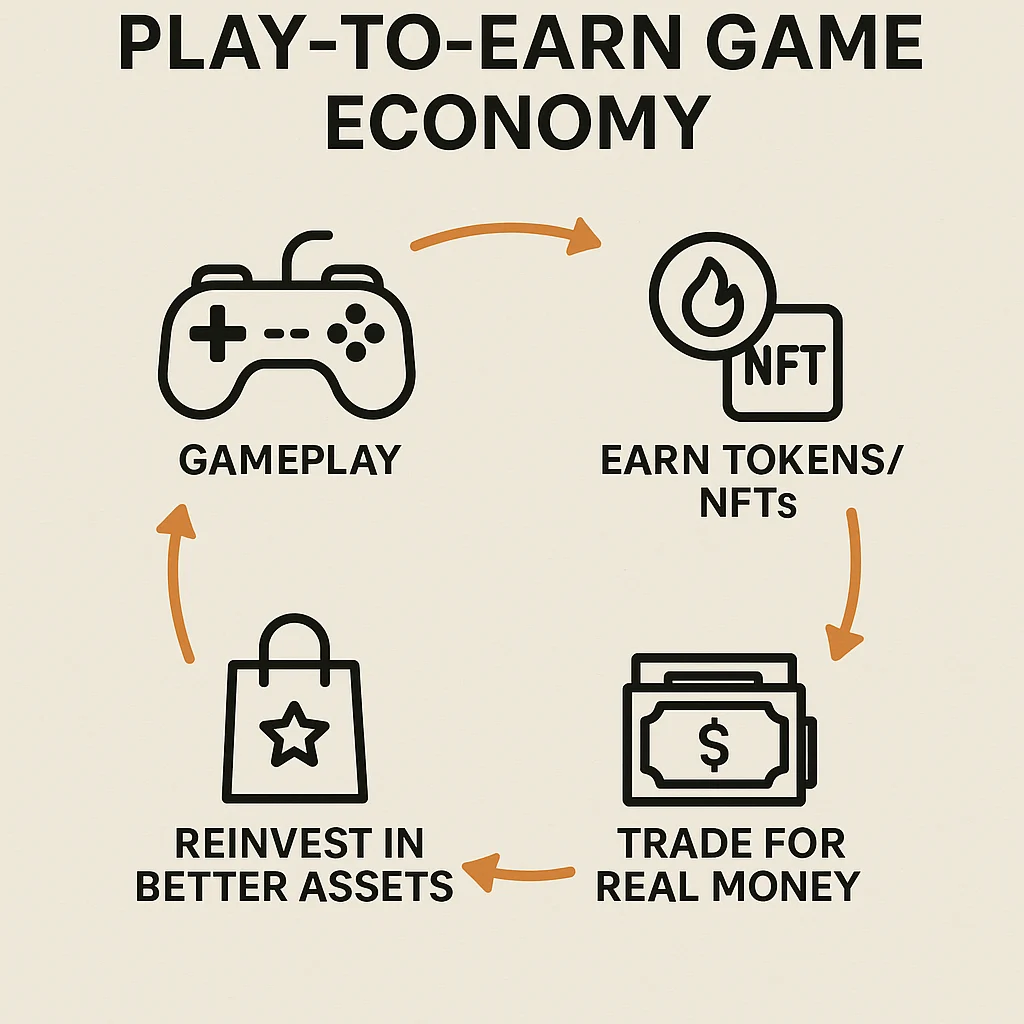
Infographic showing play-to-earn game economy cycle from gameplay to earning tokens/NFTs, trading for money, and reinvesting in assets

Real-World Examples

  • Axie Infinity – Players earned thousands monthly during peak, especially in Philippines and Venezuela
  • Splinterlands – Card-based battles with tradeable NFT cards and daily token rewards
  • STEPN – Move-to-earn app rewarding users for walking and running

Why Beginners Should Care

P2E can provide real income in countries with lower living costs, but earnings have crashed dramatically from 2021-2022 peaks as token prices fell and player bases saturated.

High upfront costs often required to start playing – quality NFT characters can cost hundreds or thousands of dollars before earning anything.

Sustainability questions remain about whether P2E economies can maintain high earning rates as player bases grow and token inflation increases.

Related Terms: NFT, Gaming Token, Metaverse, Scholarship

Back to Crypto Glossary

Similar Posts

  • Back Running

    Back Running: Following Profitable TransactionsBack running involves placing transactions immediately after profitable transactions to capture secondary opportunities. It's like following successful traders to pick up the crumbs they leave behind.Back running is a MEV extraction strategy where bots place transactions immediately after profitable transactions to capture residual value or secondary opportunities. This technique exploits the predictable…

  • Verifiable Randomness

    Verifiable Randomness: Provably Fair Random NumbersVerifiable randomness provides cryptographically secure random numbers that can be independently verified for fairness. It's like having dice that everyone can mathematically confirm are not loaded.Verifiable randomness refers to random number generation systems that produce unpredictable outputs while providing cryptographic proofs that the randomness is fair and unbiased. This enables trustless…

  • Real Yield

    Real Yield: Sustainable Return GenerationReal yield refers to returns generated from actual economic activity and revenue rather than token emissions or inflationary rewards. It's like earning interest from a bank's profitable lending operations instead of them just printing more money to pay you.Real yield describes investment returns generated from genuine economic activity, protocol revenue, or…

  • Atomic Swap

    Atomic Swap: Trustless Cross-Chain Trading Atomic swaps enable direct trading between different cryptocurrencies without exchanges or intermediaries. Either both trades complete successfully, or neither happens – no middle ground. An atomic swap is a smart contract technology that enables the exchange of cryptocurrencies from different blockchains without requiring a trusted third party. The swap either…

  • Governance Token

    Governance Token: Voting Rights in Digital Form Governance tokens turn users into stakeholders with voting power over protocol decisions. It’s democracy meets DeFi, with mixed results. A governance token grants holders voting rights on protocol decisions like parameter changes, upgrade proposals, treasury spending, and strategic direction. Token weight typically determines voting power – more tokens…

  • Peer-to-Peer (P2P)

    Peer-to-Peer (P2P): Direct Network Communication Peer-to-peer networks enable direct communication between participants without central intermediaries. It’s like having a telephone system where everyone connects directly instead of going through switchboard operators. Peer-to-peer (P2P) refers to network architectures where participants communicate directly with each other rather than through centralized servers or intermediaries. This creates decentralized systems…