
Public Key

Public Key: Your Crypto Receiving Address

Your public key is like your email address for crypto – you can share it freely without security concerns.

A public key is cryptographically derived from your private key and generates your wallet addresses where others can send you cryptocurrency. It’s mathematically linked to your private key but reveals nothing about it.

How Public Keys Work

Your private key mathematically generates your public key through one-way cryptographic functions. This public key then creates your wallet addresses.

Anyone can use your public key to verify that transactions were actually signed by your private key, but they can’t work backwards to discover your private key.

It’s like a mathematical lock that only your private key can open, but everyone can verify the lock belongs to you.
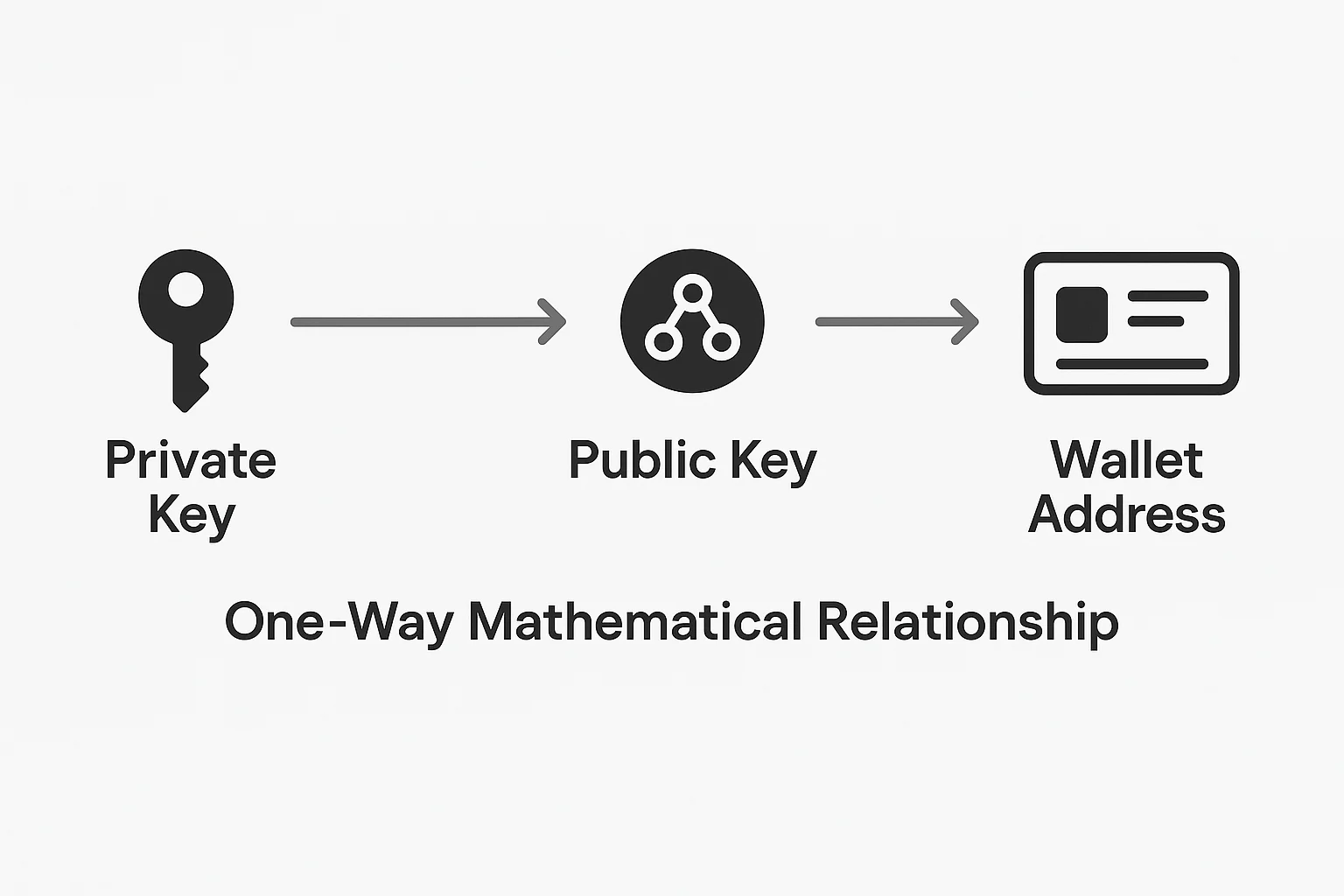
Diagram showing one-way cryptographic relationship from private key to public key to wallet address

Real-World Examples

  • Bitcoin addresses start with 1, 3, or bc1 and are derived from public keys
  • Ethereum addresses are 42-character strings starting with 0x
  • QR codes often encode public keys for easy mobile payments

Why Beginners Should Care

Understanding the private key/public key relationship helps you grasp crypto security fundamentals. Your public information (addresses) can be shared freely, while your private information (keys) must remain secret.

This cryptographic system enables trustless transactions. People can send you crypto without knowing anything about you except your public address.

Related Terms: Private Key, Wallet Address, Digital Signature, Cryptography

Back to Crypto Glossary

Similar Posts

  • Appchain

    Appchain: Application-Specific Blockchains Appchains are blockchains designed for single applications or use cases rather than general-purpose smart contracts. They’re like having a dedicated highway for one type of vehicle instead of mixed traffic. An appchain is a blockchain optimized for a specific application or use case rather than supporting general-purpose smart contracts. This specialization enables…

  • Sanctions

    Sanctions: Government Financial RestrictionsCryptocurrency sanctions involve government restrictions on specific addresses, entities, or services to prevent them from accessing financial systems. They're economic weapons adapted for the digital age.Sanctions refer to government-imposed restrictions that prohibit individuals, entities, or services from accessing financial systems or conducting specific activities. In crypto, this includes blocking addresses and restricting access…

  • EigenLayer

    EigenLayer: Ethereum Restaking ProtocolEigenLayer enables Ethereum validators to restake their ETH to secure additional protocols and earn extra rewards. It's like using the same security deposit to protect multiple different services simultaneously.EigenLayer is a protocol that allows Ethereum validators to restake their staked ETH to provide security for additional protocols and services beyond Ethereum itself. This…

  • Algorithmic Stablecoin

    Algorithmic Stablecoin: Code-Controlled Price StabilityAlgorithmic stablecoins maintain price stability through automated mechanisms rather than asset backing. They're like self-driving cars for currency stability – controlled by code instead of human intervention.An algorithmic stablecoin is a cryptocurrency that maintains price stability through automated protocols and market mechanisms rather than collateral backing. These systems use smart contracts to…

  • Floor Price

    Floor Price: The Cheapest Entry Point Floor price is the lowest price you can buy into an NFT collection. It’s the most watched metric in NFT trading and often determines a project’s perceived value. Floor price is the lowest listed price for any NFT in a collection on marketplaces. It represents the minimum cost to…

  • Meta Transactions

    Meta Transactions: Gasless User InteractionsMeta transactions enable users to interact with blockchain applications without paying gas fees directly. It's like having someone else pay your transaction fees while you control the actual operations.Meta transactions are blockchain transactions where the gas fees are paid by a third party (relayer) while the user maintains control over the…