
Restaking Slashing

Restaking Slashing: Enhanced Penalty Risks

Restaking slashing involves penalties from multiple protocols simultaneously, amplifying potential losses for validators who secure additional networks. It’s like being liable for multiple insurance policies with a single accident.

Restaking slashing refers to the enhanced penalty mechanisms that apply when validators use restaked assets to secure multiple protocols, potentially facing slashing from multiple sources for single violations. This creates compounded risk but also enhanced rewards.

How Restaking Slashing Works

Multiple slashing conditions from different protocols can trigger simultaneously, creating larger penalty exposure than traditional single-protocol staking.

Cascading failures may occur when slashing in one protocol affects the validator’s ability to meet requirements in other protocols they’re securing.

Risk amplification means validators face greater potential losses in exchange for earning rewards from multiple sources simultaneously.
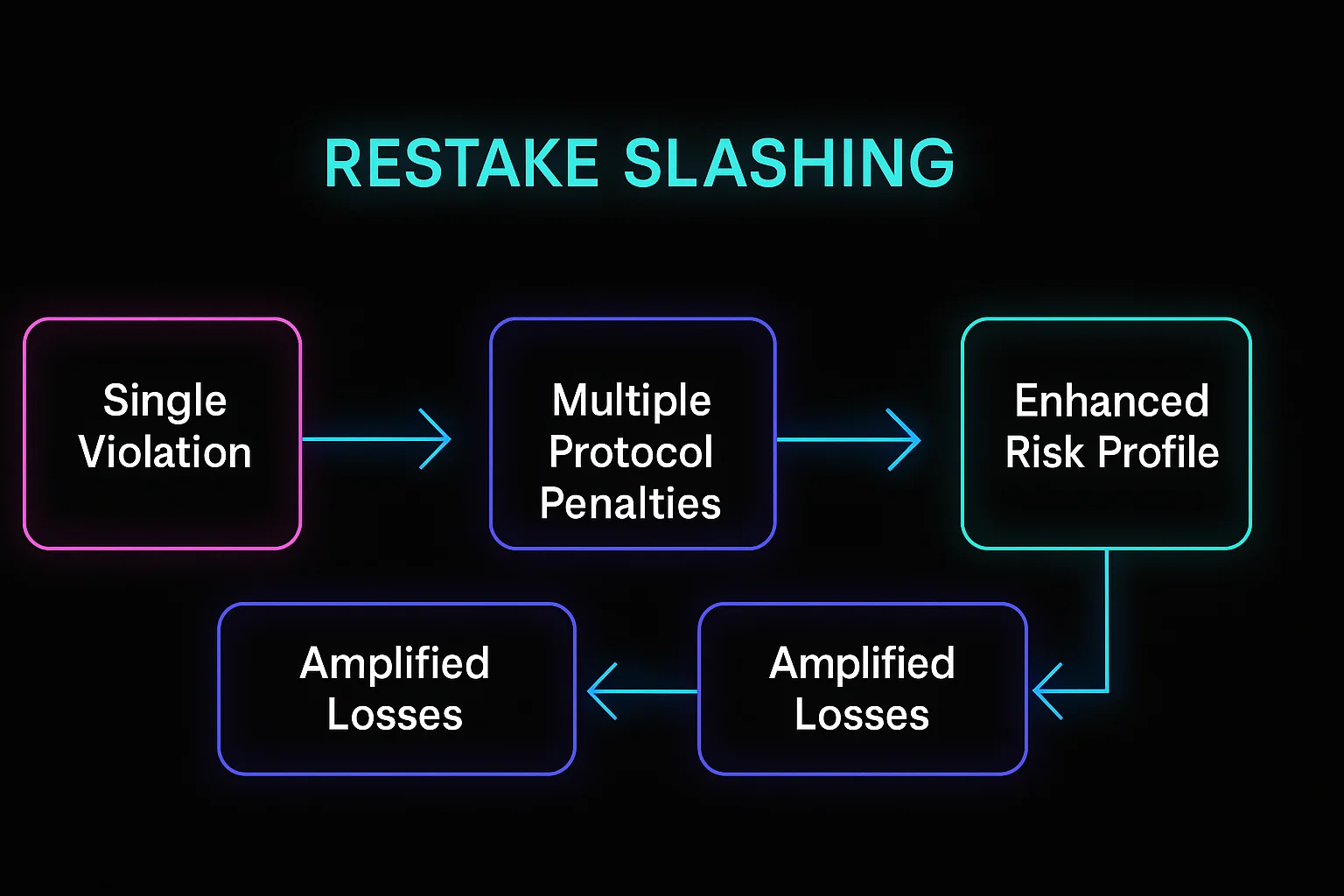
Restaking slashing diagram showing single violation, multiple protocol penalties, amplified losses, and enhanced risk profile

Real-World Examples

  • EigenLayer restaking creates exposure to slashing from both Ethereum and additional protocol violations
  • Babylon Bitcoin staking introduces slashing mechanisms to normally non-slashable Bitcoin
  • Various middleware protocols that add their own slashing conditions to base layer stakes

Why Beginners Should Care

Risk multiplication requires careful consideration of whether enhanced yields justify significantly increased slashing exposure.

Operator selection becomes more critical when choosing validators who must competently manage multiple protocol requirements.

Insurance considerations may become important for large restaking positions given the amplified penalty risks.

Related Terms: Restaking, Slashing, Validator, Risk Management

Back to Crypto Glossary

Similar Posts

  • Transaction Cost

    Transaction Cost: The Price of Blockchain OperationsTransaction cost refers to the total expense of executing operations on blockchain networks, including fees, gas, and opportunity costs. It's the price you pay for using decentralized financial infrastructure.Transaction cost encompasses all expenses associated with executing blockchain operations, including network fees, gas costs, slippage, and time value. Understanding total transaction…

  • Peg Mechanism

    Peg Mechanism: Maintaining Price StabilityPeg mechanisms are systems designed to maintain stable exchange rates between cryptocurrencies and reference assets like fiat currencies. They're like autopilot systems that keep stablecoins flying at steady altitudes.A peg mechanism is a system that maintains the exchange rate of one asset relative to another through automatic adjustments, reserves, or market…

  • Anti-Sybil Mechanism

    Anti-Sybil Mechanism: Preventing Fake Identity Attacks Anti-Sybil mechanisms prevent individuals from creating multiple fake identities to gain unfair advantages in voting, airdrops, or governance systems. They’re like requiring photo ID to prevent ballot stuffing. Anti-Sybil mechanisms are systems designed to prevent or detect when single entities create multiple fake identities to manipulate voting, governance, or…

  • EVM Compatibility

    EVM Compatibility: Ethereum Code EverywhereEVM compatibility allows blockchain networks to run Ethereum applications without modification. It's like having different computers that can all run the same software.EVM compatibility refers to blockchain networks that can execute Ethereum smart contracts and support Ethereum-based applications without requiring code changes. This enables easy migration and cross-deployment of Ethereum applications.How EVM…

  • Hash Rate

    Hash Rate: Network Security Measurement Hash rate measures how much computational power secures a blockchain network. Higher hash rates mean stronger security against attacks and manipulation. Hash rate is the total computational power used by miners to process transactions and secure a proof-of-work blockchain network. It’s measured in hashes per second – calculations attempting to…

  • Liquidity Mining

    Liquidity Mining: Earning Tokens for Providing LiquidityLiquidity mining rewards users with tokens for providing liquidity to decentralized exchanges and protocols. It's like getting paid to be a market maker in the digital asset ecosystem.Liquidity mining is an incentive mechanism where DeFi protocols distribute tokens to users who provide liquidity to trading pools, lending markets, or…