
zkSync

zkSync: Ethereum’s Zero-Knowledge Scaling

zkSync is a Layer 2 scaling solution that uses zero-knowledge proofs to bundle transactions while maintaining Ethereum’s security. It’s like having an express lane that’s mathematically guaranteed to follow traffic laws.

zkSync is a zero-knowledge rollup that scales Ethereum by processing transactions off-chain and submitting cryptographic proofs of validity to the main network. It enables faster, cheaper transactions while inheriting Ethereum’s security guarantees.

How zkSync Works

Zero-knowledge proofs validate transaction bundles without revealing individual transaction details, enabling privacy and scalability simultaneously.

Batch processing combines hundreds of transactions into single proofs that get submitted to Ethereum, dramatically reducing per-transaction costs.

EVM compatibility (in zkSync Era) allows existing Ethereum applications to deploy without modification while benefiting from improved performance.
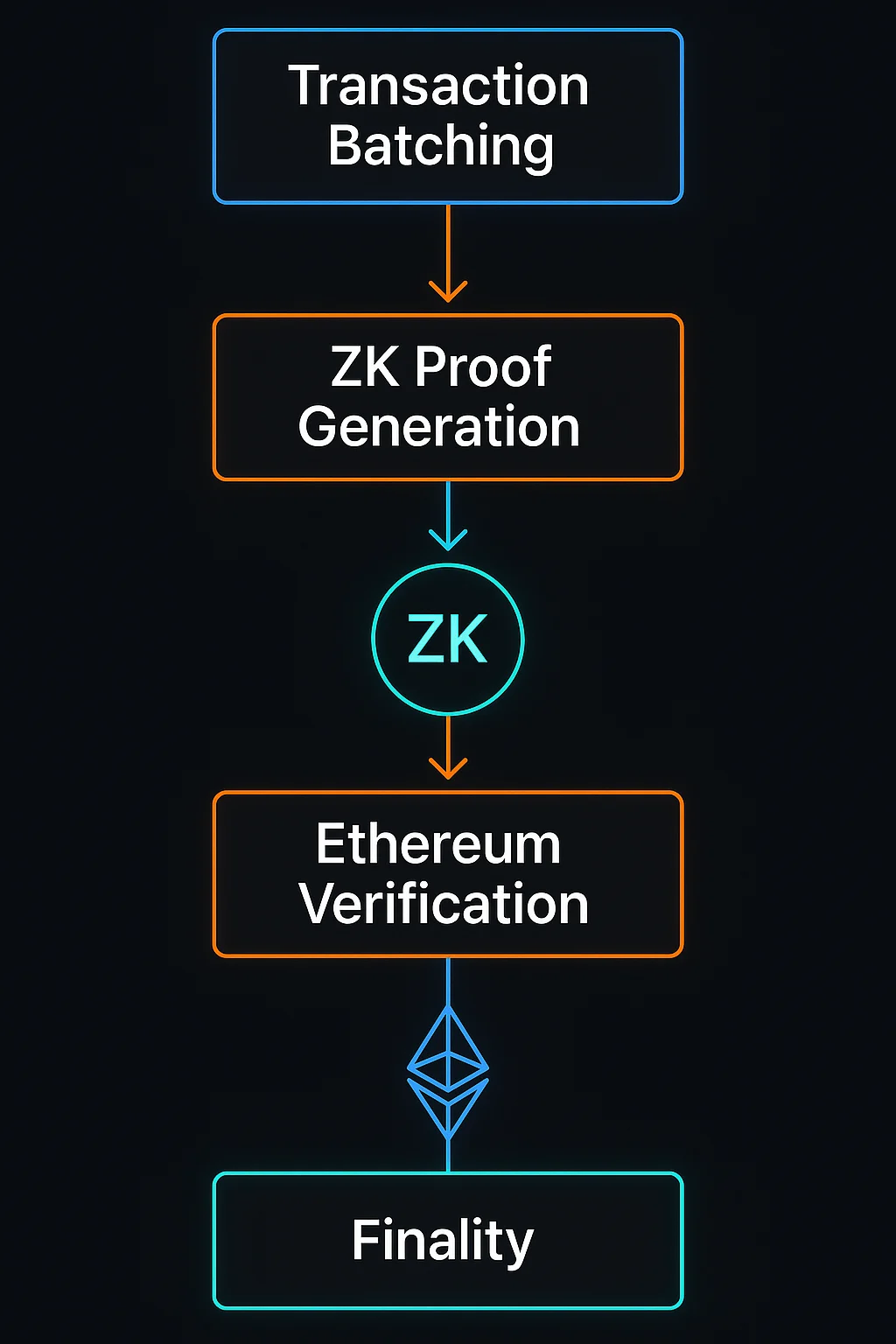
zkSync architecture showing transaction batching, ZK proof generation, Ethereum verification, and finality

Real-World Examples

  • zkSync Era supports full EVM compatibility for seamless dApp migration from Ethereum
  • Major DeFi protocols have deployed on zkSync for lower fees and faster confirmation
  • NFT marketplaces use zkSync to reduce minting and trading costs significantly

Why Beginners Should Care

Significant cost savings compared to Ethereum mainnet while maintaining the same security guarantees through mathematical proofs.

Faster finality for most transactions since ZK proofs provide immediate validity confirmation rather than requiring fraud proof waiting periods.

Technical complexity in ZK proof generation creates different trade-offs compared to optimistic rollups, affecting developer experience and computational requirements.

Related Terms: Zero-Knowledge Proof, Layer 2, Rollups, EVM Compatibility

Back to Crypto Glossary

Similar Posts

  • Price Feed

    Price Feed: Real-Time Market DataPrice feeds provide real-time cryptocurrency market data to applications and smart contracts that need current asset values. They're like financial news tickers that continuously update with the latest stock prices, but for digital assets and automated systems.Price feed refers to continuous streams of current market prices and trading data that supply…

  • Proof of Burn

    Proof of Burn: Destroying Value for Consensus Proof of Burn requires destroying cryptocurrency to participate in consensus or gain network benefits. It’s like burning money to prove you’re serious about network security. Proof of Burn is a consensus mechanism where participants destroy cryptocurrency by sending it to unrecoverable addresses to gain mining rights or network…

  • zk-STARKs

    zk-STARKs: Advanced Zero-Knowledge Proofszk-STARKs are cryptographic proofs that enable verification of computations without revealing underlying data, offering better scalability than earlier zero-knowledge technologies. They're like magic tricks where you can prove the trick worked perfectly without revealing how it was done, even to expert magicians.zk-STARKs (Zero-Knowledge Scalable Transparent Arguments of Knowledge) are advanced cryptographic proofs…

  • Market Maker

    Market Maker: Providing Trading LiquidityMarket makers provide continuous buy and sell orders to ensure trading liquidity and narrow bid-ask spreads. They're like the vendors at a farmer's market who are always ready to trade.A market maker is an individual or entity that provides liquidity to trading markets by continuously offering to buy and sell assets…

  • Sovereignty

    Sovereignty: Independent Control and GovernanceSovereignty in blockchain refers to independent control over governance, economics, and technical decisions without external interference. It's like having your own country with its own rules.Sovereignty refers to complete independence and self-governance for blockchain networks, applications, or communities without requiring permission from or dependence on external authorities. This includes technical, economic, and…

  • Block Confirmation

    Block Confirmation: Transaction Security VerificationBlock confirmation refers to the number of blocks added to the blockchain after a transaction, indicating its security level. It's like waiting for concrete to fully harden before considering construction complete.Block confirmation is the number of blocks that have been added to the blockchain after the block containing a specific transaction. More…