
51% Attack

51% Attack: When Consensus Gets Hijacked

A 51% attack occurs when a single entity controls the majority of a network’s mining power or stake, allowing them to manipulate transactions and double-spend coins.

A 51% attack is when an individual or group controls more than half of a blockchain network’s mining hash rate or staking power, giving them the ability to reverse transactions and manipulate the blockchain. It’s the digital equivalent of hijacking the entire banking system.

How 51% Attacks Work

Majority control allows attackers to mine or validate blocks faster than the honest network, eventually creating a longer chain that becomes the “true” blockchain according to consensus rules.

Double spending becomes possible when attackers reverse their own transactions after receiving goods or services, effectively spending the same coins twice.

Network disruption can halt transaction processing as attackers refuse to include certain transactions in blocks or reorganize the blockchain to exclude them.
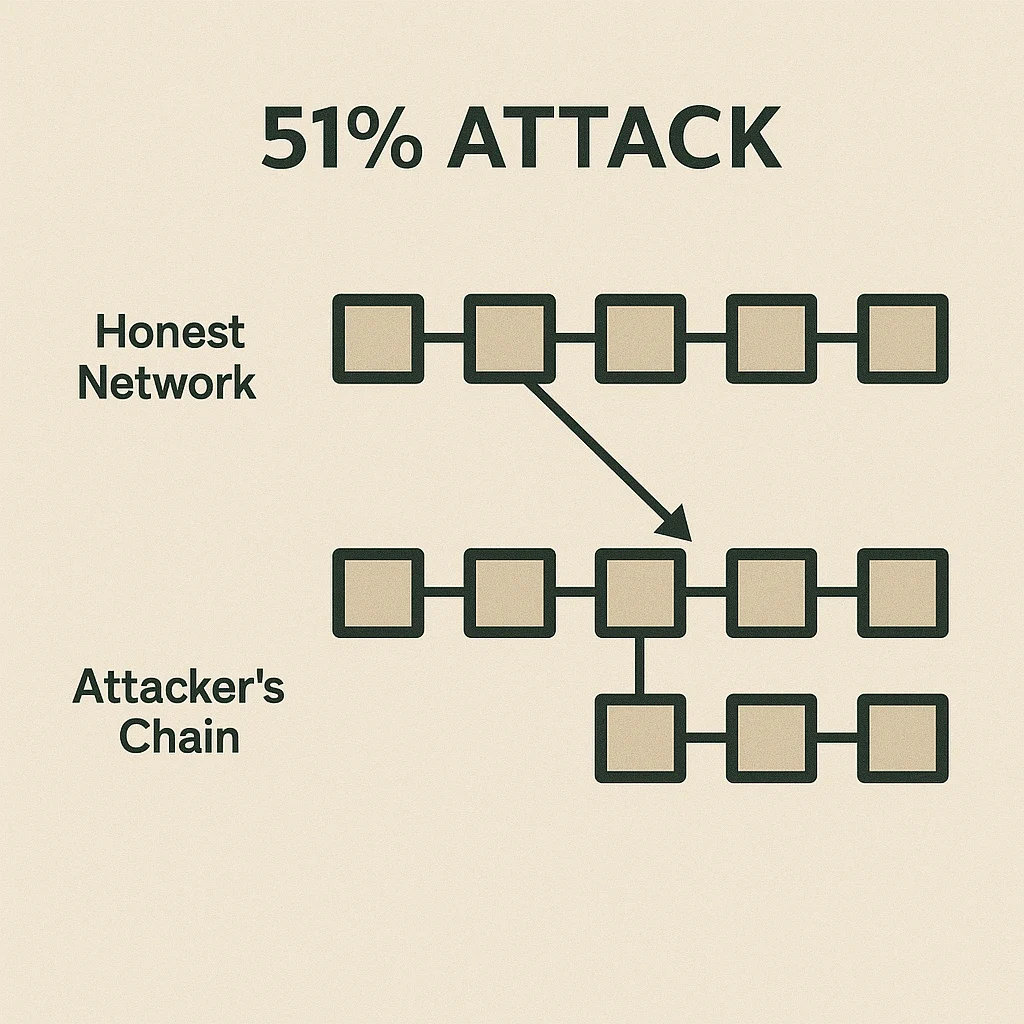
Infographic showing a 51% attack with an honest network and an attacker’s chain that eventually overtakes the main chain

Real-World Examples

  • Bitcoin Gold suffered multiple 51% attacks resulting in millions in double-spent coins
  • Ethereum Classic experienced several attacks after major miners moved to Ethereum mainnet
  • Smaller altcoins are frequent targets due to lower hash rates and cheaper attack costs

Why Beginners Should Care

Network size matters for security. Bitcoin’s massive hash rate makes 51% attacks prohibitively expensive, while smaller networks remain vulnerable to well-funded attackers.

Exchange risks increase during 51% attacks as attackers often target high-value transactions on exchanges through double-spending schemes.

Recovery challenges exist after successful attacks. Networks must decide whether to reverse attacker transactions, which can undermine immutability principles.

Related Terms: Hash Rate, Mining, Consensus Mechanism, Double Spending

Back to Crypto Glossary

Similar Posts

  • LayerZero

    LayerZero: Omnichain Interoperability Protocol LayerZero is an interoperability protocol that enables applications to send messages and transfer assets across different blockchains. It’s like having a universal translator for blockchain networks. LayerZero is a cross-chain communication protocol that enables decentralized applications to operate across multiple blockchains seamlessly. It provides infrastructure for omnichain applications that can access…

  • Resistance

    Resistance: Technical Analysis Price BarriersResistance refers to price levels where cryptocurrency faces selling pressure that prevents further upward movement. It's like hitting an invisible ceiling where the price bounces back down, as if there's a barrier preventing it from going higher.Resistance describes price levels where selling pressure consistently prevents cryptocurrency prices from rising further, creating…

  • Consensus Layer

    Consensus Layer: Network Agreement FoundationThe consensus layer handles how blockchain networks achieve agreement on valid transactions and network state. It's the democratic voting system that keeps everyone on the same page.The consensus layer is the component of blockchain architecture responsible for coordinating agreement among network participants about transaction validity and blockchain state. This layer ensures all…

  • Mixing Service

    Mixing Service: Shuffling Coins for Privacy Mixing services (or tumblers) pool cryptocurrencies from multiple users then redistribute different coins to break transaction links. It’s like exchanging your marked bills for unmarked ones. A mixing service is a privacy tool that pools cryptocurrencies from multiple users and redistributes them to break the link between sending and…

  • Gas Price

    Gas Price: Cost of Ethereum ComputingGas price determines how much you pay per unit of computational work on Ethereum. It's like setting the hourly rate for blockchain computing services.Gas price is the amount of cryptocurrency (usually measured in gwei) that users are willing to pay for each unit of gas consumed by their Ethereum transactions. Higher…

  • ICO

    ICO: Initial Coin OfferingAn ICO is a fundraising method where new cryptocurrency projects sell tokens to early investors. It's like an IPO for stocks, but for new cryptocurrency tokens instead of company shares.An Initial Coin Offering (ICO) is a fundraising mechanism where cryptocurrency projects sell tokens to investors to raise capital for development and operations. ICOs…