
Bonding Curve

Bonding Curve: Algorithmic Token Pricing

Bonding curves use mathematical formulas to automatically price tokens based on supply. As more tokens get bought, prices increase predictably according to the curve’s formula.

A bonding curve is an algorithmic pricing mechanism that determines token price based on token supply through a mathematical function. Prices increase as supply grows and decrease as supply shrinks, creating automatic market making without human intervention.

How Bonding Curves Work

Mathematical formulas like y = x² create predictable price relationships where each additional token costs more than the previous one, generating exponential price growth.

Continuous liquidity exists since the curve itself acts as a market maker, always willing to buy or sell tokens at the current curve price without requiring counterparties.

Price discovery happens algorithmically rather than through order book matching, ensuring tokens always have deterministic prices based on current supply levels.
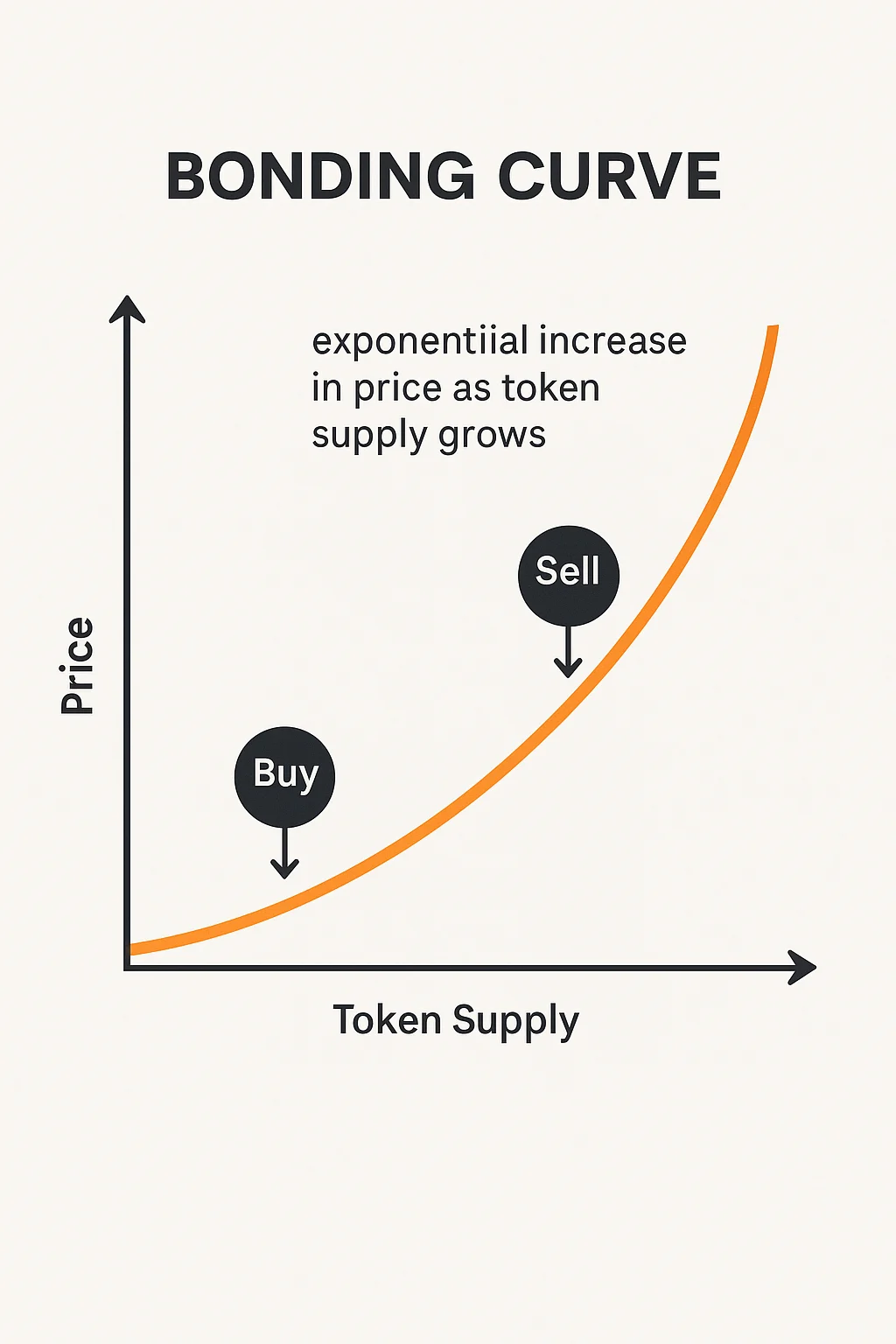
Bonding curve graph showing exponential price increase as token supply grows, with labeled buy and sell points along the curve.

Real-World Examples

  • Bancor protocol pioneered bonding curve AMMs for continuous token liquidity
  • Curation markets use bonding curves to price shares in content or prediction markets
  • Social tokens often launch with bonding curves to bootstrap initial liquidity and price discovery

Why Beginners Should Care

Front-runner advantages exist since early buyers get lower prices while later buyers pay increasingly higher amounts, creating wealth concentration among early adopters.

No liquidity shortages occur with bonding curves since the algorithm always provides liquidity, eliminating concerns about market makers withdrawing support.

Price volatility can be extreme with steep bonding curves where small buy or sell orders create large price movements, especially at low supply levels.

Related Terms: AMM, Price Discovery, Algorithmic Trading, Token Launch

Back to Crypto Glossary

Similar Posts

  • Economic Security

    Economic Security: Financial Incentive ProtectionEconomic security refers to protection mechanisms that use financial incentives and penalties to secure blockchain networks and protocols. It's like having a security system where guards are paid well for protecting property and fined heavily for allowing break-ins.Economic security describes protection mechanisms that use financial incentives, stake requirements, and economic penalties…

  • Self-Sovereign Identity

    Self-Sovereign Identity: You Own Your Digital SelfSelf-sovereign identity puts you in complete control of your personal data and digital credentials. It's like having a passport that you issue and manage yourself, without needing government approval.Self-sovereign identity (SSI) is a digital identity model where individuals have complete control over their personal data, credentials, and identity verification…

  • zk-SNARKs

    zk-SNARKs: Zero-Knowledge Proof Technologyzk-SNARKs are cryptographic proofs that verify information without revealing the underlying data. They're like proving you know a secret without telling anyone what the secret actually is.zk-SNARKs (Zero-Knowledge Succinct Non-Interactive Arguments of Knowledge) are cryptographic proofs that allow verification of computations without revealing the inputs or intermediate steps. This enables privacy and scalability…

  • NFT Lending

    NFT Lending: Borrowing Against Digital Art NFT lending allows using non-fungible tokens as collateral for cryptocurrency loans. It’s like pawning your rare baseball cards, except the cards live in digital wallets. NFT lending enables borrowers to use their non-fungible tokens as collateral to obtain cryptocurrency loans while retaining the potential upside of their digital assets….

  • Anonymity

    Anonymity: Hiding Identity in Digital TransactionsAnonymity in cryptocurrency refers to the ability to conduct transactions without revealing personal identity. It's like wearing a mask that completely hides who you are during financial transactions.Anonymity refers to the state of being unidentifiable in cryptocurrency transactions and blockchain interactions. True anonymity means that transaction participants cannot be linked to…

  • Storage Refund

    Storage Refund: Incentivizing Data CleanupStorage refund mechanisms return gas fees to users who clean up blockchain storage by removing unnecessary data. It's like getting a deposit back when you return empty bottles.Storage refund refers to mechanisms that provide gas fee rebates or payments to users who free up blockchain storage space by deleting data or…