
Dust

Dust: Tiny Amounts That Clog Networks

Dust refers to cryptocurrency amounts so small they’re not economically viable to spend due to transaction fees exceeding their value. It’s like having pennies that cost dollars to use.

Dust consists of very small amounts of cryptocurrency that cost more in transaction fees to send than their actual value. These tiny balances accumulate in wallets over time and can clog network resources if moved.

How Dust Accumulates

Change outputs from transactions often leave small remainders that aren’t worth the gas fees to consolidate or spend separately.

Airdrop residuals may distribute tiny token amounts that become worthless after market prices decline below transaction costs.

Spam attacks deliberately send dust to many addresses to clog networks or track user behavior through forced interactions.
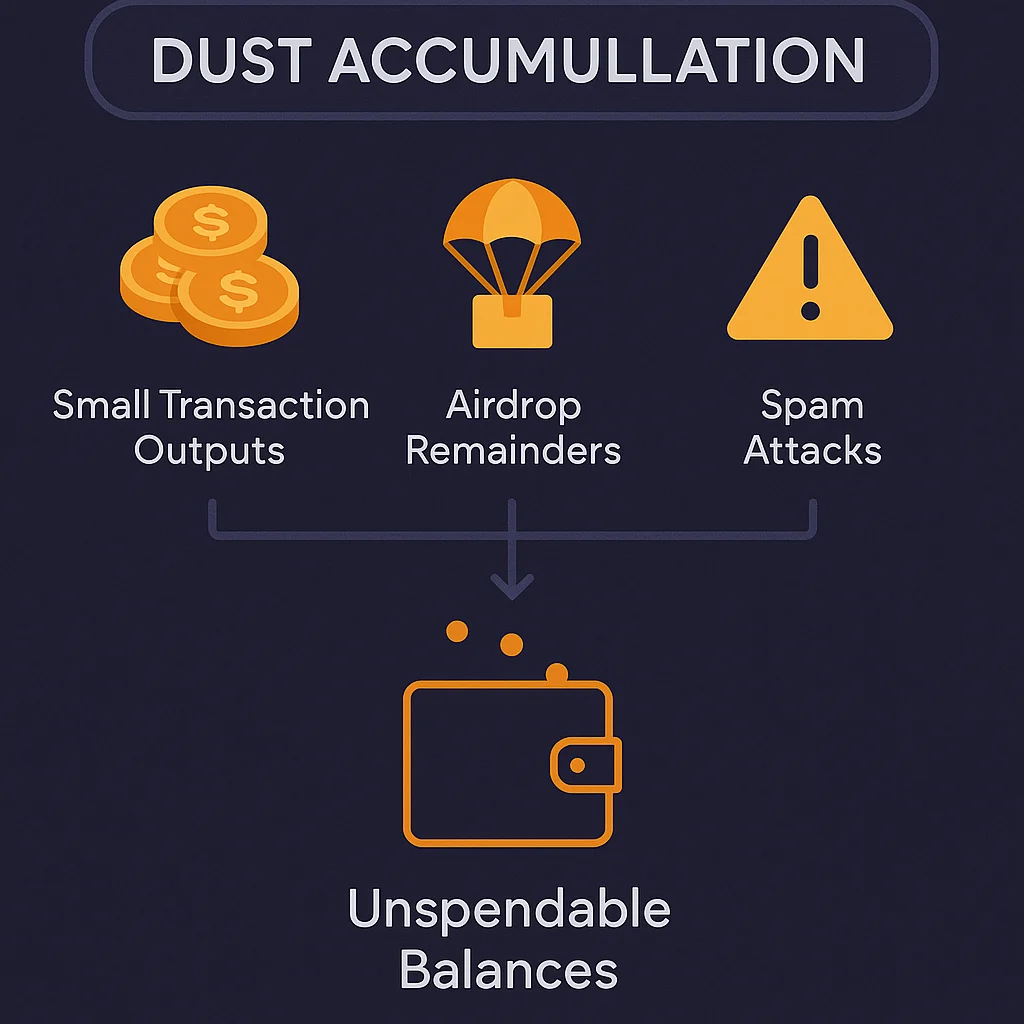
Dust accumulation diagram showing how small transaction outputs, airdrop remainders, and spam attacks lead to unspendable balances in crypto wallets.

Real-World Examples

  • Bitcoin dust limit is around 546 satoshis – amounts below this may be rejected by nodes
  • Ethereum gas fees can make sub-$10 token amounts uneconomical to move during network congestion
  • BSC spam tokens often leave dust amounts that users can’t profitably remove

Why Beginners Should Care

Wallet clutter from dust makes portfolio tracking difficult and can hide significant balances among dozens of worthless token remnants.

Privacy implications exist since dust can be used for tracking purposes when users consolidate small amounts with larger balances.

Network efficiency suffers when dust gets moved, consuming block space for economically insignificant transactions that could handle larger value transfers.

Related Terms: Transaction Fees, UTXO, Dusting Attack, Spam

Back to Crypto Glossary

Similar Posts

  • Peer-to-Peer (P2P)

    Peer-to-Peer (P2P): Direct Network Communication Peer-to-peer networks enable direct communication between participants without central intermediaries. It’s like having a telephone system where everyone connects directly instead of going through switchboard operators. Peer-to-peer (P2P) refers to network architectures where participants communicate directly with each other rather than through centralized servers or intermediaries. This creates decentralized systems…

  • Self-Custody

    Self-Custody: Direct Asset ControlSelf-custody means personally controlling your cryptocurrency private keys rather than trusting third parties to hold your assets. It's like keeping cash in your own safe instead of depositing it in someone else's bank account.Self-custody refers to the practice of personally maintaining control over cryptocurrency private keys and digital assets without relying on…

  • Interoperability

    Interoperability: Blockchain Networks Working TogetherInteroperability enables different blockchain networks to communicate and share information seamlessly. It's like having universal translators for blockchain languages.Interoperability refers to the ability of different blockchain networks to communicate, share data, and interact with each other without requiring centralized intermediaries. This enables cross-chain applications and unified user experiences.How Blockchain Interoperability WorksCross-chain protocols enable…

  • Trading Pairs

    Trading Pairs: Currency Exchange MarketsTrading pairs represent the exchange rate between two different cryptocurrencies or assets. They're like forex pairs but for digital currencies.A trading pair consists of two assets that can be traded against each other, showing the exchange rate between them. Trading pairs enable price discovery and liquidity for cryptocurrency markets.How Trading Pairs WorkBase…

  • Gaming Token

    Gaming Token: In-Game Digital CurrencyGaming tokens are cryptocurrencies designed specifically for use within video games and virtual worlds. They enable player ownership, trading, and monetization of in-game assets and achievements.Gaming tokens are cryptocurrencies created for specific video games or gaming ecosystems, enabling player ownership of in-game assets, rewards, and economic participation. These tokens bridge traditional gaming…

  • Social Engineering

    Social Engineering: Manipulating People for AccessSocial engineering involves manipulating people psychologically to reveal sensitive information or perform actions that compromise security. It's hacking humans instead of computers.Social engineering refers to psychological manipulation techniques used to trick people into revealing confidential information, performing actions, or making security mistakes that benefit attackers. These attacks exploit human psychology rather…