
State Channel

State Channel: Off-Chain Interaction Highways

State channels enable instant, low-cost transactions between parties by moving interactions off-chain while maintaining blockchain security. It’s like having a private highway between two cities.

A state channel is a two-way communication channel between blockchain users that enables off-chain transactions with on-chain security guarantees. Participants can transact instantly and cheaply, settling final balances on the main blockchain.

How State Channels Work

Channel opening requires both parties to lock funds in a smart contract that enforces the rules smart contract rfor off-chain state updates.

Off-chain updates happen instantly between parties without broadcasting to the blockchain, enabling real-time interactions with minimal costs.

Dispute resolution mechanisms allow either party to challenge invalid state updates by submitting proofs to the on-chain contract.
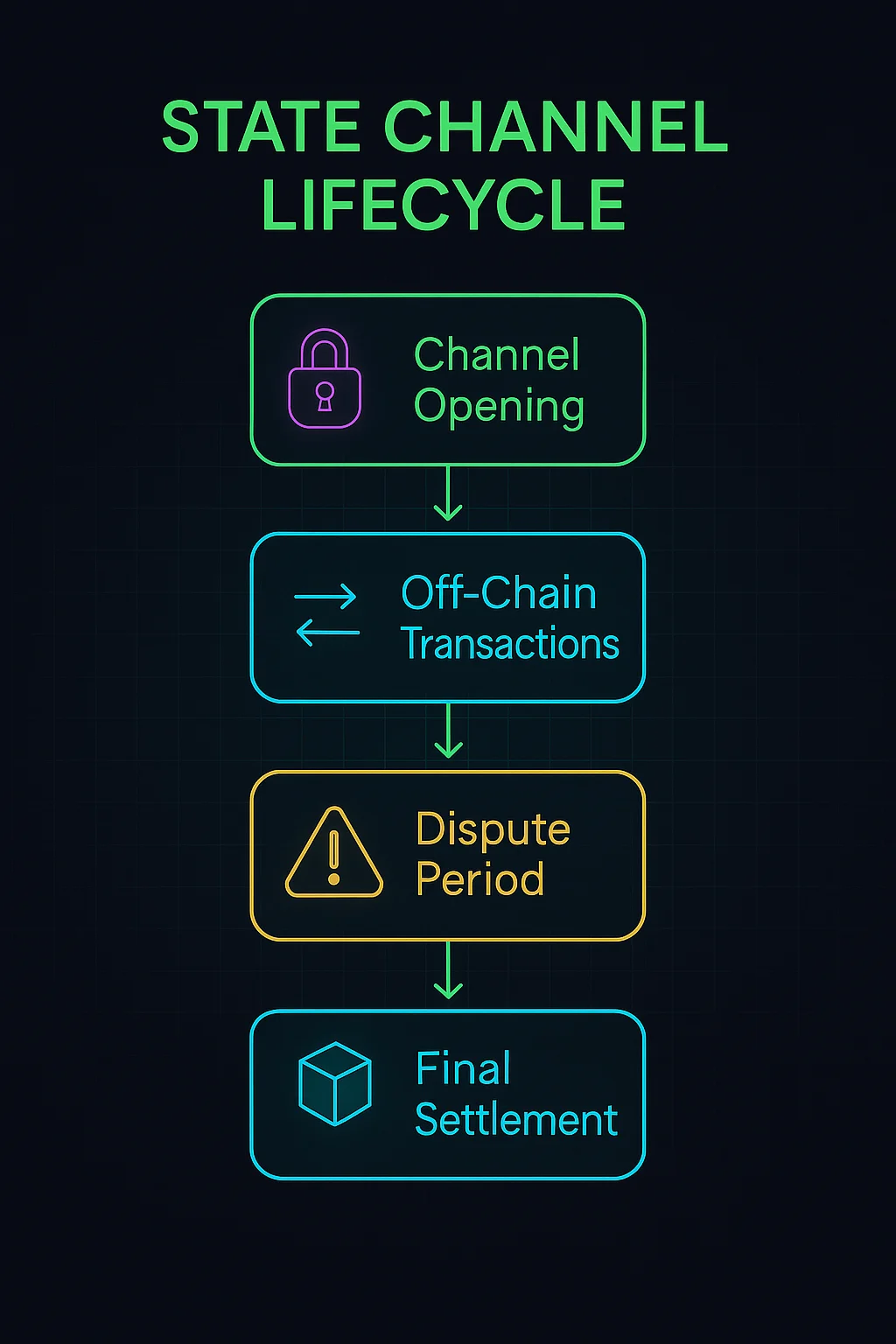
Infographic showing the state channel lifecycle: channel opening, off-chain transactions, dispute period, and final settlement

Real-World Examples

  • Lightning Network enables instant Bitcoin payments through payment channels
  • Connext provides Ethereum state channels for fast, cheap transfers
  • Gaming applications use state channels for real-time multiplayer interactions

Why Beginners Should Care

Instant finality for payments and interactions without waiting for blockchain confirmation times.

Low costs since only channel opening and closing require on-chain transactions regardless of off-chain activity volume.

Complexity requirements for channel management, dispute handling, and liquidity routing that limit mainstream adoption.

Related Terms: Lightning Network, Payment Channel, Layer 2, Dispute Resolution

Back to Crypto Glossary

Similar Posts

  • Market Cycle

    Market Cycle: Recurring Price PatternsMarket cycles are recurring patterns of price movements in cryptocurrency markets driven by investor psychology and market dynamics. They're like seasons that markets go through repeatedly over time.Market cycles refer to recurring patterns of price appreciation and depreciation in cryptocurrency markets driven by alternating periods of optimism and pessimism among investors. These…

  • Pump and Dump

    Pump and Dump: Coordinated Market Manipulation Pump and dump schemes are crypto’s version of old-school stock manipulation. Coordinated groups artificially inflate prices, then dump on unsuspecting victims. A pump and dump is a form of market manipulation where a group artificially inflates an asset’s price through coordinated buying and false promotion, then sells at peak…

  • Voting

    Voting: Decentralized Decision MakingVoting in cryptocurrency enables token holders to participate in governance decisions that shape project direction and protocol changes. It's like being a shareholder who can vote on company decisions, except the company is a decentralized protocol owned by its users.Voting refers to the democratic process where cryptocurrency token holders express preferences on…

  • Intent-Based

    Intent-Based: Goal-Oriented Transaction DesignIntent-based systems allow users to specify desired outcomes rather than exact transaction steps, with the system automatically determining optimal execution paths. It's like telling a travel agent your destination and preferences, then letting them handle all the complex booking details and connections.Intent-based refers to blockchain systems where users express their desired outcomes…

  • DeFi Lending

    DeFi Lending: Decentralized Borrowing and LendingDeFi lending enables cryptocurrency borrowing and lending without traditional financial intermediaries through smart contracts. It's like peer-to-peer banking powered by code instead of humans.DeFi lending refers to decentralized finance protocols that enable users to lend and borrow cryptocurrencies through smart contracts without requiring traditional banks or credit checks. These systems operate…

  • DCA

    DCA: Dollar Cost Averaging Investment StrategyDCA (Dollar Cost Averaging) involves making regular purchases of cryptocurrency regardless of price to reduce timing risk. It's like buying groceries on the same day each week instead of trying to predict when prices will be lowest.Dollar Cost Averaging (DCA) is an investment strategy that involves purchasing cryptocurrency at regular…