
Preconfirmation (Pre-confirm)

Preconfirmation (Pre-confirm): Faster Transaction Guarantees

Preconfirmations provide early guarantees that transactions will be included in upcoming blocks before final confirmation. It’s like getting a reservation confirmation before the restaurant officially opens.

Preconfirmation is a mechanism where validators or sequencers provide early commitments to include specific transactions in future blocks. This reduces user-perceived latency by providing execution guarantees before final settlement.

How Preconfirmations Work

Early commitments from validators signal intent to include transactions in their next block, providing users with confidence about execution timing.

Economic bonds often back preconfirmation promises, with validators facing penalties if they fail to include preconfirmed transactions.

Reduced uncertainty enables applications to provide better user experiences by showing transaction status before final blockchain confirmation.
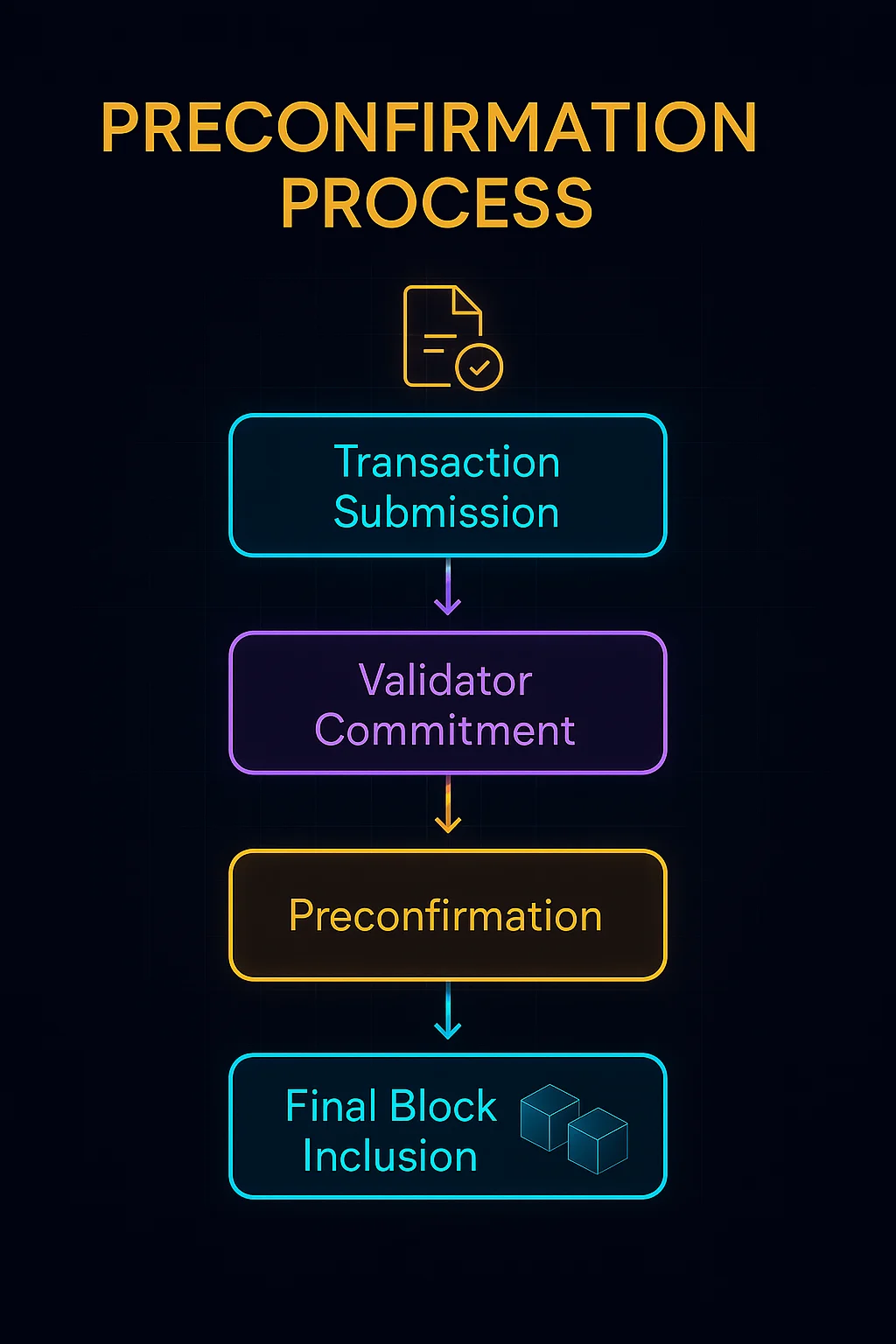
Infographic showing blockchain preconfirmation process: transaction submission, validator commitment, preconfirmation, and final block inclusion

Real-World Examples

  • Layer 2 sequencers provide preconfirmations for faster user feedback on rollup transactions
  • MEV-Boost implementations experiment with preconfirmation mechanisms for Ethereum
  • Application-specific chains often implement preconfirmations for improved user experience

Why Beginners Should Care

Faster feedback improves user experience by reducing perceived transaction latency even when final confirmation takes the same time.

Trust assumptions require believing that validators will honor their preconfirmation commitments rather than waiting for cryptographic finality.

Implementation complexity makes preconfirmations challenging to implement correctly without introducing new attack vectors or centralization risks.

Related Terms: Block Confirmation, Finality, Sequencer

Back to Crypto Glossary

Similar Posts

  • Mining

    Mining: How New Bitcoins Are Created Bitcoin mining is the process that creates new bitcoins and secures the network. It’s like a global lottery where miners compete to solve mathematical puzzles for rewards. Mining is the computational process of validating transactions and adding new blocks to a blockchain while earning newly created cryptocurrency as rewards….

  • Transaction

    Transaction: Moving Value on the BlockchainA cryptocurrency transaction transfers value from one address to another on a blockchain network. It's like writing a check, but with mathematical guarantees instead of trust.A transaction is a digitally signed transfer of cryptocurrency from one wallet address to another, recorded permanently on the blockchain. Every transaction includes sender information, recipient…

  • Yield Optimization

    Yield Optimization: Maximizing Investment ReturnsYield optimization involves strategies and protocols that automatically maximize returns on cryptocurrency investments through dynamic allocation and compounding. It's like having a financial advisor that works 24/7 to find the best returns.Yield optimization refers to automated strategies that maximize returns on cryptocurrency investments by continuously monitoring opportunities and reallocating funds to…

  • Transaction Ordering

    Transaction Ordering: Sequence Control SystemsTransaction ordering determines the sequence in which transactions get processed within blockchain blocks. It's like controlling the line at a busy restaurant.Transaction ordering refers to the process by which blockchain networks determine the sequence of transactions within blocks. This ordering can significantly affect transaction outcomes, especially in DeFi applications sensitive to price…

  • Fractional Ownership

    Fractional Ownership: Shared Asset OwnershipFractional ownership enables multiple people to own portions of expensive assets that would be difficult to purchase individually. It's like buying a slice of expensive real estate instead of the whole property.Fractional ownership refers to dividing ownership of assets into smaller portions that can be owned by multiple parties, typically enabled…

  • Validator

    Validator: Proof-of-Stake Network Guardians Validators are the security backbone of proof-of-stake networks. They propose blocks, verify transactions, and earn rewards for honest behavior. A validator is a network participant in proof-of-stake blockchains who validates transactions, proposes new blocks, and maintains network consensus in exchange for staking rewards. Validators replace miners in PoS systems. How Validators…