
Bull Market

Bull Market: When Everything Goes Up

Bull markets are when crypto investors feel like geniuses. Prices rise, optimism soars, and everyone becomes a trading expert. Until they don’t.

A bull market is a sustained period of rising cryptocurrency prices accompanied by widespread investor optimism. During bull runs, even terrible projects can see massive gains as speculation overtakes fundamentals.

How Bull Markets Work

Bull markets feed on themselves. Rising prices attract new investors, whose buying drives prices higher, attracting even more investors. This creates positive feedback loops that can last months or years.

Media attention amplifies bull markets. Mainstream coverage brings retail investors who have never owned crypto, providing new money to fuel further price increases.

“This time is different” becomes the prevailing sentiment. New investors believe prices will keep rising indefinitely, leading to increasingly risky behavior.
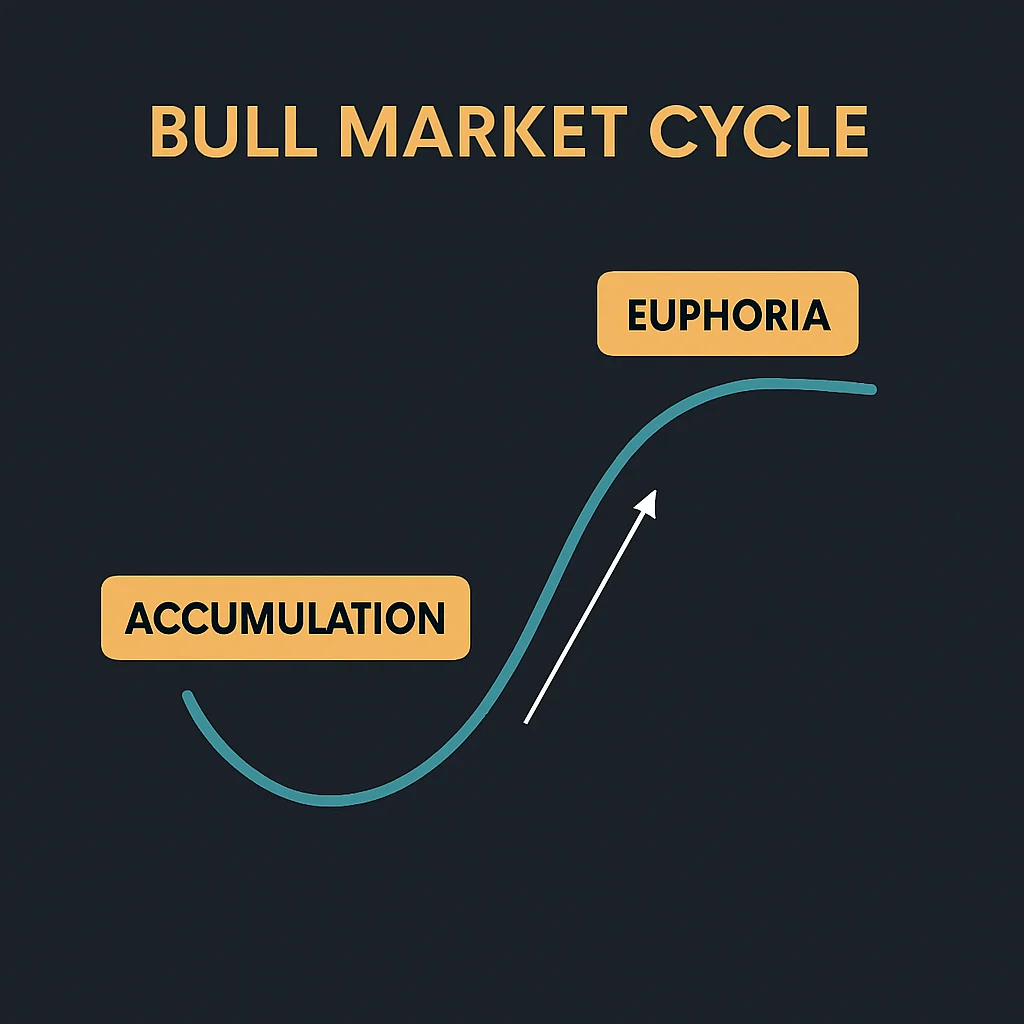
Bull market cycle chart showing phases: accumulation, euphoria, and distribution

Real-World Examples

  • 2017 Bull Run – Bitcoin went from $1,000 to $20,000 in one year
  • 2021 Bull Run – Total crypto market cap reached $3 trillion
  • DeFi Summer 2020 – Decentralized finance tokens gained 1000%+

Why Beginners Should Care

Bull markets create life-changing wealth but also devastating losses. The same psychological forces that drive prices up eventually reverse, often violently.

Smart strategies include taking profits systematically, avoiding leverage, and remembering that bull markets always end. The time to be greedy is when others are fearful, not when everyone’s celebrating.

Related Terms: Bear Market, FOMO, ATH, Market Cycle

Back to Crypto Glossary

Similar Posts

  • Two Way Peg

    Two Way Peg: Bidirectional Asset TransferA two-way peg enables moving assets between different blockchain networks in both directions while maintaining value equivalence. It's like having a currency exchange that works both ways between different countries.A two-way peg is a mechanism that allows assets to move freely between two blockchain networks while maintaining equivalent value on…

  • Floor Price

    Floor Price: The Cheapest Entry Point Floor price is the lowest price you can buy into an NFT collection. It’s the most watched metric in NFT trading and often determines a project’s perceived value. Floor price is the lowest listed price for any NFT in a collection on marketplaces. It represents the minimum cost to…

  • Asset Rehypothecation

    Asset Rehypothecation: Reusing Collateral for Multiple PurposesAsset rehypothecation involves using the same collateral for multiple financial purposes simultaneously. It's like using your house as collateral for multiple loans at the same time.Asset rehypothecation refers to the practice of using deposited or pledged assets as collateral for additional financial activities beyond their original purpose. This can multiply…

  • Pump and Dump

    Pump and Dump: Coordinated Market Manipulation Pump and dump schemes are crypto’s version of old-school stock manipulation. Coordinated groups artificially inflate prices, then dump on unsuspecting victims. A pump and dump is a form of market manipulation where a group artificially inflates an asset’s price through coordinated buying and false promotion, then sells at peak…

  • Synthetic Yield

    Synthetic Yield: Engineered Return Products Synthetic yield creates artificial return streams through derivatives and structured products rather than underlying asset productivity. It’s like manufacturing dividends through financial engineering. Synthetic yield refers to returns generated through derivative strategies, structured products, or financial engineering rather than from the underlying asset’s inherent productivity. These products create yield where…

  • Proof of History

    Proof of History: Solana’s Time Innovation Proof of History creates a cryptographic timestamp that proves events occurred in a specific sequence. It’s like having an unforgeable clock built into the blockchain. Proof of History (PoH) is a consensus mechanism that creates a historical record proving that events occurred at specific moments in time. It uses…