
Impermanent Loss

Impermanent Loss: The Hidden Cost of Liquidity Providing

Impermanent loss is the sneaky tax on liquidity providers. Your tokens can lose value even when the pool is profitable. It’s math, not magic – but it feels like getting robbed.

Impermanent loss occurs when the price ratio of tokens in a liquidity pool changes compared to when you deposited them. You end up with less value than if you had simply held the tokens separately, even though you earned trading fees.

How Impermanent Loss Works

Automated Market Makers maintain token ratios through arbitrage. When one token’s price increases, arbitrageurs buy it from the pool until the price matches external markets.

You’re selling winners and buying losers automatically. If ETH pumps 50% against USDC, the pool sells your ETH for USDC to maintain balance, giving you less ETH than you started with.

The loss is “impermanent” because if prices return to original ratios, the loss disappears. But if price divergence persists, the loss becomes very real.
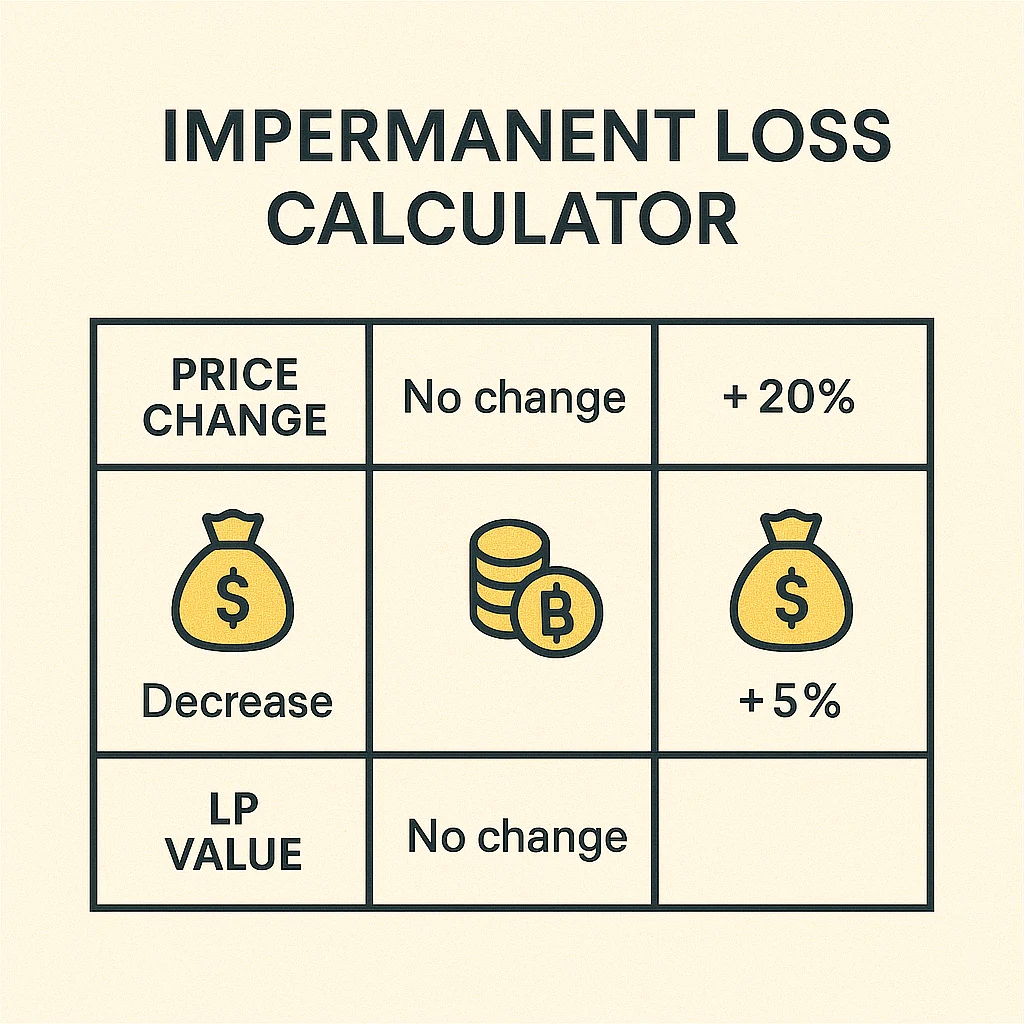
Infographic showing impermanent loss scenarios based on token price changes and their impact on LP value

Real-World Examples

  • ETH/USDC pool during ETH bull run – you miss some ETH gains but earn trading fees
  • Stablecoin pools have minimal impermanent loss but lower fee returns
  • Volatile pairs can create severe impermanent loss that exceeds fee earnings

Why Beginners Should Care

Many new DeFi users discover impermanent loss after the fact, wondering why their “profitable” liquidity position lost money compared to holding tokens.

Calculate the trade-off before providing liquidity. High-fee pools might compensate for impermanent loss, while low-fee pools might not justify the risk.

Stablecoin pairs minimize impermanent loss risk while still earning yield from trading fees and liquidity mining rewards.

Related Terms: Liquidity Pool, Yield Farming, AMM, DEX

Back to Crypto Glossary

Similar Posts

  • Recursive Proofs

    Recursive Proofs: Self-Verifying Cryptographic SystemsRecursive proofs are cryptographic proofs that can verify other proofs of the same type, enabling compression and scalability. They're like mathematical matryoshka dolls where each proof contains and verifies other proofs.Recursive proofs are cryptographic systems where proofs can verify other instances of the same proof system, enabling compression of multiple proofs…

  • Order Flow

    Order Flow: Transaction Request RoutingOrder flow refers to the stream of buy and sell orders flowing through trading systems and how they're routed to different execution venues. It's like watching the flow of cars through different highway lanes to see which routes get the best traffic conditions.Order flow encompasses the path that trading orders take…

  • Data Marketplace

    Data Marketplace: Trading Information AssetsA data marketplace enables buying and selling of data assets using cryptocurrency payments and blockchain verification. It's like eBay for information where data providers monetize their datasets.A data marketplace is a platform where data providers can sell access to information assets while buyers purchase data using cryptocurrency or token payments. Blockchain technology…

  • AML (Anti-Money Laundering)

    AML (Anti-Money Laundering): Fighting Financial Crime AML regulations force crypto businesses to monitor and report suspicious activities. It’s the government’s attempt to prevent crypto from becoming a money laundering paradise. Anti-Money Laundering (AML) refers to laws, regulations, and procedures designed to prevent criminals from disguising illegally obtained funds as legitimate income. Crypto exchanges and businesses…

  • Sandwich Attack

    Sandwich Attack: Extracting Value from Your Trades Sandwich attacks place trades before and after your transaction to manipulate prices and extract profit from your slippage. It’s like cutting in line twice – once in front of you and once behind you. A sandwich attack involves placing a buy order immediately before a victim’s trade and…

  • Gas Fees

    Gas Fees: The Cost of Using Ethereum Gas fees are the tolls you pay to use Ethereum. Sometimes they’re pennies, sometimes they’re hundreds of dollars. Welcome to decentralized computing. Gas fees are transaction costs paid to miners or validators for processing transactions on blockchain networks. Think of gas as the fuel needed to power your…